
Virtual Reality for Industrial Safety: Which Procedures to Simulate First
 By Carlos Franco, Co-Founder & CEO at Fyware · LinkedIn
The short answer: VR for industrial safety is simulator training for the dangerous procedures that cannot be practiced without exposing someone or stopping the line, such as lockout/tagout, crane operation, forklifts, confined spaces and fire extinguisher use. Start with the procedure whose error costs the most, that today is only explained and that the most people go through, and the simulator records how each person performed it.
The conversation about safety and virtual reality almost always starts backwards. Someone saw an impressive demo, asks what it would cost to build "something like that" for their plant, and the discussion moves to technology before deciding which problem it solves.
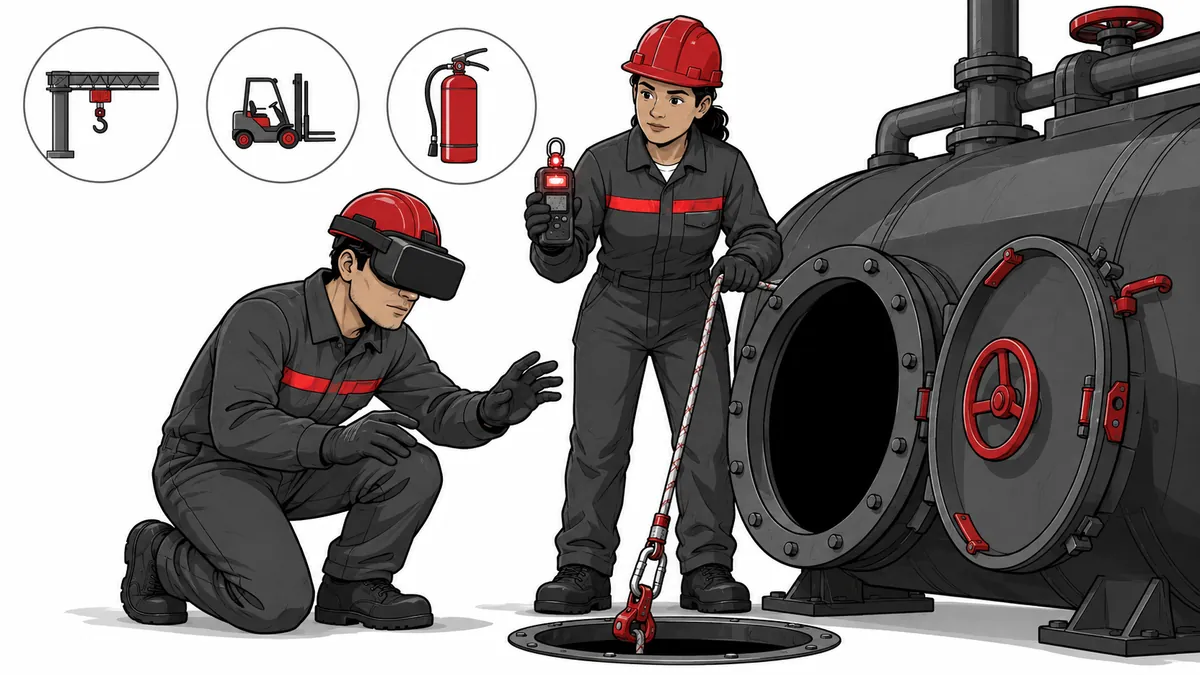
The right question is duller and far more useful: of all the hazardous procedures in your operation, which one can you not actually practice without exposing someone or stopping the line?
That is where a simulator pays for itself. Everywhere else, probably not.
The regulation is already asking for practice
Before talking technology, it is worth noticing how the standards are written.
OSHA's powered industrial truck standard, 29 CFR 1910.178(l), does not ask for a course. It requires that training combine formal instruction, practical training, and evaluation of the operator's performance in the workplace. It then adds a requirement most programs treat as an afterthought: "An evaluation of each powered industrial truck operator's performance shall be conducted at least once every three years."
The lockout/tagout standard, 29 CFR 1910.147(c)(7), takes the same shape. Besides the training itself, the employer must "certify that employee training has been accomplished and is being kept up to date," with each employee's name and the dates.
Read together, the regulator is asking for three things: teach it, have them do it, and prove you evaluated them. Most programs are strong on the first and thin on the other two.
And there is the operational trap. In a confined space, in a crane lift, or during a start-up with hazardous energy, the real "practical training" is precisely what you do not want to run with inexperienced people. Practicing risk by being exposed to risk is a contradiction every plant resolves halfway, usually with a demonstration the operator watches instead of performs.
Simulation is the only way to run the practical part many times, failures included, without anyone entering the tank.
The five procedures where it pays most, and why
Lockout/tagout. The classic failure is skipping a step under time pressure, even when the procedure is known. A simulator can reproduce exactly that pressure: the line down, the supervisor asking for restart, the secondary energy source nobody remembers. That does not get taught in a slide deck. The six steps of 1910.147 and how to drill them without stopping the line are in lockout tagout training at three in the morning.
Crane operation and load handling. This is the most expensive thing to train for real, because it ties up the equipment, ties up the bay and stops production. It is also where errors are irreversible. A simulator lets you repeat the critical lift a hundred times, with wind, with an off-center load and with reduced visibility.
Forklifts. The problem is equipment behavior in conditions rarely practiced: high loads, poor floor surfaces, pedestrians appearing in the aisle. Practicing that for real means creating the dangerous scenario on purpose. And since OSHA already requires a documented performance evaluation every three years, you need a repeatable way to run one. How to drill it without taking a truck out of service is in forklift training with a pedestrian in the aisle.
Confined spaces. The full procedure, with atmospheric testing, an attendant and an emergency plan, is almost never rehearsed end to end. In simulation it can be, and each role can be evaluated separately. The permit criteria and ten examples are in confined spaces and OSHA 1910.146.
Fire extinguisher use and incipient fire response. Traditional training burns fuel in a yard, happens once a year, and gives each participant one attempt. In simulation everyone gets ten, across different fire classes, and it records who reached for the wrong agent.
Which agent works on each class of fire, and what OSHA 1910.157 asks of a plant, is in our guide to the types of fire extinguishers.
There is an obvious sixth candidate, work at height, and I would rather be direct: it is a risk category where simulation makes complete sense, but it is not a module we offer today as standard-compliant. When we do, we will say so with the same specificity as the rest.
How to choose the first one
After a fair number of projects, I use three filters, in this order:
- Cost of the error. A procedure that rarely fails but costs a life or three days of downtime when it does beats one that fails often with minor consequences.
- Impossibility of practicing. If your people can already repeat the procedure without exposure and without stopping production, a simulator adds less. Prioritize what today only gets explained.
- Volume of people passing through. High turnover, contractors, seasonal staff. The cost of the simulator spreads across everyone who uses it, and we do not charge per headset or per user, so that spread is real.
That third filter is the one most often ignored and the one that most changes the return.
The uncomfortable question
Your safety program probably reports coverage: what percentage of staff is trained on each topic. That is the number presented to the committee.
Now answer a different one: of the people listed as trained on your most hazardous procedure, how many would execute it completely, today, unassisted and without looking anything up?
If you do not have that number, the reason is structural. The system measures attendance and you need to measure competence. They are different indicators and only one predicts incidents.
The lagging indicator is still worth knowing: the TRIR calculator compares your recordable rate with the BLS average for your industry.
What a simulator measures that a written test cannot
A written test measures recall, and that has value. On the floor, the failure comes in execution under real conditions, and there are four things you only see when the person performs:
Sequence. Almost every operator knows the steps. Far fewer perform them in the right order when they are rushed. A multiple choice test cannot tell knowing the steps from knowing the order.
Time under pressure. How long someone takes to identify the secondary energy source, or to decide the atmosphere is not safe to enter. In a classroom everyone gets it right. With a clock running, they do not.
The decision to stop. It is the hardest competence to teach and the one that saves the most lives: recognizing that conditions changed and suspending the activity. You can only assess it by putting the person in the situation.
The error nobody reports. In a simulator the mistake is recorded without consequence or blame, so people actually make it instead of hiding it. That record is information your safety program does not have today, because nobody files a report on something that almost went wrong.
That fourth point is the one that surprises me most when we review results with a client. The failure pattern is almost never the one management expected.
What changes on the plant floor
What the GIRI platform reports with digital work instructions is 62.3% fewer errors and US$1.5 million recovered per year in a 250-employee plant. That is the manufacturer's figure, not one of our clients': its original source is ar-giri.com, which publishes it as €1.4 million out of €3.8 million in annual inefficiencies.
I bring it with its origin attached because safety runs on too many ownerless statistics, and a number you cannot trace is useless when you defend a budget.
On the training side, the saving we measure reaches 60% versus traditional methods, and it comes from three unglamorous places: fewer instructor hours, fewer line stoppages to train, and less travel.
How it connects to what you already have
Your safety program stays as it is, because a simulator does not replace it: it produces the per-person performance record that supports it, which is exactly the evidence OSHA asks you to certify.
If you operate plants in Mexico, the documentation requirements are different and worth knowing: we cover them in the DC-3 certificate and what it actually proves and in the guide to Mexico's STPS safety standards.
Training is only the start. Six months later, correct execution is sustained by having the procedure available at the machine, which is the job of digital work instructions.
If you are budgeting, here are the real investment ranges.
Where to start
Pick one procedure. The most expensive one when it fails. Measure how ten already-certified people execute it today, with a stopwatch and a list of critical steps. That number, uncomfortable as it usually is, is your baseline and your business case.
In industrial safety almost everyone has a practice problem, and they treat it with training.
And the practice you cannot run in reality is exactly the practice you need most.
Is fire risk your immediate priority? Meet Fyware Safe, our line of VR safety simulators: its fire module trains fire extinguisher use with five classes of fire, a reaction timer and an evacuation protocol, built to complement your site's fire drills. The same line includes PPE, forklift and pedestrian crossing simulators.
Frequently asked questions
Which safety procedures should you simulate first?
The ones that pass three filters, in this order: the error costs the most (a life, or a line down for days), they cannot be practiced today without exposure or stopping production, and many people go through them, such as new hires, contractors or seasonal staff. In most plants that points to lockout/tagout, crane operation, forklifts, confined spaces and fire extinguisher use.
Does a VR simulator replace my safety training program?
No. Your safety program stays as it is: the simulator follows the content you already teach, adds the hands-on practice that rarely happens today, repeated as often as needed, and produces a per-person performance record that supports the evidence you already keep.
What does a safety simulator measure that a written test cannot?
Four things that only show up when the person performs the task: the order of the steps under time pressure, how long it takes to recognize a hazard, the decision to stop when conditions change and the mistakes nobody reports on the floor. The simulator records them with no consequences for whoever gets it wrong, and that record shows which step your people miss.
To put a number on what an avoidable incident costs you today: safety and training ROI calculator.
See also: contractor safety orientation and the evidence that is missing, on the outside workforce that enters your site. And hands-on PPE training, on 1910.132 and why a signed roster is not proof of competence.
 Tom Klukowski
Fyware Partner · Valcre Marketing
Before we quote, we check whether virtual reality fits your operation
Fyware has delivered 750+ XR projects for clients like Gerdau Corsa, Cummins and Medverse, from Mexico in US Central Time. Tell us your case and we will tell you what is feasible, how long it takes, and on what budget.
Get the next articles
Practical guides on VR, AR and industrial training. No spam: we only write when we publish.