
Mexico's STPS Safety Training Standards (NOMs): A Guide for Plant Managers
 By Carlos Franco, Co-Founder & CEO at Fyware · LinkedIn
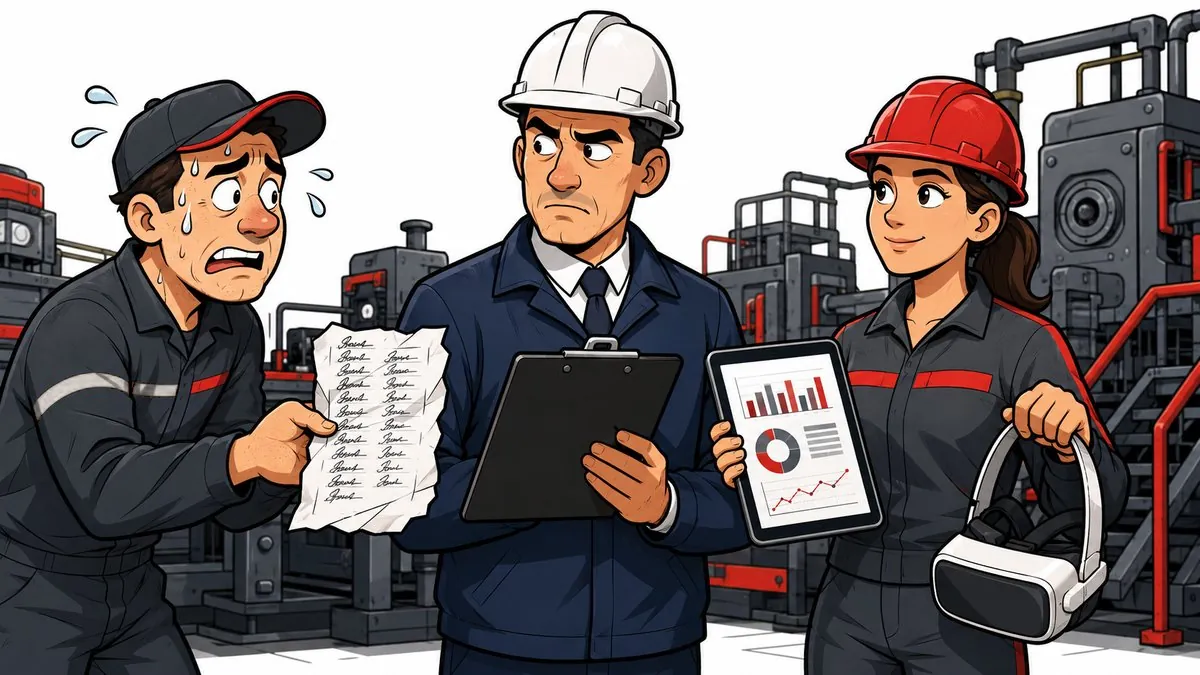
The short answer: Mexico's STPS safety training standards that inspectors check most are NOM-009 (work at heights), NOM-033 (confined spaces), NOM-006 (forklifts, cranes, and hoists), NOM-002 (fire prevention and response), NOM-004 (machinery and equipment), and NOM-029 (electrical maintenance).
When Mexico's labor authority (STPS) inspects a plant, it asks for two things: each exposed worker's DC-3 training certificate and evidence that the training actually happened. Missing them costs 250 to 5,000 UMAs per violation under Article 994 of the Federal Labor Law: with the 2026 UMA at $117.31 MXN, that is roughly $29,000 to $586,000 pesos each time. If you manage Mexican plants from Texas or anywhere in the US, these are the rules your EHS team lives under. This guide summarizes the STPS safety training standards (NOMs) and, more importantly, how to prove you comply.
The NOMs inspectors check most
- NOM-009-STPS-2011 (work at heights): for work above 1.80 m, theory and practice training matched to the equipment in use, and an emergency plan that covers rescue.
- NOM-033-STPS-2015 (confined spaces): classify the space, analyze the risks of each job, issue permits, monitor the atmosphere, assign an attendant and train every role.
- NOM-006-STPS-2023 (forklifts, cranes and hoists): operator training and safety procedures; in force since September 2024, replacing the 2014 version. What that looks like in practice: a crane operator training simulator in a steel mill.
- NOM-002-STPS-2010 (fire prevention and protection): drills, theory and practice training on fire extinguishers and, in high fire risk workplaces, brigades.
- NOM-004-STPS-1999 (machinery): the basis of lockout-tagout (LOTO) procedures.
- NOM-029-STPS-2011 (electrical maintenance): specific training for electrical work.
- NOM-017-STPS-2024 (personal protective equipment): theoretical instruction and hands-on training before the employee starts, a refresher at least every two years, and a record with name, position, date and topics; in force since September 2025. How that trains in practice: hands-on PPE training.
The pattern repeats across all of them: teaching a course is not enough, you must be able to demonstrate competence. And that is where the traditional file falls short.
How to prove the training to an STPS inspector
A signed attendance list proves the worker sat in a classroom. It does not prove they can rescue a colleague hanging in a harness, or execute lockout-tagout in the right order. Inspectors know this, and so do your corporate clients' auditors.
VR training changes the nature of the evidence: every simulator session is logged with objective, individual performance data, attempt by attempt. In an A/B test at a global auto parts manufacturer, 100% of the team using our digital work instructions reported feeling capable of performing their activity, versus 11% with the traditional method. That is the difference between a signed paper and a measured competence.
How virtual reality maps to each standard
- Fire and extinguishers (NOM-002): our Fyware Safe virtual reality fire simulator trains all 5 fire classes with unlimited repetitions and a measured evacuation protocol.
- Heights, confined spaces and forklifts: we build simulators custom to your plant's real procedure, so the risk scenario is practiced without exposing anyone. For forklifts there is also a ready-made circuit, described in forklift training that includes pedestrians.
- Procedures and LOTO: digital work instructions leave the visual step-by-step on the equipment and a log of every execution.
One honest clarification we always make: Fyware is not an STPS-registered training agent and does not issue DC-3 certificates. We provide the objective performance evidence and work alongside your training agent, as we explain in detail in our guide to the DC-3 certificate and virtual reality in Mexico.
Where to start
Take the standard you get inspected on most and ask whether your current evidence would survive a demanding audit. If the answer makes you uncomfortable, start with that procedure: it is the one that justifies the investment fastest. To plan the year ahead, the Mexico safety regulations calendar for 2027 pairs each deadline with a free tool. Our industrial VR training page explains how we build it and the results our clients report.
Bring your own number before you ask for a quote. Our VR training ROI calculator estimates the return using your operation's data: headcount, hourly cost, classroom hours and turnover. If your bottleneck is the procedure on the floor, there are calculators by vertical for mining, aviation and steel.
Fines are the visible cost of non-compliance. The accident that paper training failed to prevent is the invisible one. The NOMs exist because of the second.
If the date in front of you is safety week, our VR activation for safety week brings five experiences to your plant (working at heights, fire extinguishers, forklifts, pedestrian crossing and PPE) in a four-hour session, from $3,800 USD.
Frequently asked questions
How do I comply with Mexico's STPS standards using digital training?
Digital training helps with the instruction requirement and, above all, with the evidence: each session leaves individual performance data, attempt by attempt, instead of an attendance sheet. What it does not do is replace whoever certifies the course, your in-house instructor or a registered training agent. Fyware is not registered with STPS and does not issue DC-3 certificates: we provide the objective evidence and work alongside whoever can certify.
Which STPS standards require training with evidence?
The ones covering high-risk activities get inspected most: NOM-009 for work at heights, NOM-004 and NOM-018 for machinery and substances, NOM-002 for fire prevention, NOM-005 for hazardous substances, and NOM-006 for materials handling, which includes forklifts. Across all of them the usual weak point is proving the person ended up competent.
How much can an STPS fine cost?
Article 994 of Mexico's Federal Labor Law sets a range of 250 to 5,000 UMAs per violation. With the 2026 UMA at MXN 117.31, that runs from roughly MXN 29,327 to MXN 586,550 per violation, and fines stack per standard and per exposed worker. The invisible cost is the accident the paper training failed to prevent.
See also: contractor safety orientation and the evidence that is missing, on the outside workforce that enters your site.
 Tom Klukowski
Fyware Partner · Valcre Marketing
Before we quote, we check whether virtual reality fits your operation
Fyware has delivered 750+ XR projects for clients like Gerdau Corsa, Cummins and Medverse, from Mexico in US Central Time. Tell us your case and we will tell you what is feasible, how long it takes, and on what budget.
Get the next articles
Practical guides on VR, AR and industrial training. No spam: we only write when we publish.