
Types of Fire Extinguishers: Which One Your Plant Needs
 By Carlos Franco, Co-Founder & CEO at Fyware · LinkedIn
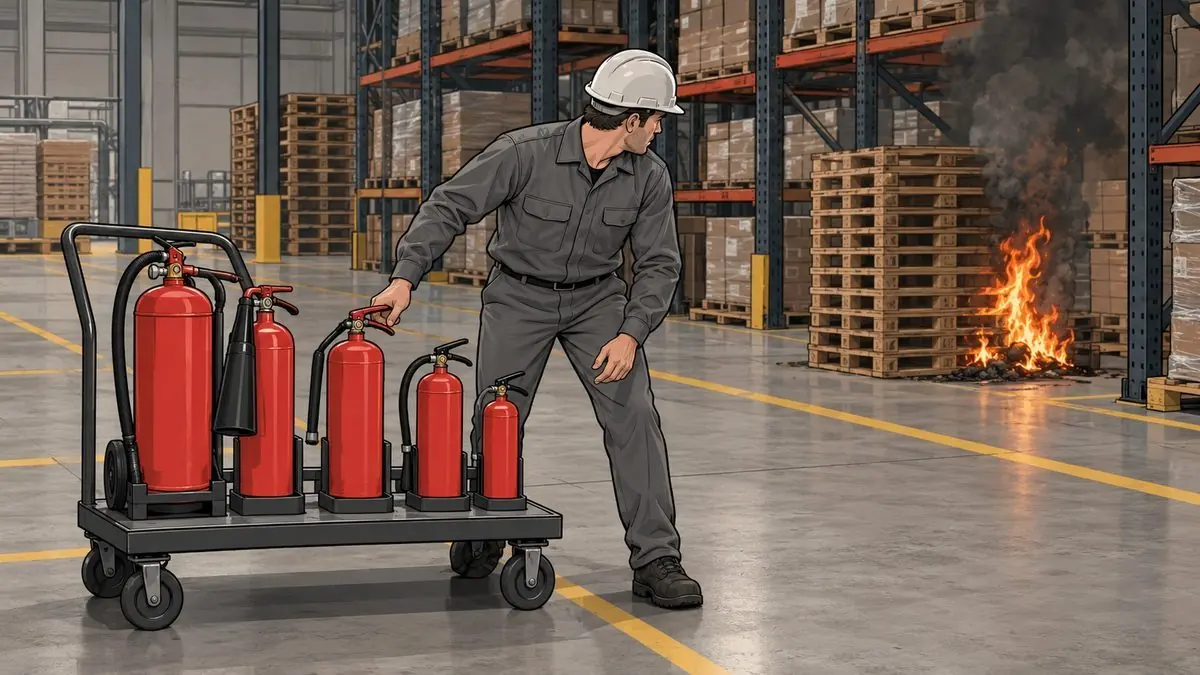
The short answer: the types of fire extinguishers are named for the agent inside (water, foam, carbon dioxide, dry chemical, clean agent, wet chemical and dry powder), and you pick them by the five classes of fire: A, B, C, D and K. In a US plant, OSHA 29 CFR 1910.157 asks for an extinguisher within 75 feet of travel for Class A hazards and 50 feet for Class B, a monthly visual check, annual maintenance and yearly training for anyone expected to use one.
"OSHA does not require that fires actually must be started and extinguished to simulate emergency fire conditions during employee training." That sentence is from a 1991 OSHA interpretation letter. The same letter says hands-on training should include "the actual discharging of fire extinguishers appropriate for the type of fires expected."
We build a VR fire extinguisher simulator, so we read those two lines together: practice the decision as many times as it takes, and still put a real extinguisher in people's hands once. Everything below is about the decision.
What are the types of fire extinguishers?
NFPA describes each type by its agent and the classes it is rated for:
- Water: primarily Class A, and useless in freezing conditions because the water inside freezes.
- Foam (AFFF or FFFP): Class A and Class B.
- Carbon dioxide (CO2): Class B and Class C, with a short range of 3 to 8 feet.
- Multipurpose dry chemical (ABC): an ammonium phosphate agent rated for Class A, B and C. Deep-seated fires may need the material broken apart.
- Ordinary dry chemical (BC): sodium or potassium bicarbonate, usually rated for B and C only.
- Clean agent: larger models are listed for A, B and C, which suits electronics. Halon production has been phased out.
- Wet chemical: the Class K extinguisher for cooking oil fires; its potassium salts conduct electricity.
- Dry powder: Class D metals only, sometimes applied with a scoop and shovel.
Five classes of fire, and only four in OSHA
OSHA defines four classes in 1910.155: Class A for "ordinary combustible materials such as paper, wood, cloth"; Class B for flammable or combustible liquids, flammable gases and greases; Class C for "energized electrical equipment"; and Class D for combustible metals such as magnesium, titanium, zirconium, sodium, lithium and potassium. Class K, for cooking oils and fats, comes from NFPA 10; the phrase "Class K" does not appear anywhere in OSHA's general industry standards.
On a plant floor that translates into pallets and cardboard (A), solvents, hydraulic oil and forklift propane (B), live panels and motors (C), magnesium or titanium fines from machining (D) and the cafeteria fryer (K).
How far can an extinguisher be under OSHA 1910.157?
OSHA writes the rule as travel distance:
- Class A: 75 feet or less from any employee to any extinguisher, 1910.157(d)(2).
- Class B: 50 feet or less, measured from the Class B hazard area, (d)(4).
- Class C: distributed on the pattern of the existing A or B hazards, (d)(5).
- Class D: 75 feet from the metal working area, required where metal powders, flakes or shavings are generated "at least once every two weeks," (d)(6).
Class K extinguishers go within 30 feet of the cooking area, and that number is NFPA 10's. So are the mounting heights: the top no higher than 5 feet for units under 40 pounds, 3.5 feet above that, and the bottom at least 4 inches off the floor. OSHA itself only asks that extinguishers be "readily accessible." Walk the distance the way a person would; NFPA's guidance says nobody is expected to walk through walls.
Some areas carry their own rule. A flammable liquid storage room needs an extinguisher of at least 12-B outside the door and within 10 feet of it, 1910.106(d)(7). Spray booths need extinguishers nearby, and a hot work fire watch keeps one at hand for at least half an hour after the welding stops, 1910.252.
Does every plant need fire extinguishers?
Not under 1910.157. A plant with a written policy of immediate total evacuation, an emergency action plan and a fire prevention plan, and no extinguishers, is exempt from the section, (b)(1), unless another standard requires them, like the flammable liquids rule above. If only designated employees use them and everyone else evacuates, the distribution rules in (d) don't apply, (b)(2). In a 1986 letter OSHA wrote that "the decision to use fire extinguishers may not be left up to the employees but must be spelled out in an emergency action plan."
Inspection, maintenance and hydrostatic tests
A visual inspection every month, (e)(2), and a maintenance check every year with its date on record, kept "one year after the last entry or the life of the shell, whichever is less," (e)(3). Stored pressure dry chemical units on a 12-year hydrostatic test are emptied and serviced every 6 years, (e)(4). Table L-1 sets the hydrostatic test at 5 years for carbon dioxide, water and AFFF, and 12 for dry chemical in mild steel shells. In a 2006 letter OSHA called the monthly frequency "not only explicit, but reasonable," so an insurer's quarterly schedule doesn't replace it.
How do you train people to pick the right extinguisher?
Every employee who may use one gets education at hire and at least annually, (g)(1) and (g)(2). Designated employees get hands-on training on assignment and every year, (g)(3) and (g)(4). OSHA's non-mandatory Appendix A says simulated fires are "an acceptable part of a training program."
In our VR fire extinguisher training simulator, the fire team faces two to five fires placed on its own floor, with a cart holding A, B, C, D and K extinguishers and 70 seconds to control each fire; a repeat recharges nothing. It runs on a Meta Quest 3 with no PC or internet and is one of four modules of Fyware Safe, adapted to your brand in one or two weeks. For the shift huddle there is a free fire extinguisher toolbox talk. Where VR fits the rest of a safety program is in our guide to virtual reality for industrial safety, and the budget side in what VR training costs.
Frequently asked questions
What are the 5 types of fire extinguishers?
Most lists mean water, foam, carbon dioxide, dry chemical and wet chemical. NFPA's own list adds clean agent and dry powder for metals. The number five belongs to the classes of fire: A, B, C, D and K.
Which fire extinguisher is used on electrical fires?
One rated for Class C: carbon dioxide, ABC or BC dry chemical, or a clean agent. Not water, and not wet chemical, whose potassium salts conduct electricity.
Does OSHA require Class K fire extinguishers?
OSHA's general industry standards never mention Class K. The requirement to place one within 30 feet of cooking areas comes from NFPA 10, so check which edition your local fire code adopts.
How often do fire extinguishers need to be inspected?
Visually every month and a maintenance check every year, both under 1910.157(e). The hydrostatic test comes every 5 or 12 years depending on the type, under Table L-1.
Does OSHA require live fire training?
No. A 1991 interpretation letter says fires do not have to be started for training, though hands-on practice should include actually discharging an extinguisher. Appendix A accepts simulated fires as part of the program.
If you are going to propose simulator practice for your fire team, bring the number to the meeting: industrial training ROI calculator.
 Tom Klukowski
Fyware Partner · Valcre Marketing
Before we quote, we check whether virtual reality fits your operation
Fyware has delivered 750+ XR projects for clients like Gerdau Corsa, Cummins and Medverse, from Mexico in US Central Time. Tell us your case and we will tell you what is feasible, how long it takes, and on what budget.
Get the next articles
Practical guides on VR, AR and industrial training. No spam: we only write when we publish.