
Contractor safety orientation: the evidence that is missing
 By Oscar Tobias, Marketing Manager at Fyware · LinkedIn
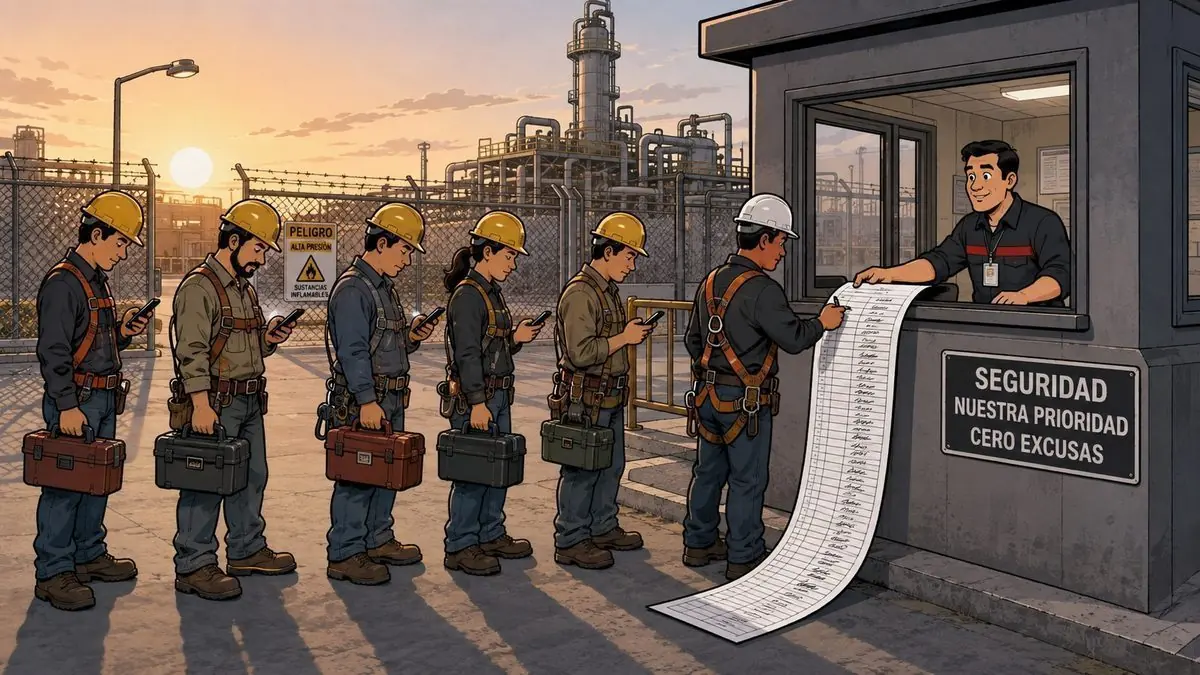
The short answer: contractor safety orientation is the host plant's exposure as well as the contractor's, and what OSHA weighs is the care you can document. A sign-in sheet does not document it.
At seven thirty, outside the guard shack, eight people are waiting. They came to weld for three days during a scheduled turnaround. At eight they watch forty slides someone built four years ago, sign a sheet and collect a badge. By ten they are in the area with the most stored energy in the plant. Nobody knows what they understood.
Who gets cited when the injured worker is not yours
The quick answer is that the contractor's employer answers for its own people. It is half true, and the missing half is the expensive one.
OSHA's Multi-Employer Citation Policy (CPL 02-00-124), in force since December 10, 1999, holds that on a multi-employer worksite more than one employer can be cited for the same hazardous condition. The host plant is usually the controlling employer, citable for a hazard that exposed somebody else's employees.
The test applied to a controlling employer is reasonable care: periodic and risk-based inspections, timely correction, consistent enforcement of the rules it set. Reasonable care is not a feeling. It is a file, and it either exists or it does not.
Contractor safety orientation is not a course
Trade training, with its own certificate, belongs to the contractor's employer and not to you. That boundary is covered in the guide to training certificates and virtual reality.
Yours is the map of your hazards: your energy sources, your evacuation routes, your permit to work system, your muster point and who is allowed to stop a job. The best certified contractor in the country can arrive with every document in order and still not know that line four stays pressurized on Mondays. And if you run a process covered by 29 CFR 1910.119, paragraph (h)(2) already names the duty: inform contract employers of the known potential fire, explosion or toxic release hazards of your process, explain your emergency action plan, and periodically evaluate how the contract employer performs.
So it works as access control: the only training you deliver to people you did not hire, about hazards that are yours.
What does your sign-in sheet prove in an inspection?
It proves eight people were in a room. Nothing more.
The standard already tells you what better evidence looks like, and it is not a signature. For contract employees, 1910.119(h)(3)(iv) requires a record containing the identity of the employee, the date of training, and the means used to verify that the employee understood the training. That last clause is the whole problem. A sheet records attendance. It records no verification of anything.
Freeman and colleagues (PNAS, 2014, 225 studies) found that students in purely lecture-based classes fail 1.5 times more often than those taught with active methods. Forty slides with no practice and no assessment is the extreme case. And there is an aggravating factor nobody measures: it is delivered by whoever is free that day. Tuesday's version is not Thursday's, and neither is recorded.
What should actually be on record for each person
Six fields, none of them exotic:
- Who they are and which contractor they work for
- Which areas and which specific hazards were presented to them
- What decisions they made in a scenario
- Where they got it wrong and whether they repeated it until right
- The date of the orientation and the expiry of their access
- The revision of the procedure they were taught, because procedures change
None of them fits on a signature line, and the last one is the most expensive: when you change a permit to work in March, you have no way to know which of the people inside today learned the previous revision.
Why is orientation the first candidate?
Frequency. A plant with contracted maintenance and an annual turnaround delivers it hundreds of times a year, same content, same hurry: it is the most repeated procedure on site and the worst documented. The argument for it is that the evidence produces itself, per person and with a date. When we at Fyware decide where to start a virtual and augmented reality project for industrial operations, the criterion is which procedure repeats most and leaves the worst trail. Applied to other procedures, that criterion is in the guide to virtual reality for industrial safety.
Kiosk, touchscreen or simulator: how to choose
Not everything has to be a simulator, and treating it that way is why many plants never start. Four boxes, and you pick by type of hazard.
The simulator is for what the body executes and gets wrong only once: energy isolation, working at height, confined space. Its value is rehearsing the mistake without the consequence.
The interactive verification experience covers the rest of the orientation. It is a touchscreen station at the gate where the person applies the rules: three or four scenarios from your plant, they decide, and the badge prints when they solve it. This category is mature already: vendors in the United Kingdom, Australia, India and the United States sell induction kiosks that gate site access on answering correctly.
The screen asking instead of telling is the mechanism: Roediger and Karpicke (Psychological Science, 2006) showed that on delayed tests, people who had been tested retained substantially more than people who had restudied the same material. Asking also produces learning.
Reinforcement touchscreens are the third box: at the entrance to the area, on the day a permit changes, thirty seconds that reopen what was already covered. Forgetting is fought on day twenty.
The fourth is the map itself, which lives better in digital work instructions, where one GIRI client measured 62.3% fewer errors and US$1.5M recovered per year in a 250-person plant. That interactive content works without a simulator is already shown in the comparison of immersive training against onboarding video.
Of the contractors inside your plant right now, how many could tell you where their muster point is without looking at their badge? If you have to estimate the number, you already have the diagnosis.
That orientation is the last thing you control before somebody else's employee touches your energy. Treating it as gate paperwork is deciding that the gate manages that risk.
Frequently asked questions
Who is responsible for a contractor's safety orientation?
Both parties, for different things. The contractor's employer owns trade training. The host plant owns the hazards of its own site, and under OSHA's multi-employer policy it is usually the controlling employer.
Is contractor safety orientation required by OSHA?
There is no single standard that names it. What exists is exposure: a controlling employer must exercise reasonable care over hazards on its site, and PSM-covered plants must inform contract employers of process hazards under 1910.119(h)(2).
Does a sign-in sheet count as training evidence?
It records attendance and says nothing about understanding. For contract employees, 1910.119(h)(3)(iv) asks for the identity of the worker, the date, and the means used to verify the worker understood the training.
Can contractor orientation be done with VR or touchscreens?
Yes, and it does not have to be a simulator. Simulators fit maneuvers the body executes; a touchscreen verification station covers the rest of the orientation, and digital work instructions carry the site map.
 Tom Klukowski
Fyware Partner · Valcre Marketing
Before we quote, we check whether virtual reality fits your operation
Fyware has delivered 750+ XR projects for clients like Gerdau Corsa, Cummins and Medverse, from Mexico in US Central Time. Tell us your case and we will tell you what is feasible, how long it takes, and on what budget.
Get the next articles
Practical guides on VR, AR and industrial training. No spam: we only write when we publish.