
In here you can get it wrong: hands-on PPE training
 By Amparo Romo, Project Coordinator at Fyware · LinkedIn
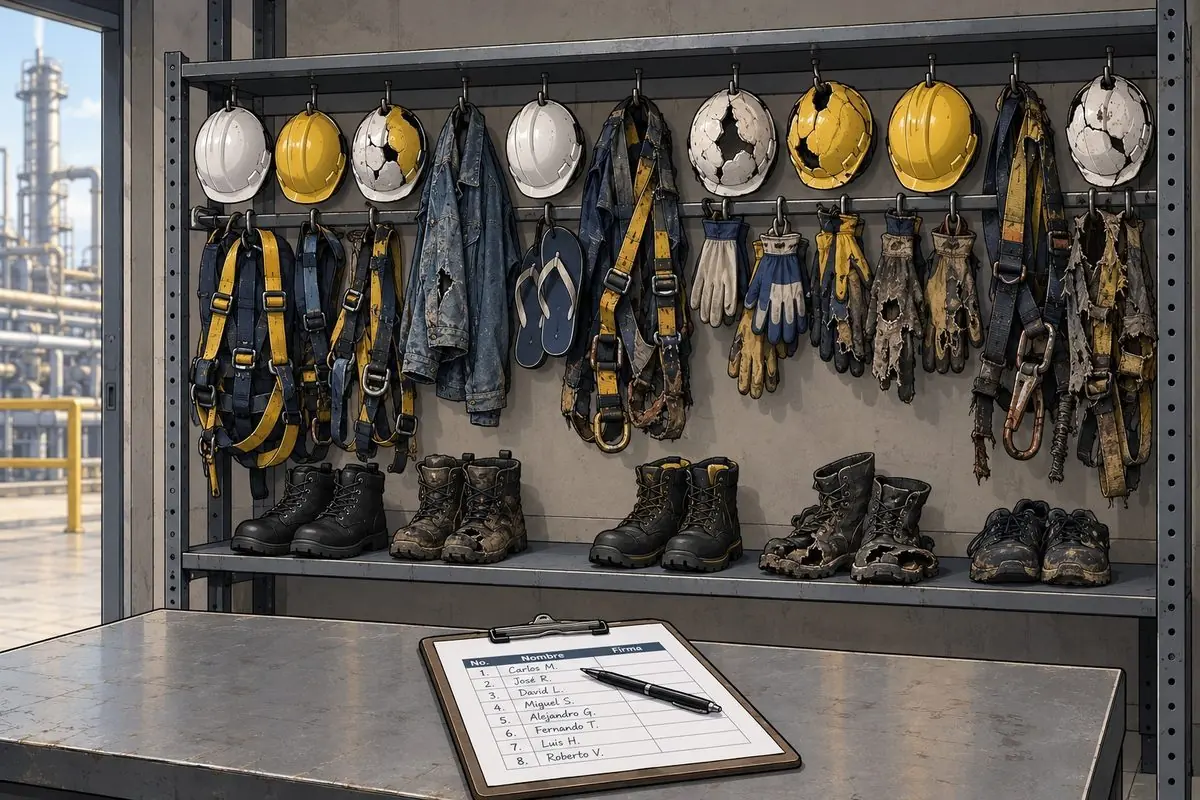
The short answer: OSHA 1910.132(f)(2) requires every affected employee to demonstrate an understanding of hands-on PPE training and the ability to use the equipment properly before being allowed to do the work. A signed roster proves people sat in a room, not that anyone can use a harness.
A sign-in sheet with eight names.
That is what most plants can produce when an inspector asks how their people were trained on personal protective equipment. It proves eight people were in a room. It does not prove that any of them can tell a cracked hard hat from a good one, or knows which piece goes on first.
I work at Fyware, where we build virtual and augmented reality projects, mostly for industrial training. And the standard has been explicit about this for a long time. Most plants just have not read past the first paragraph.
What OSHA asks for: hands-on PPE training
The rule has five teaching points and one hard gate. Under 1910.132(f)(1) the employee has to be taught when PPE is necessary, what PPE is necessary, how to put it on and take it off and adjust it, the limitations of the equipment, and its proper care, maintenance, useful life and disposal.
Then comes the part that a roster cannot satisfy. Paragraph (f)(2) says each affected employee shall demonstrate an understanding of that training and the ability to use PPE properly, before being allowed to perform work requiring it. Not afterwards. Not during the first week.
The only written certification in the rule is the one for the hazard assessment, under (d)(2); for training, the rule asks for that demonstration and does not prescribe a form. It is the same pattern you find in the other safety training standards that name a specific procedure: giving the class is not the obligation, being able to prove competence is.
Two minutes per person, and space is no excuse
Here is the real question: how do you run training that actually lands? With virtual reality.
It is fast. You decide. You pick it up. You put it on. You practice. It grades you. You notice things.
All inside one simulator.
Two minutes per person. With a single headset, that is roughly 15 to 20 people an hour. Short on floor space? No excuse there either. It fits in two by two meters, which is why it works inside a safety week, where the whole plant rotates through in two days.
I take you and your crew into a virtual PPE room: everything your activity calls for, and everything you should not be wearing.
There is good equipment.
There is damaged equipment.
There are things that look useful and are not.
There are even distractions: flip flops, a denim jacket, hard hats that belong in the trash.
Because here the decision is yours.
Get it wrong? You cannot keep getting dressed until you fix it.
Get it right? You move on and get ready to start work.
That is how the PPE module in Fyware Safe is built, and it is the simulator I work with.
A harness is the extreme case of PPE. When OSHA requires one and how often to retrain is in our guide to fall protection training under 1910.30.
And the paperwork? What the record has to show
The part I like most is not the equipment list. During the exercise you start to understand why the order matters, why the equipment has to match the activity, and why wearing it correctly protects the person next to you too.
That is what we are after.
Not that someone hears they have to wear PPE.
That they practice it.
That they make the call.
That they get it wrong.
That they fix it.
And that when they reach the floor, they have already lived that moment.
Retraining is not a calendar item either. Paragraph (f)(3) triggers it when the workplace changes, when the PPE changes, or when what an employee does with the equipment shows the skill is gone. A simulator produces that evidence on its own, per person, with a date, which is the argument we make in our guide to virtual reality for industrial safety.
In here you can get it wrong. On the floor, you cannot. If the retraining you owe still has no money behind it, my colleague Olga explains where the training budget you did not spend ends up in January.
For the reminder each morning, the PPE toolbox talk is ready to read at the start of the shift, with three questions for the crew and a PDF sign-in sheet.
Frequently asked questions
Does a signed PPE roster count as training evidence?
No. It proves attendance. OSHA 1910.132(f)(2) asks the employee to demonstrate understanding and the ability to use the equipment before doing the work.
When does hands-on PPE training have to happen for a new hire?
Before the employee is allowed to perform work requiring that PPE, from day one. The wording in (f)(2) is "before being allowed to perform work".
How often does PPE training have to be repeated?
OSHA retrains by trigger, with no fixed interval: the workplace changes, the PPE changes, or the employee's use of the equipment shows the understanding is gone.
Does a simulator replace the employer's training record?
No. It adds hands-on practice before the employee uses their own gear. The training record is still the employer's document, and Fyware does not issue training certificates.
 Tom Klukowski
Fyware Partner · Valcre Marketing
Before we quote, we check whether virtual reality fits your operation
Fyware has delivered 750+ XR projects for clients like Gerdau Corsa, Cummins and Medverse, from Mexico in US Central Time. Tell us your case and we will tell you what is feasible, how long it takes, and on what budget.
Get the next articles
Practical guides on VR, AR and industrial training. No spam: we only write when we publish.