
Lockout tagout training is won at three in the morning
 By Oscar Tobias, Marketing Manager at Fyware · LinkedIn
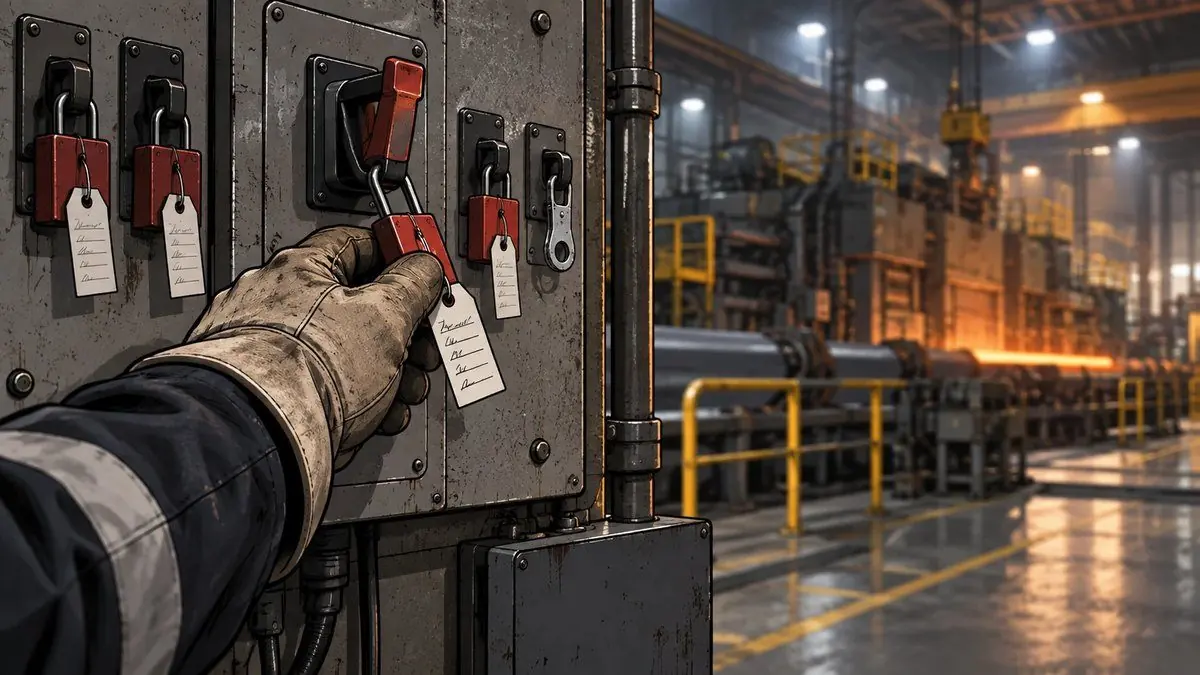
The short answer: lockout tagout training almost never fails because people do not know the procedure. It fails when the line is waiting and the technician skips a step he has skipped before with no consequences. OSHA wrote the sequence into 29 CFR 1910.147 and asks for documented procedures; what decides whether they get followed is how many times they were practiced without a real machine in the way.
A breakdown in the middle of the shift concentrates everything that makes lockout dangerous. The line is down, the supervisor asks every five minutes how much longer, and the technician knows what to do: shut down, isolate, lock, release stored energy, verify. Doing it in full takes minutes that feel endless with everyone waiting. That is where the procedure is won or lost.
It is signed, it is in the binder, and it gets forgotten in a hurry
In almost every plant I visit the energy control procedure exists, signed, in a binder the inspector can open. The binder does not show the execution at three in the morning: the shortcut is usually taken by the person in a hurry who got away with it before. The same happens with the job safety analysis for each task. And it is never a single energy: electrical, mechanical, hydraulic, pneumatic, thermal and chemical. Each one is a lock that can be forgotten, and the one that gets forgotten is the one that hurts.
Six steps OSHA wrote down, and the one nobody quotes
29 CFR 1910.147 does not leave lockout to each plant's judgment. Paragraph (c)(4) requires procedures to be developed, documented and used, and paragraph (d) puts the application of control in six steps: preparation for shutdown, machine shutdown, isolation, application of lockout devices, release of stored energy, and verification of isolation. Then the line almost nobody quotes, (e)(3): each device shall be removed by the employee who applied it. Paragraph (c)(6) asks for a periodic inspection of the procedure at least annually, and (c)(7) for training on the energy sources, their magnitude and the means to isolate them.
OSHA's own numbers show how the paper does not hold: in fiscal year 2025 the standard was the fourth most cited in the country, with 2,562 violations. The rest of the standards are in our guide to virtual reality for industrial safety.
No standard can require the body to remember the sequence under pressure. Repetition does that: Freeman's meta-analysis in PNAS, 2014, across 225 studies, found that people who learn through passive methods fail 1.5 times more often than those who learn by doing. With a mistake that costs a finger, that difference is not academic.
The lockout tagout training board nobody looked at
A safety manager at an engine and foundry plant told us that energy control is the most latent hazard across every site in his corporation. They had a physical practice board, a cell with a machining center, the only one in the plant. In his words: most of the time, nobody looked at it.
A board gets practiced once, with the instructor beside you, and leaves no record of who failed at which step. A simulator reproduces the real machine, forces you to isolate each energy in order, apply the lock and verify zero energy, and lets a person make the mistake dozens of times without hurting anyone or stopping production. That is where the correct sequence becomes the only one the body remembers.
The three tools plants use to train lockout cover different parts of the job:
| Lockout tagout training board | VR simulator | Digital work instruction | |
|---|---|---|---|
| What it trains | Applying locks and tags on physical isolation devices | The full sequence on your own machine, energy by energy, through verification | Each machine's procedure, step by step, at the machine |
| What record it leaves | The sign-in sheet | Each person's performance on every attempt, if the simulator keeps a record | Who executed which step |
| People per session | One or two, with the instructor beside them | One per headset and several at once, with the instructor watching every headset | Every technician on their phone or tablet, on their shift |
| For another plant | You build another board | The same app goes on more headsets | The same procedure opens from a QR code, translated into that plant's language |
| When it fits | First contact with locks and tags | Repeating the sequence until it comes out in order, without stopping the line | Having the procedure at hand every time the equipment is serviced |
Lockout tagout training in a steel mill: once, and right
At Gerdau Corsa, the program that started with crane simulators grew over seven years to eleven modules, and one of them is lockout tagout. The reason came from the plant itself: a steel mill has lockout procedures that are used once and have to come out right. Today they report ten hours of simulator time a month and zero production stoppages to train.
The inspector does not ask for the signature, he asks for the record
Fyware is not an OSHA outreach trainer and does not issue training cards. What the simulator adds is the evidence that (c)(7) asks the employer to certify and that a sign-in sheet cannot give: who executed the procedure, how many attempts it took and at which step it failed. That gives the signed binder something to defend in an inspection: each person showed they can isolate all six energies.
And the procedure can be sustained afterwards on the job with digital work instructions: at a global auto parts manufacturer, 100% reported feeling capable of executing the procedure alone, against 11% with the paper manual, across two plants in November 2024.
If the next breakdown happens at three in the morning, your people will execute the full lockout or the shortcut they rehearsed without meaning to every time there was a hurry. The procedure is already written. The only thing left to decide is how many times they will practice it first.
Lockout/tagout on your own equipment is best practiced on a simulator of your own procedure, which is custom VR training. And if what is in front of you is safety week, our safety week activation brings five ready-made experiences to your plant (working at heights, fire extinguishers, forklifts, pedestrian crossing and PPE) in a four-hour session.
Frequently asked questions
Which standard regulates lockout tagout in the United States?
OSHA's 29 CFR 1910.147, the control of hazardous energy, whose paragraph (d) lists the six steps of application, (e)(3) says the employee who applied the lock removes it, and (c)(6) requires a periodic inspection at least annually.
What is a lockout tagout training board?
A panel with physical switches, valves and isolation devices where people practice applying locks and tags. It teaches the hardware before anyone locks out equipment on the floor; your machine's sequence and the record of who failed at which step are trained separately.
Is a written energy control procedure enough for OSHA?
No. Paragraph (c)(7) requires training authorized employees and certifying it with each name and date. The binder proves the procedure exists. Whether each person can execute it shows in practice.
Does a lockout tagout simulator replace OSHA training?
No. Fyware is not an authorized outreach trainer and does not issue cards. The simulator provides the per-person, per-attempt performance evidence that complements the training your program already delivers.
How many energy sources have to be locked out before working on a machine?
All that are present: electrical, mechanical, hydraulic, pneumatic, thermal and chemical. The isolation step, 1910.147(d)(3), exists so that none is forgotten.
Does a simulator replace the lockout tagout training board?
They complement each other. The board gives first contact with physical locks and tags; the simulator repeats your machine's sequence as many times as needed without stopping production, and can store each attempt.
Before you decide how to train it, price every minute of stopped line and every mistake with the industrial training ROI calculator.
 Tom Klukowski
Fyware Partner · Valcre Marketing
Before we quote, we check whether virtual reality fits your operation
Fyware has delivered 750+ XR projects for clients like Gerdau Corsa, Cummins and Medverse, from Mexico in US Central Time. Tell us your case and we will tell you what is feasible, how long it takes, and on what budget.
Get the next articles
Practical guides on VR, AR and industrial training. No spam: we only write when we publish.