
How Much Does VR Training Cost? How to Read the Quote
 By Carlos Franco, Co-Founder & CEO at Fyware · LinkedIn
The short answer: a VR training project delivered outside Mexico runs from $15,000 to over $450,000 USD: $15,000 to $75,000 for one focused experience on a single procedure, $75,000 to $150,000 for a program with several scenarios and assessment, and $150,000 and up for complete systems.
It is the first question on almost every call, and it almost always arrives badly framed, through no fault of the buyer: "how much does a simulator cost" is like asking how much a factory building costs. It depends on the square footage, the process, and what goes inside.
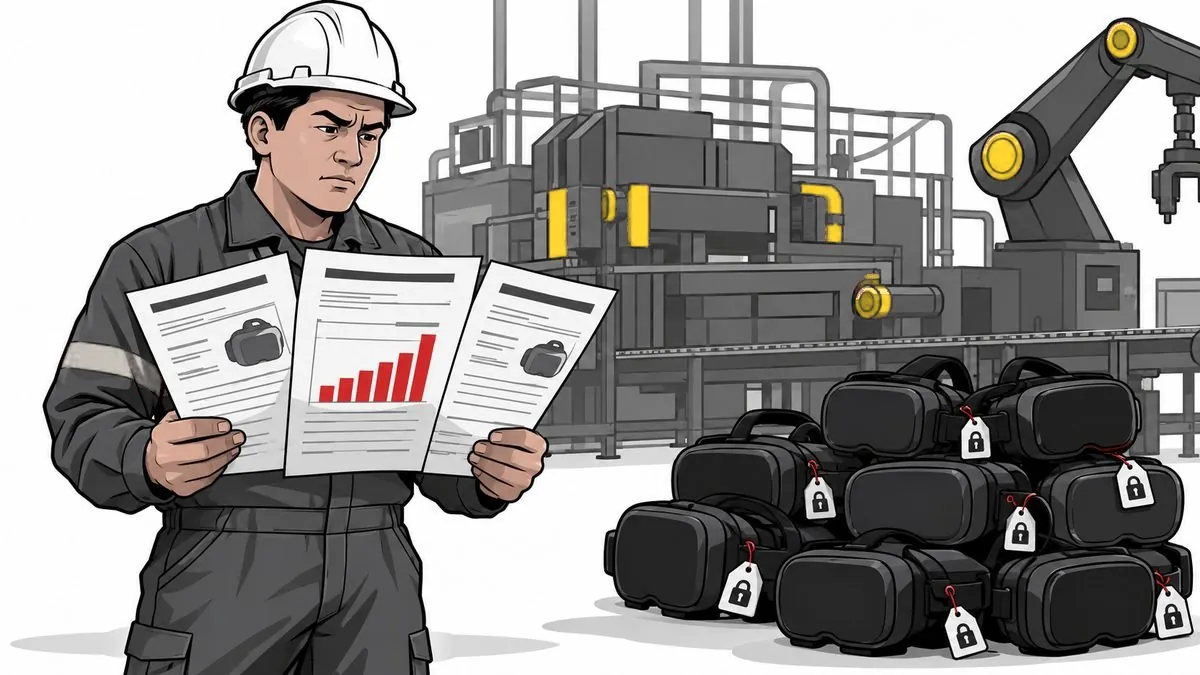
What I can do is teach you to read a quote, which is what you actually need before you request three.
How much VR training costs: the ranges, without hedging
At Fyware, projects delivered outside Mexico run in these ranges:
If you do not yet know whether your procedure calls for virtual or augmented reality, our virtual reality vs augmented reality guide settles it in four questions; the wider map of uses and prices is in virtual reality in Mexico.
| Range (USD) | What it usually includes |
|---|---|
| $15,000 – $75,000 | One focused experience: a single procedure, a single job position or a specific safety simulation. |
| $75,000 – $150,000 | Programs with several scenarios, participant assessment and deployment across multiple headsets. |
| $150,000 – $450,000 | Complete training systems per area, for example crane operation or procedure preparation, with metrics and integration into your processes. |
| $450,000+ | Multi-plant corporate platforms, continuous content and centralized real-time supervision. |
For projects delivered inside Mexico the floor is $10,000 USD. The difference is not a foreign surcharge: travel, on-site discovery and in-person deployment add to the scope, and I would rather that sit in the first conversation than in scope change number three.
The timeline depends on the type of project more than on the price range:
| Type of project | Typical timeline |
|---|---|
| Ready-made Fyware Safe safety simulator (fire, PPE, forklift or pedestrian crossing) | Deployed in days; adapted to your brand in one or two weeks |
| Diagnostic Pilot | About 3 weeks |
| Awareness experience | About a month |
| Custom training simulator | About three months |
| Complex project | Three to six months |
Publishing ranges costs us some calls. It also saves many: a buyer with a $4,000 budget does not book, and a buyer with $80,000 arrives knowing what to expect.
And if what you need is not a custom build, these are the reference prices of our other lines, the same ones each line publishes on its own page:
| Line | Reference price | What it includes |
|---|---|---|
| Diagnostic Pilot | From $5,000 USD | One of your procedures, a navigable prototype and a business case with a baseline in about 3 weeks. Credited to the project if you move forward. |
| VR headset rental (Mexico) | From $2,500 to $3,500 MXN per headset per day | Meta Quest 3 or fleet equipment, MDM setup and your content preloaded. |
| Event package with staff (Mexico) | From $15,000 to $35,000 MXN per day | Multiple stations, on-site technician, setup, attendee rotation and continuous support. |
| Safety Week activation | From $3,800 USD | Five experiences (heights, fire extinguishers, forklifts, pedestrian crossing and PPE), two stations and two technicians in a 4-hour activation. |
| Fyware Safe, GIRI and Team as a Service | By scope | Quoted to the scope of your operation; we give you the range on the first call. |
The four factors that actually move the number
Simulation fidelity. Replicating a crane cabin with its physics, response times and behavior under load does not cost what a guided plant walkthrough costs. The useful question is "which specific error do you want to stop happening." There is almost always a cheaper fidelity level that solves that error.
Number of scenarios and variants. One procedure under normal conditions is one project. The same procedure with equipment failure, reduced visibility, night shift and two load types is four. Price scales with variants; hours of content barely move it.
Assessment and metrics. Recording who passed and who did not, with what performance and on which attempt, and feeding that into your systems, is separate development. It is also what turns training into evidence, so I rarely recommend cutting it.
Hardware and operating mode. How many headsets, across how many sites, and above all whether you need 100% offline operation. Many plants have no reliable WiFi on the floor, or their IT group will not approve cloud traffic. That is an architecture decision, and it belongs before the quote. If you already run Meta Quest headsets, add one date to that decision: what changed with the end of Meta Horizon managed services.
What almost no quote tells you
This is where I have seen projects blow past budget, and it was never the development:
- Content refresh. When the procedure changes, who updates the simulation and at what cost? If the answer is "we quote each change," your real cost is not today's number.
- Ownership of the build. Is it yours, or licensed to you? That is the difference between an asset and a rental.
- Per-user or per-headset licensing. This moves the most money over three years and gets asked about the least at the start.
- Hardware replacement. Headsets get dropped, scratched and obsolete. Either the contract anticipates that or it arrives as a surprise.
- Integration. If you want results in your LMS or training system, define it at the start or pay for it at the end.
The question that changes the order of magnitude
Take the cheapest quote on your table and add three years of per-user licensing for the real number of operators who will pass through it, turnover included.
Is it still the cheapest?
In most cases I have seen, no. The per-seat subscription model looks good in year one and becomes the largest line item by year three, exactly when the program finally scaled and more people are using it. That is the moment the vendor has the most leverage and you have the fewest alternatives.
At Fyware the build is your company's property and we do not charge per-headset licenses: deploying on 1 headset or 30 costs the same. I mention it because it changes the arithmetic of the comparison entirely, and because it is exactly what you should be comparing. That comparison, model against model with the 5-year cumulative math, is published in VR training subscription vs custom development: Fyware vs Ludus.
How to compare three quotes that look nothing alike
The practical problem is that quotes arrive in different formats and comparing totals is misleading. When a client asks me to help evaluate competing proposals, I reduce everything to the same table:
| What to ask | Why it matters |
|---|---|
| Total cost over 3 years, not 1 | This is where licensing and the vendor's real business model appear |
| Who owns the build when it ships? | Decides whether you bought an asset or rented a service |
| Cost to update one procedure | Your processes change; if every change is quoted, the cost is open-ended |
| Headsets included, and the price of headset 31 | Separates project pricing from per-seat pricing |
| Who authors content for new scenarios | If you depend on the vendor for everything, your marginal cost never drops |
| What happens to the performance data | If it lives only in their cloud, it is not yours |
With those six answers, three proposals that looked equivalent almost never are. And the cheapest one in year one rarely stays cheapest in the three-year column.
One more counterintuitive move: ask them to quote your hardest procedure first. It is tempting to start with something simple so the number looks good, but the easy project teaches you nothing about the vendor. The hard one does.
How to tell whether the number makes sense for your operation
A training budget is evaluated against what not having it costs you today.
With digital work instructions, the GIRI platform reports 62.3% fewer errors and US$1.5 million recovered per year in a 250-employee plant. That is the manufacturer's figure, not one of our clients': its original source is ar-giri.com, which reports it as €1.4 million out of €3.8 million in annual inefficiencies. I bring it with its origin attached because a number without a source is useless when you defend a budget to a CFO.
There is a more direct saving too: up to 60% lower training cost versus traditional methods, from fewer instructor hours, fewer line stoppages and less travel.
Before requesting quotes, run the numbers with yours. We publish ROI calculators by industry where you enter your own assumptions and see the result in minutes. If your specific concern is the cost of each new hire, that is in the real cost of the learning curve.
Where to start without over-committing
My recommendation is always the same: start with the procedure where an error costs the most, the one generating the most incidents, rework or stoppages, and measure before and after. A tight project with one clear metric tells you more than a large pilot with no success criterion.
If you need a number of your own before a full project, that is what the Diagnostic Pilot is for: from $5,000 USD we map one of your procedures and in about 3 weeks deliver a navigable prototype and a business case with a baseline. If you move forward, the cost is credited to the project.
If you are also comparing vendors, we published an honest comparison of custom VR training companies, to read before you request proposals.
The price of a simulator is negotiated once. The licensing model is paid every year.
Ask about the second one before the first.
Cost is half the decision. Return is the other half: VR training return calculator.
What changed on Oct 22, 2026: we added the typical timeline for each type of project, a link to the source of the GIRI figure and a note on Meta Quest headsets after the end of business sales.
Frequently asked questions
What does it cost to implement VR training in a plant?
A custom simulator starts around USD 15,000 outside Mexico, where the base is higher because of travel and on-site deployment, and USD 10,000 from Mexico. The figure rises with the number of procedures, the level of realism and whether headsets are included. What almost nobody budgets and does cost is your experts' time to define the correct procedure: no vendor can supply that input.
Is off-the-shelf content cheaper than custom?
Up front, yes, and sometimes it is the right call. Off-the-shelf works when the procedure is generic, like extinguishers or PPE. It stops working when what you need to train is YOUR equipment, YOUR line and YOUR sequence, because the operator learns a scenario that does not resemble the one they will meet. Rule of thumb: off-the-shelf to raise awareness, custom to certify.
How do I calculate the return before spending?
With three of your own numbers: training cost per person, time until someone new is productive, and the cost of one error in that process. We publish calculators where you enter those inputs and get the estimated return, and you can review the full assumptions without leaving your email.Follow Us And if that budget is training budget 2026 you have not spent yet, the clock runs differently: what is left in December is what gets cut in January.
 Tom Klukowski
Fyware Partner · Valcre Marketing
Before we quote, we check whether virtual reality fits your operation
Fyware has delivered 750+ XR projects for clients like Gerdau Corsa, Cummins and Medverse, from Mexico in US Central Time. Tell us your case and we will tell you what is feasible, how long it takes, and on what budget.
Get the next articles
Practical guides on VR, AR and industrial training. No spam: we only write when we publish.