
Confined spaces and OSHA 1910.146: 10 examples to train in VR
 By Oscar Tobias, Marketing Manager at Fyware · LinkedIn
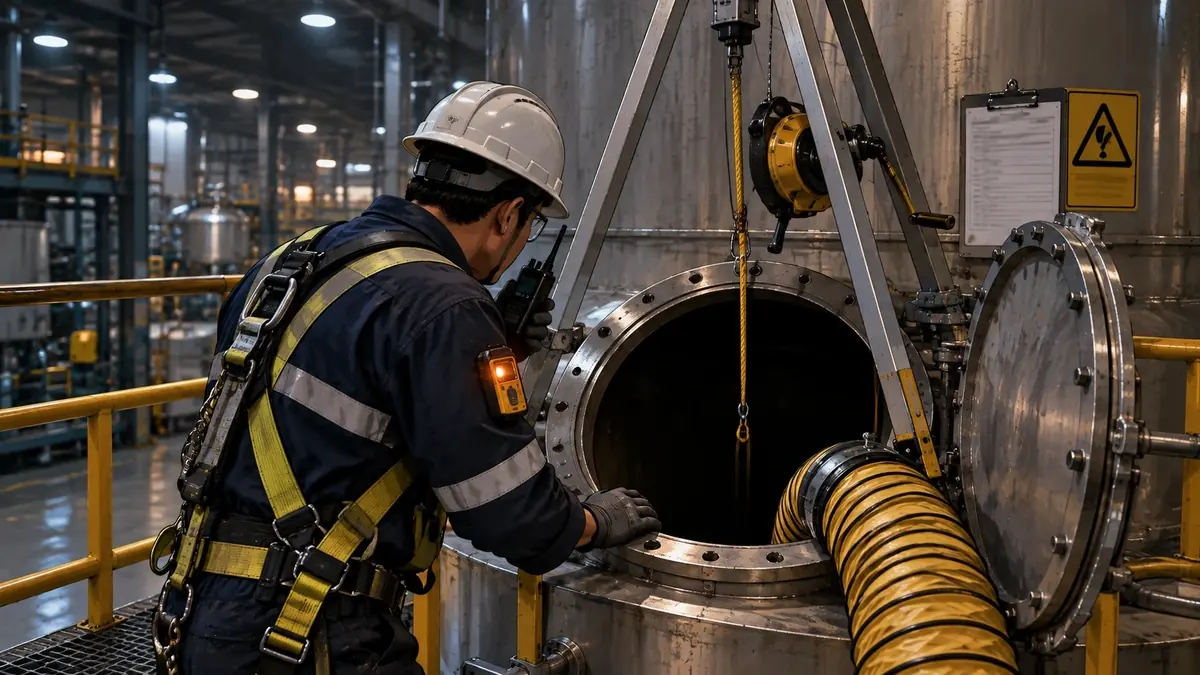
A worker goes down to clean a tank. A few minutes later the radio goes quiet. The coworker outside does what anyone would: looks in, sees them at the bottom and climbs down after them. In a confined space, that is the moment one victim becomes two.
The coworker had courage to spare. What they lacked was the one thing nobody had them practice.
The short answer: a confined space is large enough to enter, has limited entry or exit and is not designed for continuous occupancy. Under OSHA 1910.146, a permit-required space needs an attendant, the coworker who stays outside, because according to NIOSH more than 60% of confined space deaths are would-be rescuers. That decision to stay out is what gets practiced in virtual reality.
Want to see how it would look with your tank or pit? Book 30 minutes or message us on WhatsApp.
The rule puts someone outside
The NIOSH figure is from 1986 and still holds: the atmosphere that knocked out the first person is waiting for the second.
That is why 1910.146(i) gives the attendant one position: outside the permit space for the whole entry, until another attendant takes over. From there they track who is inside, summon rescue and perform non-entry rescue with the retrieval line. They only go in if they are trained and equipped for rescue and someone else takes their post.
It is the one job in the operation whose most important task is not doing what the body is asking for.
Permit-required or not, the meter decides
Under 1910.146 the question is not what the space looks like, but what it contains or could contain:
| Criterion | Non-permit space | Permit-required space |
|---|---|---|
| Atmosphere | No potential hazardous atmosphere | Oxygen below 19.5% or above 23.5%, or flammable gas above 10% of the LFL |
| Engulfment | None | Material that can engulf an entrant |
| Configuration | No trapping shape | Inwardly converging walls or a floor that slopes to a narrower section |
| Other hazards | None that can kill or seriously injure | Any other recognized serious hazard |
The same tank can look harmless on Monday and be deadly on Thursday. That is why the air is tested before every entry, and during the work.
10 permit-required confined spaces and what is practiced in VR
None of these is permit-required by definition. This is what usually makes them so, and this is what gets practiced for each one:
- Storage tanks. Empty is not clean: the vapors stay. In the headset, the multigas meter picks them up.
- Grain silos and hoppers. Fermentation eats oxygen and grain can engulf. In the headset, the reading drops with someone inside.
- Septic tanks and sumps. Hydrogen sulfide stops being smellable at high concentrations. In the headset, the alarm goes off even when nothing smells.
- Manholes and sewers. Gases travel through the network. In the headset, the reading changes without anyone touching anything.
- Nitrogen-inerted tanks. Nitrogen is odorless and colorless, so it gives no warning. In the headset, you test before you trust.
- Reactors under maintenance. A residue or a line nobody locked out. In the headset, each isolation is checked against the permit, as in lockout tagout training and VR for industrial safety.
- Boilers and furnaces that are off. Off is not cold: carbon monoxide and heat remain. In the headset, you test and ventilate before entering.
- Ducts and service tunnels. The atmosphere changes with the work inside. In the headset, welding forces continuous monitoring.
- Tanker trucks and railcars. They carry vapors from the last load. In the headset, every attempt brings a different load.
- Dust collectors. Accumulated dust can burn or explode. In the headset, a sparking tool forces the work to stop.
The rescue drill 1910.146 requires and almost nobody runs in full
On paper, the rule is met. In practice, a full drill means shutting down, ventilating and emptying the tank, and even then the real emergency never shows up: the meter going off, the radio going silent and the urge to climb down.
When the inspection comes, what is left is the training certificate. It proves people sat through the course, not that they know what to do when the alarm sounds.
What the rule asks for and what the simulator covers:
| What OSHA 1910.146 asks for | How the simulator covers it |
|---|---|
| Training before the first assignment (g) | In your modeled space, with unlimited attempts |
| Training certification (g) | Critical failures and a score per person |
| Rescue practice at least every 12 months (k) | Unannounced events, without shutting down or emptying the tank |
| Atmospheric testing before entry | Readings that change on every attempt |
| Entry permit (f) | The permit is filled out field by field |
| Retraining when duties or hazards change (g) | Repeated without stopping operations |
How it is practiced in a custom simulator
The participant goes through the procedure by role in your own tank, pit or sump, and if someone climbs down to rescue, the scenario takes them back to the point where they had to decide.
Every attempt is recorded per person: answers, errors, critical failures and time, in an exportable file. It runs without internet or controllers, and the instructor follows the session live. You own the development: there is no per-headset license.
This is how we build custom industrial training.
The entry permit, the employer's training certification and the drill with real equipment stay with you. The attendant arrives at that drill having stayed outside dozens of times.
Your attendant is going to hear that silence on the radio one day. The only thing you get to decide is whether the first time they stay outside happens in the headset or in your plant.
Frequently asked questions
What is a confined space?
Under OSHA 1910.146, a space large enough to enter, with limited entry or exit, not designed for continuous occupancy. It does not have to be small or underground: a silo or a tanker truck qualifies.
What is a permit-required confined space?
One that has or could have a hazardous atmosphere, engulfment, a trapping shape or another serious hazard. In Fyware's simulator, readings change on every attempt, so nobody classifies from memory.
What does a confined space entry permit include?
Fifteen items, from the space, entrants, attendant and supervisor to hazards, isolation, test results and rescue. In Fyware, the simulator scores each participant and delivers a results table per person.
What does a confined space attendant do?
Stays outside during entry, tracks who is inside, summons rescue and performs non-entry rescue. In Fyware's simulator, the entrant stops answering and the attendant has to do exactly that.
How often is confined space rescue training required?
In-house rescue teams must practice permit space rescues at least once every 12 months. In Fyware's simulator, the rescue is repeated without shutting down the tank.
What is a confined space simulator?
Your space recreated in virtual reality, where mistakes are part of the training: if someone climbs down, the scenario makes them pay for it. Fyware builds it to order from photos of your space. See in Fyware Safe how the fire, PPE and forklift simulators look.
Before you take it to leadership, price shutting down a tank for a real drill with the industrial training ROI calculator.
 Tom Klukowski
Fyware Partner · Valcre Marketing
Before we quote, we check whether virtual reality fits your operation
Fyware has delivered 750+ XR projects for clients like Gerdau Corsa, Cummins and Medverse, from Mexico in US Central Time. Tell us your case and we will tell you what is feasible, how long it takes, and on what budget.
Get the next articles
Practical guides on VR, AR and industrial training. No spam: we only write when we publish.