
The DC-3 Certificate in Mexico: What It Proves, What It Does Not, and Where VR Fits
 By Carlos Franco, Co-Founder & CEO at Fyware · LinkedIn
The short answer: the DC-3 is the certificate a Mexican employer issues to document that a worker took and passed a training course (Article 153-V of Mexico's Federal Labor Law), and it is issued by the company or by a training agent registered with the STPS, never by a simulator. Fyware is not a registered training agent: the simulator produces the per-person performance evidence that backs the certificate, and if your plant has no agent, an independent registered instructor can issue it as an optional add-on.
If you run manufacturing in Mexico from a headquarters somewhere else, you have probably signed off on DC-3 certificates without ever reading what they legally say. Your plant manager files them, the folder looks complete, and the topic never reaches your desk again.
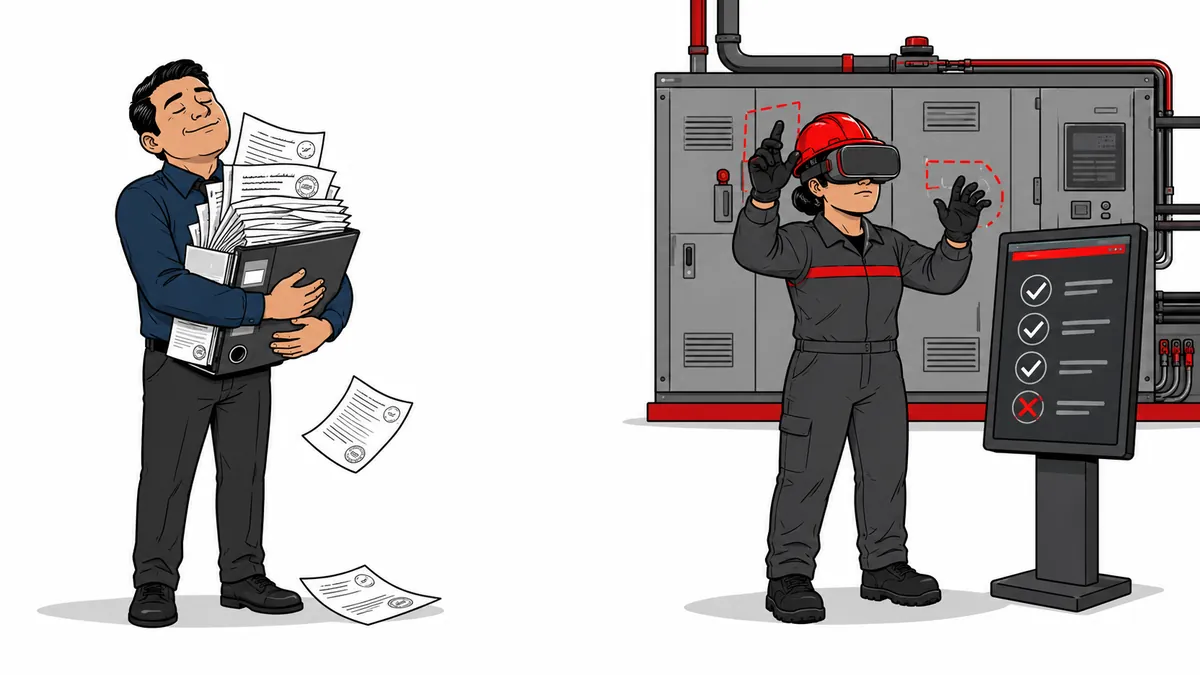
It should: it answers a narrower question than most executives assume.
What the DC-3 actually is
The DC-3, formally the *Constancia de Competencias o de Habilidades Laborales*, is the certificate an employer issues to document that a worker completed training. Its legal basis is Article 153-V of Mexico's Federal Labor Law, which defines it as "the document with which the worker shall accredit having taken and passed a training course."
Read those two verbs again: taken and passed.
Most compliance programs document the first one rigorously and treat the second as a formality. An attendance sheet proves a person was in the room. It does not prove they passed anything, and it certainly does not prove they can run the procedure on the night shift, on the real equipment, without the instructor standing next to them.
The same article carries an obligation that surprises foreign operators: companies must send the Ministry of Labor and Social Welfare, for registration and control, the lists of certificates they have issued. The state counts how many certificates you issue. It does not count whether they worked.
One more piece of the structure, from Article 153-E: any company with more than 50 workers must form a joint labor-management committee for training, development and productivity. If your Mexican plant is of any real size, that committee already exists and already owns this process.
Who can legally issue it
This is where foreign operators get sold things that do not hold up.
Article 153-A allows the employer to deliver training "inside the company or outside it, through its own personnel, specially hired instructors, institutions, schools or specialized organizations." The same article requires that institutions, schools, specialized organizations and independent instructors be registered with the Ministry.
In practice: your Mexican entity can train with internal instructors and issue its own certificates. If you hire a third party to deliver the course and sign, that third party must be a registered training agent.
Fyware is not a registered training agent with the STPS. I say it plainly because it is the question your compliance team should ask any vendor, and because I have heard promises of "DC-3 included" that do not survive scrutiny. A simulator does not issue certificates. Your company issues them, or the registered agent you contracted does. What a simulator can do is different, and in my experience more useful: produce the evidence behind the signature.
The gap a corporate audit finds
While nothing goes wrong, the folder is enough. The problem is that the folder was designed for the quiet day and gets used on the bad one.
Mexican regulation is more explicit about this than most people outside the country realize. NOM-033-STPS-2015, which governs confined space work, devotes its Chapter 11 to training and asks for three things: "theoretical instruction, practical training, and evaluation of the knowledge and skills acquired."
Theory is well documented in every plant I know. Practical training is documented with a group photograph. And the evaluation, when it exists, is usually a multiple choice test that measures whether the operator remembers the procedure; execution goes unmeasured.
If you are used to OSHA, the parallel is exact. 29 CFR 1910.147(c)(7) requires the employer to "certify that employee training has been accomplished and is being kept up to date," with each employee's name and dates. Same logic, same blind spot: the certification proves the event happened and says nothing about competence.
The question that undoes any training file
Pick ten operators at random who signed a certificate six months ago. Ask them to run the full procedure unassisted. How many finish?
Most operations directors I work with do not know. The system was designed to accredit, and that question falls outside what it measures.
We have our own measurement of that gap. In an A/B test with a global auto parts manufacturer, across two plants in two countries, in November 2024, we compared the paper manual against digital work instructions. With the traditional binder, 11% of the team reported feeling capable of performing their activity. With digital instructions, 100%. Same procedure, same people, different way of delivering the knowledge.
That 89% gap does not show up in any training folder. It shows up in scrap, rework and incidents.
What the gap costs before anyone gets hurt
Compliance gets discussed as if the only exposure were a fine. In practice the gap between accredited and capable bills you much earlier and much more quietly.
It bills you in the learning curve, when the certified operator runs at half capacity for weeks and nobody counts it because, on paper, they are trained. It bills you in shadowing, when your best line operator stops producing to walk the new hire through the job. It bills you in the night shift rework, when there is nobody to ask.
None of that lands in the training budget. It lands spread across production, quality and maintenance, which is exactly why nobody adds it up.
When you do add it up, the order of magnitude tends to surprise people. That is the exercise I suggest before quoting any simulator: calculate the real cost of the learning curve for each new hire, then compare it against what closing it costs.
What a simulator records that a sign-in sheet cannot
When training happens in a simulated environment, the record stops being a signature and becomes a per-person performance file:
- Which scenarios each operator completed, on what date, in how many attempts.
- Where they failed, which is usually more useful than where they succeeded. If eight out of ten fail at the same step, the problem is in the procedure or the way it is taught.
- The same content on every shift and in every plant. With rotating instructors, standardization is an aspiration. With a simulator, it is the default.
- An explicit passing criterion, which is precisely the verb the law asks for and almost nobody documents.
None of those four replace the certificate. All four support it the day somebody asks what it was based on.
How it fits without rebuilding your compliance process
What we do at Fyware connects to your registered program and does not replace it. We align the simulation to the syllabus your training team already has, define the passing criteria with your own experts, and deliver the per-operator performance reports that back the issuance of your certificates.
Your joint committee keeps doing what it does. Your registered training agent keeps signing what it signs. Behind each signature, instead of an attendance list, there is now an execution record.
What if your plant does not have a training agent? We offer one as an optional add-on: an independent instructor registered with the STPS joins a session of the program and issues the DC-3 certificates, while the simulator generates the performance evidence that backs them. The registry is public and you can verify it yourself: open the official STPS training agent search and paste the RFC RADA910922NV2 into the RFC field. You will see the active registration and its 45 programs on file with the Ministry.
There is a second half almost nobody covers. Initial training solves the start; daily operation is where knowledge leaks. That is why the loop closes with digital work instructions at the workstation, available at the machine when the operator needs them, six months after the course.
Where to start
If you are evaluating this, the order I recommend is simple: take the procedure where an error costs the most, measure how ten already certified people execute it today, and decide with that number in hand.
If you also want the full map of what each Mexican standard requires, we published a practical guide to the STPS safety standards. And if the open question is budget, here are the real investment ranges. The 2027 deadlines for the certificate and the SIRCE notice are in the Mexico safety regulations calendar.
The folder proves you complied with the law. The evidence proves the operator knows.
Only one of the two helps you on the day of the incident.
Frequently asked questions
Who can issue a DC-3 certificate?
The company itself, with its own instructors, or a third party registered with Mexico's Ministry of Labor as a training agent, under Article 153-A of the Federal Labor Law. The company must also send the Ministry the lists of certificates it issues. A simulator vendor that is not registered cannot issue it.
Does Fyware issue DC-3 certificates?
No. Fyware is not a training agent registered with the STPS. If your plant has no training agent, we offer one as an optional add-on: an independent instructor registered with the STPS joins a session of the program and issues the certificates, while the simulator generates the performance evidence that backs them. The registration can be checked in the official STPS training agent search with the RFC RADA910922NV2.
What does VR add to the DC-3?
The evidence an attendance sheet does not have: which scenarios each operator completed, on what date and in how many attempts, the step where they failed and the passing criterion written before the session. That evidence backs the certificate the day someone asks what it rests on.
Once you know which procedure you need to certify, cost it out: ROI calculator per certified procedure.
 Tom Klukowski
Fyware Partner · Valcre Marketing
Before we quote, we check whether virtual reality fits your operation
Fyware has delivered 750+ XR projects for clients like Gerdau Corsa, Cummins and Medverse, from Mexico in US Central Time. Tell us your case and we will tell you what is feasible, how long it takes, and on what budget.
Get the next articles
Practical guides on VR, AR and industrial training. No spam: we only write when we publish.