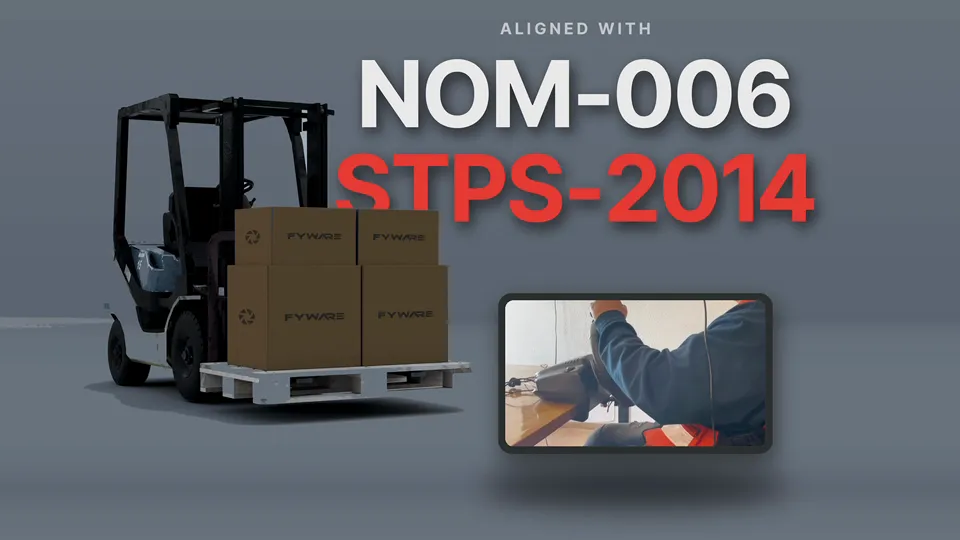
A pedestrian crosses without warning. The operator has braked before.
Seated, with a wheel, pedals, reverse and a fork lever, the operator drives three circuits with three different loads. At some point someone runs across, and if they cannot brake in time, the circuit restarts.
It is one of the four Fyware Safe simulators, it is aligned with OSHA 29 CFR 1910.178(l) and it is the only one that exports the session results, as a local CSV file.
OSHA requires every operator to be trained, evaluated in the workplace and certified before operating, and re-evaluated every three years. In practice the training is a classroom, and the first time an operator brakes for a pedestrian is in the plant aisle with a real load. Here they do it first, seated, with a wheel, pedals, reverse and a fork lever.
Aligned with OSHA 29 CFR 1910.178(l)
3Circuits in sequence with three different loads and a counterbalance forklift
4Questions on which forklift suits which load, answered before climbing into the cab
1Headset and a chair. Seated, with no physical movement
CSVResults at the end of the session, downloadable from the headset as a local file
The walkthrough
Judgment first, then the wheel
A voice assistant calls out every maneuver. The full session takes 15 to 20 minutes per operator.
1
They gear up before climbing in
PPE goes on before approaching the cab. Operating well starts with showing up properly equipped.
2
They answer which forklift to use
Four equipment-selection questions based on the load, before touching the wheel.
3
Circuit 1 · Pallet
An aisle with a marked pedestrian crossing: pick up, carry and set down without invading it.
4
Circuit 2 · Bulky load
The bulk blocks the view and forces a change of speed and approach angle.
5
Circuit 3 · Steel coil
Picked up from the center with the forks. This is the maneuver where loads get dropped.
6
The pedestrian crosses without warning
They appear at a run in a different spot every time. Fail to brake and the circuit restarts.
Classroom, real truck or simulator
Braking for a pedestrian cannot be practiced in a classroom. The first time an operator brakes for a pedestrian is usually in the aisle, with a real load.
How forklift operators are trained today
Classroom
Practice on a real forklift
Forklift simulator
What the operator does
Listens and takes the test
Drives with an instructor next to them
Drives three circuits with three loads
A pedestrian crossing without warning
Explained
Cannot be staged
Runs across, in a different spot every time
If they cannot brake in time
Nothing
An accident
The circuit restarts
What practice costs
Classroom time
The truck out of service, plus fuel or battery
A chair and a headset
What is left at the end
A test and an attendance sheet
The instructor's observation
A local CSV with the session results
The standard behind this risk
OSHA requires every operator to be trained, evaluated in the workplace and certified before operating, and re-evaluated every three years.
The forklift standard, by market
Market
Standard
United States
Forklift · OSHA 29 CFR 1910.178(l)
Mexico
Montacargas · NOM-006-STPS-2023
Brazil
Empilhadeira · NR-11
European Union
Lift truck · Directive 2009/104/EC
Germany
Flurförderzeug · DGUV V68 §7
Japan
フォークリフト · 労働安全衛生法 第61条
The simulator is the practice before the real truck. The evaluation in the workplace, the written certification and supervised practice on your own equipment are still yours.
In Germany the rule asks for a theory and practical test before the written assignment; in Mexico, NOM-006-STPS-2023 requires each operator to be trained and authorized.
For the start of the shift in the warehouse, the forklift safety toolbox talk has the script to read, three questions and the PDF with a sign-in sheet.
On your side
What it takes to run it at your plant
The simulator runs inside the headset and needs no network: there is nothing to install, and IT does not have to get involved.
15-20
How long
Minutes per operator for the full session: four equipment-selection questions and the three circuits, guided by a voice assistant.
1
How much space
A headset and a chair. The operator stays seated and does not move around: the wheel, pedals and forks are inside the headset.
CSV
What you keep
The session results, downloadable from the headset as a local file. It is the only one of the four modules that exports them.
How to get it
Three ways to have it at your plant
The same simulator, depending on what you need: own it, pilot it or bring it to an event.
Buy
For your training program
The module is installed on your Meta Quest 3 headsets, or on the ones we include, and it stays at your plant. Priced to the scope of your operation: ask for the range.
Rent
For a pilot or a short event (Mexico)
Headsets with the simulator loaded for the days you need them. Headset rental in Mexico runs from $2,500 to $3,500 MXN plus VAT per headset per day: VR equipment rental.
Event
As a station at your Safety Week
It is one of the five experiences in the activation, with Fyware technicians on site. From $3,800 USD before tax: Safety Week activities.
Quoted separately, on the same engine: recreating your plant and your fleet, a pre-use inspection with a checklist and an integrated test.
Forklift training simulator FAQ
How do I train a forklift operator before they get on a real one?
Seated in a chair, with a wheel, pedals, reverse and a fork lever, running three circuits with three different loads: a pallet in an aisle with a pedestrian crossing, a bulky load in a tight space and a steel coil picked up from the center with the forks. During the run a pedestrian crosses at a running pace without warning, in a different spot every time; the distance between the forklift and the person at the moment it stops is measured, and if it cannot stop in time the accident happens and the circuit starts over. Before climbing into the cab they gear up and answer four questions on which forklift suits which load. The session takes 15 to 20 minutes per operator and the results download from the headset as a CSV file.
Does this certify or authorize my operators?
No. It is the hands-on practice they do not have today, inside your training program. The written authorization of an operator stays with your company, and the simulator does not replace supervised practice on the real equipment.
Our forklifts are not the ones you show.
It trains judgment and maneuvering on a counterbalance forklift in a generic warehouse, and recreating your fleet and your plant is quoted separately.
More questions
What results do I get from a session?
A local CSV file with the session results, downloaded from the headset. Nothing is uploaded to a server and no account is needed. If you need formal evidence per operator, we plan for it from the start.
How long does each operator take?
Between 15 and 20 minutes for the full session: they gear up, answer four equipment-selection questions based on the load and drive the three circuits, with a voice assistant calling out every maneuver.
Can I bring it to our Safety Week?
Yes. The forklift simulator is one of the five experiences in the Fyware Safety Week activation: two stations, a technician at each, and about 20 people per hour.
Tell us what you want to solve in your plant. Fyware designs extended reality around the equipment and constraints of your operation, and builds it to grow from a pilot to the whole site.
Tom Klukowski, Fyware Partner · Valcre Marketing We reply in under 24 business hours, with scope, timeline and investment range.
In the meeting you see the simulator running and what it would take to bring it to your plant, with scenarios adapted to your layout. And if you need to sell it internally, this page is your presentation: share it with your team.