
Your forklift training has no pedestrians. A VR simulator does
 By Oscar Tobias, Marketing Manager at Fyware · LinkedIn
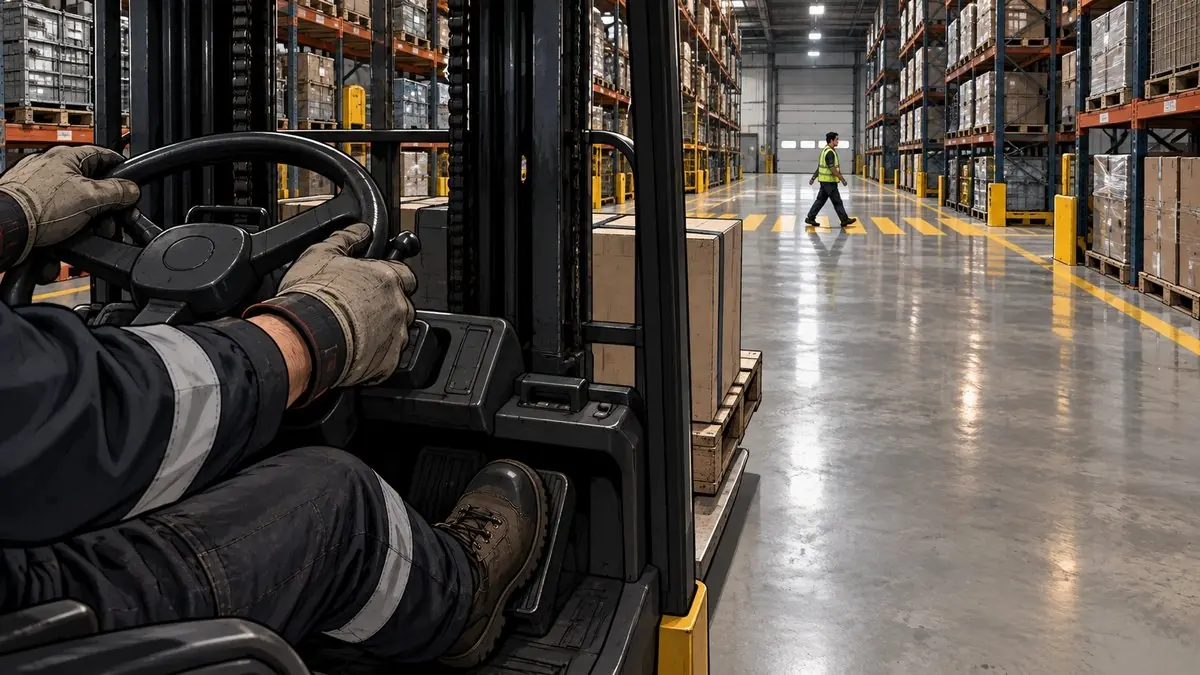
A newly certified operator turns the corner of an aisle with a pallet up. Someone runs out from between the racks. There is a second and a half, and the foot decides before the head. Last week they passed forklift training.
That training had everything except the one thing they were going to need.
The short answer: almost nobody fails forklift training, because there are no pedestrians in the training room. The test is passed by answering; the aisle is passed by braking. What most programs are missing is practice, and a forklift simulator in virtual reality lets you do it without taking a truck out of service or putting anyone at risk.
Want to see how it would look in your warehouse? Book 30 minutes or message us on WhatsApp.
Everyone passes, and that is the problem
This is how forklift operators usually get trained: a slide deck, a video, a multiple choice test and one lap around an empty yard. Everyone passes. Nobody had to brake with a load, reverse with the view blocked or react to someone running out between two racks, because doing that with a real forklift is exactly what nobody wants to risk with a rookie.
The rule knows it. OSHA's 29 CFR 1910.178(l) asks for formal instruction, practical training and an evaluation of each operator, lists pedestrian traffic as a training topic, and requires a new evaluation at least every three years. And the paper does not hold: in fiscal year 2025 the powered industrial truck standard was the eighth most cited by OSHA, with 2,150 violations. The meta-analysis by Burke and colleagues in the American Journal of Public Health, 2006, across 95 studies and 20,991 workers, found that the methods that make people participate and practice are the ones that reduce accidents and injuries the most.
Video and 360 tours work for orientation, as in our interactive 360 video for employee induction. But watching is not braking: in the video the pedestrian crosses and nobody was driving. In virtual reality someone is driving: the same aisle, the same pedestrian, and the foot has to brake.
How to drive a forklift when someone crosses
How to drive a forklift fits in eight rules, and all eight get answered right on the test. The hard part is following them without thinking:
- Inspect the truck before starting it: brakes, horn, lights, forks and leaks.
- Seat belt on before moving.
- Forks low while traveling, just off the floor.
- Look where you are going. If the load blocks the view, travel with the load trailing.
- Zone speed, and slower at cross aisles, ramps and crosswalks.
- Horn and full stop at every blind corner.
- Never exceed the data plate capacity or lift an off-center load.
- Park with the forks fully lowered, controls neutral, brake set and power off.
Written down, it looks obvious. The challenge is doing all of it at once, in a hurry, with a pedestrian who was not in the plan. In 2000, Marc Green reviewed a large body of braking studies: when something suddenly cuts into their path, a driver takes about 1.5 seconds to get a foot on the brake, twice as long as when they see it coming. At 6 mph that is over 13 feet before braking starts. That gap gets drilled in the headset, before the first shift.
The training and the VR simulator
Each one covers what the other cannot:
| Typical training | VR simulator | |
|---|---|---|
| Pedestrian | None | Crosses at a different point every time |
| Braking with a load | Explained | Done, with the pallet up |
| Blocked view | Explained | Driven with a bulky load trailing |
| Forklift | Taken out of service for the yard lap | None leaves production |
| Mistakes | Nowhere to make one | The circuit restarts |
| Evidence | Sign-in sheet and test | CSV with each operator's results |
Sit-down, three circuits and a pedestrian who runs
The forklift module in Fyware Safe is a VR forklift simulator, sit-down counterbalance, with a ready-made circuit. The operator sits with a steering wheel, pedals, reverse and fork lever, on a Meta Quest 3 headset and a chair. Before climbing in, they gear up and answer which forklift suits which load.
There are three circuits: a pallet down an aisle with a marked crosswalk, a bulky load that blocks the view, and a metal coil picked from the center. The operator knows someone is going to cross and does not know where. At some point, different every time, a pedestrian runs across. If the operator does not stop in time, the circuit restarts.
Each operator takes 15 to 20 minutes and ends with a CSV of their results. Since there is nothing to develop, it is deployed in days.
Forklift training in your own aisle
If your warehouse runs reach trucks, stand-up forklifts or clamps, or if you want your people to drill tip-overs, collisions with personnel or putaway in your own racks, the simulator is built to order: your aisles, your trucks and your procedure. It is the path Gerdau Corsa followed with overhead cranes. The ranges for a project like that are published in how much VR training costs.
It stays on your headsets
Ready-made or built to order, the simulator is delivered installed on your headsets. There is no per-seat license or forced annual plan, and adding operators or shifts does not change the price. The refresher and the three-year evaluation are done with what you already bought.
Operator certification, which 1910.178(l)(6) puts on the employer, and supervised practice on the real truck stay with you. The rest of the rules are in our guide to virtual reality for industrial safety. With the simulator, the operator reaches the real forklift after braking dozens of times.
Your next operator is going to meet a pedestrian who steps out without warning. The only thing you get to decide is whether that first time happens in the headset or in the aisle.
And if the date in front of you is safety week, forklifts are one of the five experiences in our safety week activation, and their twin on foot, the pedestrian crossing, teaches people to wait for the operator's confirmation before crossing.
For the start of the warehouse shift, the forklift safety toolbox talk has a script to read out loud, three questions and a PDF sign-in sheet.
Frequently asked questions
What does OSHA require for forklift training?
29 CFR 1910.178(l) requires a combination of formal instruction, practical training and evaluation of each operator in the workplace, an evaluation at least every three years, and a written certification with the operator's name, dates and the trainer's identity.
What is a VR forklift simulator?
A forklift modeled in 3D that the operator drives inside a headset before getting on the real truck, with no PC, cables or internet.
Is a PC forklift simulator enough for training?
It teaches you to turn a wheel on a screen, not how the body reacts to a pedestrian who appears from the side.
What are the most common forklift accidents?
NIOSH, in its Alert 2001-109, names the most common fatal ones: tip-overs, workers struck, crushed or pinned by the truck, and falls from it.
Can you practice a forklift tip-over?
Not in the ready-made circuit. The tip-over is built to order, with your trucks and your warehouse.
Does a forklift simulator replace forklift certification?
No. The certification belongs to the employer; the simulator adds risk-free practice and per-operator results to the training you already deliver.
Does it work for sit-down, reach trucks or stand-up forklifts?
The ready-made circuit is sit-down, the counterbalance truck with a steering wheel and pedals. Reach trucks, stand-up forklifts or other equipment are built to order.
When is forklift refresher training required?
Under 1910.178(l)(4), after an accident or near miss, unsafe operation, a poor evaluation, a new type of truck or a change in the workplace.
Before you decide how to train it, price a forklift out of service, a dropped pallet or a new operator learning on shift with the industrial training ROI calculator.
 Tom Klukowski
Fyware Partner · Valcre Marketing
Before we quote, we check whether virtual reality fits your operation
Fyware has delivered 750+ XR projects for clients like Gerdau Corsa, Cummins and Medverse, from Mexico in US Central Time. Tell us your case and we will tell you what is feasible, how long it takes, and on what budget.
Get the next articles
Practical guides on VR, AR and industrial training. No spam: we only write when we publish.