
Job Safety Analysis: Why Crews Sign It Without Reading It
 By Carlos Franco, Co-Founder & CEO at Fyware · LinkedIn
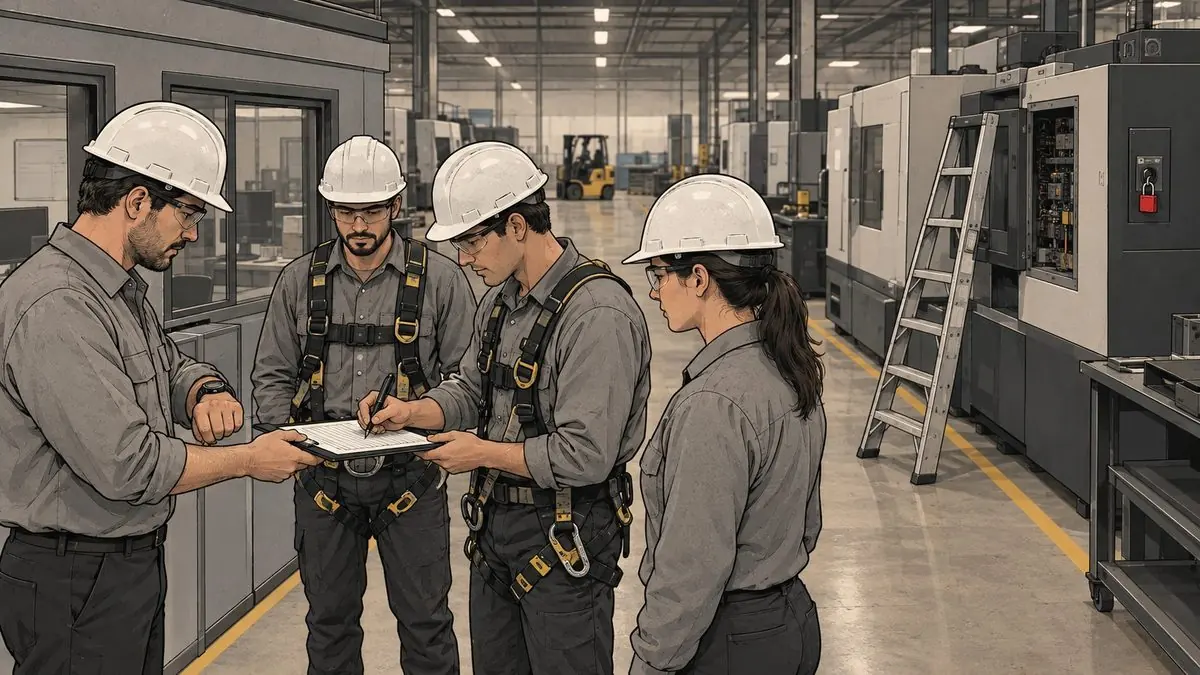
The short answer: a job safety analysis (JSA) breaks a task into steps, lists the hazard in each step and the control that prevents it. Crews usually sign it without reading it because it is written far from where the work happens. It works when the people doing the task write it and rehearse the hazardous step first: that is how Gerdau Corsa runs 10 simulator hours a month with zero production stops for training.
"Sign here, it's the JSA."
I have heard that sentence in English at a corporate safety review and, a few weeks later, in Spanish at the same company's plant in Mexico, with the form translated, the crew already harnessed, and five signatures collected in under a minute. Nobody was being careless. The form had simply arrived at the last possible moment.
What is a job safety analysis (JSA)?
It is a way to review a task before doing it. You take one specific job, split it into the sequence of steps in which it is actually performed, and for each step ask what can go wrong and what prevents it. OSHA calls the same tool a job hazard analysis; in Mexico it is the AST, in Brazil the APR.
It differs from a plant-wide risk assessment in the size of the unit. The plant assessment looks at areas and processes. The JSA looks at one task and at the people who will do it today.
How to do a JSA in four steps
- Pick the task. Start with the ones that already had an incident, the non-routine ones and the new ones.
- Break it into steps, in the order they are done, each starting with a verb: isolate, lower, open. If you end up with thirty steps, you probably have two tasks.
- Identify the hazard in each step: stored energy, falls, caught-in points, the pedestrian who crosses.
- Set the control and who verifies it, starting with removing the hazard and leaving PPE at the bottom of the list.
OSHA does not require a document called a JSA by name; it recommends the method in its publication 3071. In Mexico, several STPS standards ask for a risk analysis before specific work: NOM-033 for each confined space job, NOM-029 for each electrical maintenance activity and NOM-009 before work at heights. The training they require is summarized in our guide to Mexico's STPS safety training standards.
Whether OSHA requires a written safety program at all, and what California asks for, is in our guide to the injury and illness prevention program (IIPP).
Why does the JSA get signed and not read?
Because it shows up late and it shows up on paper. A supervisor or the safety team often writes it in an office, copying the last one for something similar. In a nearshore plant there is one more hop: the template was written at headquarters in English, translated, and handed to a crew who never saw the original.
At that point a signature stops being a review. It becomes the condition to start working.
And even if someone read every line, paper does not teach the step. "Caught-in hazard" in a cell does not show anyone where to put their hand. It is the same flaw as paper work instructions: photos taken from too far away, steps that seemed obvious to whoever wrote them, a sheet that is dirty within the first hour. The JSA inherits all of that and adds its own problem: it gets filed as soon as it is signed.
Where should the JSA be when the task starts?
On the hazardous step, in front of the person about to do it. If the task already has a digital work instruction, the JSA control belongs inside that step, with a photo of what done-right looks like, instead of in an appendix. That is how GIRI handles a procedure: the step and its warning appear together, in the current revision.
The other half is the feedback loop. A good JSA gets corrected by what happens on the floor, so the plant has to hear about it fast. In our paperless plant case, anyone can raise a hazard with a QR code in under a minute; MWAAF reports that shortly after launch a forklift that nearly ran over several people was reported that way, and management acted on the report.
What building simulators taught us about the JSA
When a plant asks us for a safety simulator, the first document I ask for is the step-by-step task analysis. It is the simulator's script. And that is where the form shows what it hides: it describes what to do when everything goes to plan, and what hurts people is usually in what leaves the plan.
In a simulator, that step gets rehearsed. The trainee isolates the energy, makes a mistake, sees the result and starts over, while the real machine keeps running. Gerdau Corsa's program grew over seven years to eleven modules, lockout tagout among them, and the plant reports 10 simulator hours a month and zero production stops for training. The full story is in the crane operator training simulator case, and the lockout logic in lockout tagout training.
How many of the signatures on your last JSA belonged to people who had done that step before?
What does it cost to train the hazardous step in VR?
It depends on whether the step already exists in a finished module. Fyware Safe has four: fire response, PPE, forklift and pedestrian crossing, used as they are or with one to two weeks of brand adaptation. A custom simulator built around your task starts at 15,000 USD: about a month for an awareness module, around three months for a training simulator, and three to six for a complex task. Scope for plants is on our industrial solutions page.
Before quoting, the JSA for the task is the first thing I will ask you for. If it does not exist yet, that is deliverable number one.
Frequently asked questions
What are the 4 steps of a job safety analysis?
Pick the task, break it into steps in the order it is performed, identify the hazard in each step, and set the control that prevents it, with someone responsible for verifying it.
Does OSHA require a job safety analysis?
Not by that name as a general rule. OSHA recommends the method in publication 3071, Job Hazard Analysis, and specific standards require hazard assessments for certain work, such as PPE selection or permit-required confined spaces.
Who should write a JSA?
A supervisor or the safety team coordinates it, but it is written with the people who do the task. They know which step gets skipped and why.
How often should a JSA be reviewed?
When the task, the equipment or the location changes, after any incident or near miss on that task, and on a periodic schedule the plant defines.
Can a JSA be trained in virtual reality?
Yes. The JSA becomes the simulator's script: each step and its hazard is rehearsed in first person, mistakes allowed, without stopping the real equipment. A finished Fyware Safe module can be adapted in one to two weeks.
If you are going to propose training the hazardous step, bring the number to the meeting: industrial training ROI calculator.
 Tom Klukowski
Fyware Partner · Valcre Marketing
Before we quote, we check whether virtual reality fits your operation
Fyware has delivered 750+ XR projects for clients like Gerdau Corsa, Cummins and Medverse, from Mexico in US Central Time. Tell us your case and we will tell you what is feasible, how long it takes, and on what budget.
Get the next articles
Practical guides on VR, AR and industrial training. No spam: we only write when we publish.