
Virtual Reality vs Augmented Reality: When to Use Each
 By Carlos Franco, Co-Founder & CEO at Fyware · LinkedIn
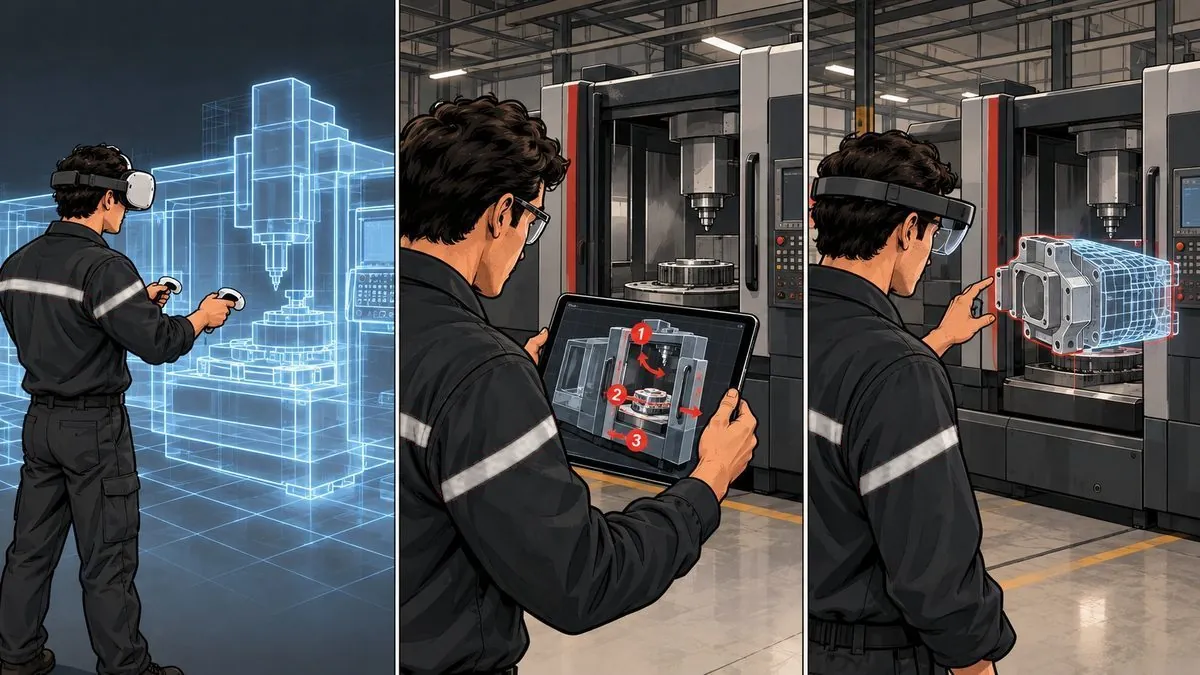
The short answer: virtual reality vs augmented reality comes down to what each does with your surroundings. Virtual reality replaces them entirely; augmented reality layers information on top of them; mixed reality makes the digital react to the physical. On the plant floor the practical rule is this: if practicing for real is expensive or dangerous, virtual reality; if the real equipment is available and what is missing is the instruction or the measurement, augmented reality; if you need both with your hands free, mixed reality.
In a 2019 meeting a plant manager asked me for "those goggles" to train his people. I asked for which procedure. A die change on a press, with the press available two shifts a day. I told him I would not buy goggles: what he needed was a tablet with the instruction on top of the machine, at a third of the cost. Seven years later that confusion is still the first conversation of almost every project, so here is the explanation I give in that meeting.
What is virtual reality and what are its types?
Virtual reality replaces what you see and hear with a computer-generated environment. You put on a headset and you are in a crane cab, a substation or an operating room without leaving the training room.
Three types matter for a company. Immersive on a standalone headset, which runs with no computer or cables and is what we use for most simulators; immersive on a PC-tethered headset, for very heavy scenes such as a flight simulator; and non-immersive on a screen, which is a 3D walkthrough in the browser or on a tablet. In the meta-analysis by Howard, Gutworth and Jacobs (Computers in Human Behavior, 2021, 184 studies) immersive hardware did not outperform non-immersive: d = 0.568 versus 0.462. The headset is not what teaches.
What is augmented reality and what are its types?
Augmented reality leaves the world where it is and adds a layer: a 3D model on an empty floor, an instruction on the machine, a part's deviation from its CAD. It runs on the phone or tablet people already carry.
Its types differ by how they anchor content. Marker-based, when a printed code or image tells the device where to put things. Markerless, when the device recognizes the geometry of the surroundings or the part; that is how inspection with Twyn works. Location-based, with GPS, for outdoors. And projection, when information is projected onto the surface and no screen is needed. The uses that already pay invoices are in our guide to augmented reality in Mexico.
Mixed reality and extended reality: where they fit
Mixed reality is augmented reality with physics: the digital recognizes real surfaces and objects, hides behind them and reacts to your hands. It runs on headsets that see the room, and it is what lets you rehearse fitting a digital part onto a real machine without putting down your tools. Our first project, in 2017, was an event staging in augmented reality on the first mixed reality headset on the market.
Extended reality, or XR, is just the umbrella over the three. When someone sells you "XR" they are selling the whole category. Ask which of the three, and for what.
Virtual reality vs augmented reality: the decision matrix
You choose the technology to fit the procedure. The same Howard meta-analysis puts it in numbers: the training effect depends on the fit between task and technology. Low fit, d = 0.207; high fit, d = 0.820. Four times the effect for choosing well, with the same hardware.
Four questions settle most cases:
- Is practicing for real expensive, dangerous or impossible? Virtual reality. Operating a crane in a steel mill, fighting a fire, a rescue at height. Gerdau Corsa trains its crane operators on virtual reality simulators and reports zero production stops to train.
- Is the real equipment available, and what is missing is the instruction or the measurement? Augmented reality. A die change, an inspection, scheduled maintenance. With digital work instructions, documenting ten procedures went from 125 to 45 hours in one plant and from 170 to 60 in another.
- Do hands need to be on the machine while seeing information? Mixed reality, on a headset. It is the most expensive option to buy and to manage; get there once the first two have shown that people actually use the tool.
- Is it for selling or for teaching? To sell something that does not exist yet, augmented reality on the customer's floor or a virtual walkthrough; to teach, whatever the risk dictates.
What none of the three solves on its own
The technical content comes from whoever masters the procedure, and that is not the vendor. Measurement has to be designed before buying anything, because without an indicator a headset is just an innovation expense. And the process has to exist: if the procedure changes every month, a custom simulation goes stale and a digital instruction, edited in an afternoon, comes first.
That is why projects die in the pilot more often than in production, and why the right order is procedure, indicator, technology. I develop it in pilot purgatory: where digital transformation projects die.
Which device each one runs on
Virtual reality: a standalone headset for training simulators, a PC-tethered headset for heavy scenes, a browser for walkthroughs. Augmented reality: a phone for catalogs and filters, a tablet for inspection and instructions, and WebXR when you do not want anyone to install anything. Mixed reality: a headset with outward-facing cameras.
The device is the small expense of the project. What costs is the content and its maintenance, which is why it pays to own the result, with no per-device license, so that installing it on one headset or thirty costs the same. The full ranges are in how much VR training costs.
Frequently asked questions
What are the 3 types of virtual reality?
Immersive on a standalone headset, immersive on a PC-tethered headset, and non-immersive on a screen, such as a 3D walkthrough in the browser. For industrial training the first is the most used.
What are the 4 main types of augmented reality?
Marker-based, markerless through environment recognition, location-based through GPS, and projection onto surfaces. On the plant floor the most used is a markerless tablet app.
What is the difference between mixed reality and augmented reality?
Augmented reality overlays information without the digital reacting to the physical world; mixed reality recognizes surfaces and objects, hides the digital behind the real and responds to hands. Mixed reality requires a headset with outward-facing cameras.
What is extended reality or XR?
The umbrella term for virtual, augmented and mixed reality. It does not describe a concrete solution, so when evaluating a vendor ask which of the three they propose and for which procedure.
Which one is right for training operators?
Virtual reality when practicing for real is expensive or dangerous; augmented reality when the equipment is available and the instruction is missing; mixed reality when you need both with hands free. Task-technology fit multiplies the training effect by four according to Howard and colleagues (2021).
Once you know which procedure goes first, bring the number to the meeting: industrial VR training ROI calculator.
 Tom Klukowski
Fyware Partner · Valcre Marketing
Before we quote, we check whether virtual reality fits your operation
Fyware has delivered 750+ XR projects for clients like Gerdau Corsa, Cummins and Medverse, from Mexico in US Central Time. Tell us your case and we will tell you what is feasible, how long it takes, and on what budget.
Get the next articles
Practical guides on VR, AR and industrial training. No spam: we only write when we publish.