
Fall Protection Training: What OSHA Requires in 2026
 By Carlos Franco, Co-Founder & CEO at Fyware · LinkedIn
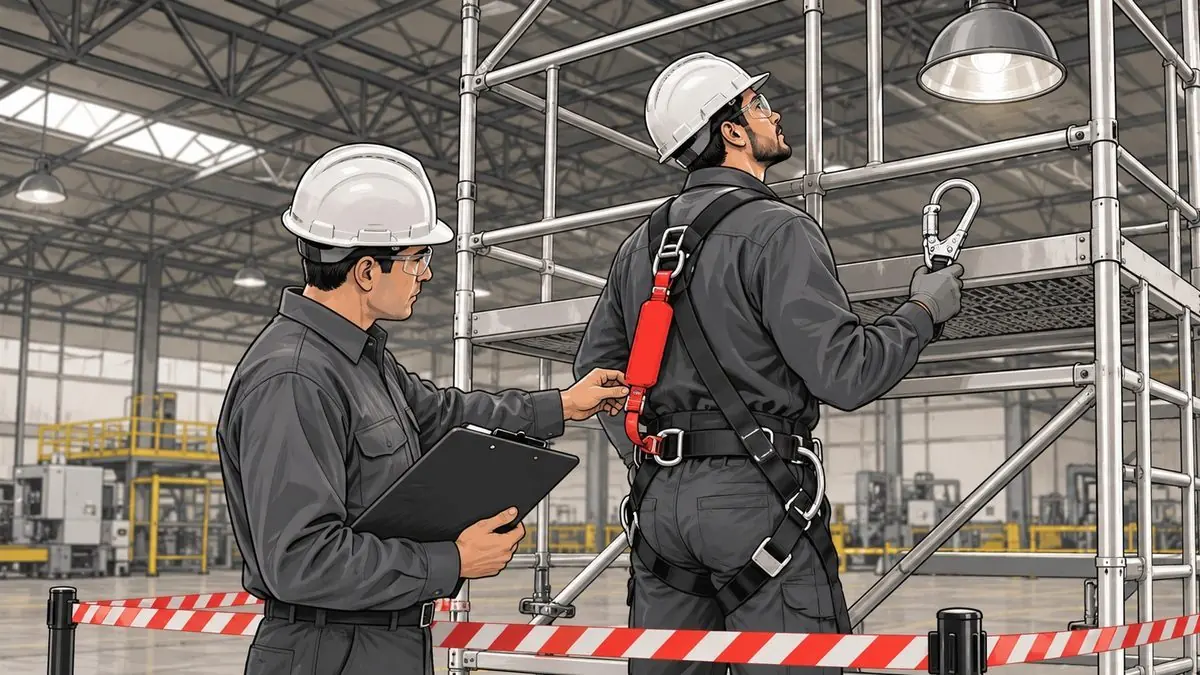
The short answer: OSHA requires fall protection training under 29 CFR 1910.30 before any employee who uses a personal fall protection system is exposed to a fall hazard. A qualified person must teach four topics. There is no fixed renewal date: retraining is triggered by changes or by gaps in skill. In general industry, protection starts at 4 feet.
- That is how many workers died from falls, slips and trips in the United States in 2024, according to the Bureau of Labor Statistics, out of 5,070 fatal work injuries. The count fell 4.6% from 2023.
I write this from Mexico, where our standard for work at height starts at 1.80 m, so the first thing I check in a US plant is the federal number, which is lower.
When does OSHA require fall protection in general industry?
At «4 feet (1.2 m) or more above a lower level» on any walking-working surface with an unprotected side or edge, under 29 CFR 1910.28(b)(1)(i). The same 4 feet applies to hoist areas, holes, dockboards, runways and stairway landings. Above dangerous equipment, the height does not matter: below 4 feet, the worker still needs a guardrail or travel restraint (1910.28(b)(6)(i)).
Construction uses 6 feet (1926.501(b)(1)). Mezzanines, maintenance catwalks and the top of a press line fall under the general industry rule, which took effect on January 17, 2017.
One date is in play: fixed ladders over 24 feet must have a personal fall arrest or ladder safety system by November 18, 2036 (1910.28(b)(9)). An April 2026 proposal would remove that deadline. Until a final rule comes out, the deadline stands.
What OSHA fall protection training must cover
Training comes «before any employee is exposed to a fall hazard», for every employee who uses personal fall protection systems (1910.30(a)(1)). A qualified person delivers it (a)(2). It covers four things (a)(3):
- The fall hazards in the work area and how to recognize them.
- The procedures to minimize those hazards.
- Installing, inspecting, operating, maintaining and disassembling the systems the employee uses.
- Correct use: hook-up, anchoring, tie-off, inspection and storage, as the manufacturer specifies.
It also has to be understandable: «in a manner that the employee understands» (1910.30(d)). On a bilingual crew, that sentence decides more than the slide deck does. We covered the same principle in hands-on PPE training.
Harness, anchor and free fall: the 1910.140 numbers
The personal fall protection rules in 1910.140 are short and specific:
- Anchorages hold 5,000 pounds per employee, or keep a safety factor of at least two under a qualified person's supervision (c)(13).
- Free fall is 6 feet or less (d)(2)(ii), deceleration distance 3.5 feet (d)(1), maximum arresting force 1,800 pounds.
- Body belts are prohibited for fall arrest (d)(3).
- Equipment is inspected before initial use during each workshift (c)(18).
- The employer provides for «prompt rescue» (c)(21).
OSHA does not define prompt in minutes. Its bulletin on suspension trauma cites research where suspension led to unconsciousness and death in under 30 minutes.
No expiry date, three retraining triggers
1910.30 has no annual requirement. The employer retrains when it has reason to believe an employee lacks the understanding or skill (c): the workplace changed, the equipment changed, or the employee's knowledge or use of it fell short.
General industry also has no written certification requirement for fall protection training. Construction does, in 1926.503(b). In practice, a sign-in sheet with the date, the trainer and the topics is what you show an inspector, and contractors who come in to work on your roof get the same check, as in any contractor safety orientation.
What an OSHA citation costs in 2026
The OSHA penalty amounts were not adjusted for inflation in 2026, so the 2025 figures remain: up to $16,550 per serious violation and up to $165,514 per willful or repeated violation. Fall protection in construction (1926.501) is first on OSHA's preliminary list of most cited standards for fiscal 2026; 1910.28 and 1910.30 are not in the top ten.
The National Emphasis Program on falls, in force since May 2023, covers all industries. Outside construction it lists ten target activities, including rooftop mechanical work.
What to rehearse before anyone climbs
Of the four topics, the last one is a skill. Where to anchor, whether the free fall clears the conveyor below, what to do when a coworker hangs in the harness: those are decisions, and the first time someone makes them should not be at height. VR lets a crew repeat them on the ground, in the plant's own layout, before the practical session with the physical harness. It does not replace that session.
We build custom VR training for industrial plants on the scaffold, roof or platform of each site, from 15,000 USD; a training simulator takes about three months. Our Safety Week stations include a work-at-height experience for awareness. Fyware is not a training provider of record and does not issue certificates; your qualified person keeps the training. If you also run a written program, see our IIPP guide.
Frequently asked questions
Is fall protection training required annually?
No. 1910.30 sets no frequency. Retraining is required when the workplace or equipment changes, or when an employee shows gaps in knowledge or use (1910.30(c)).
Who can provide fall protection training?
A qualified person (1910.30(a)(2)): someone with a recognized degree, certificate or professional standing, or extensive knowledge and experience, who has shown the ability to solve problems related to the subject.
Can fall protection training be done online?
1910.30 does not ban a format, but topic (iv) covers hook-up, anchoring and tie-off techniques, which are hands-on, and the training has to be understood by the employee (1910.30(d)).
Can a body belt be used for fall protection?
Only for travel restraint or positioning. For fall arrest, body belts are prohibited (1910.140(d)(3)).
At what height is fall protection required in general industry?
At 4 feet or more above a lower level (1910.28(b)(1)(i)), and at any height above dangerous equipment; construction uses 6 feet.
The 4-foot rule and the harness check, ready to read at the start of the shift, with a sign-in sheet: fall protection toolbox talk with sign-in sheet.
 Tom Klukowski
Fyware Partner · Valcre Marketing
Before we quote, we check whether virtual reality fits your operation
Fyware has delivered 750+ XR projects for clients like Gerdau Corsa, Cummins and Medverse, from Mexico in US Central Time. Tell us your case and we will tell you what is feasible, how long it takes, and on what budget.
Get the next articles
Practical guides on VR, AR and industrial training. No spam: we only write when we publish.