
Industrial robot digital twin
Rehearse the path before you touch the machine.
An Austrian industrial AR company asked for a twin that would work for any robot: pick the number of axes, type the length of each link, and the arm stands on the floor at real scale, running forward and inverse kinematics we wrote ourselves.
- Industry
- Industrial augmented reality
- Use case
- Industrial robot digital twin
- Technology
- Mixed reality on HoloLens 2
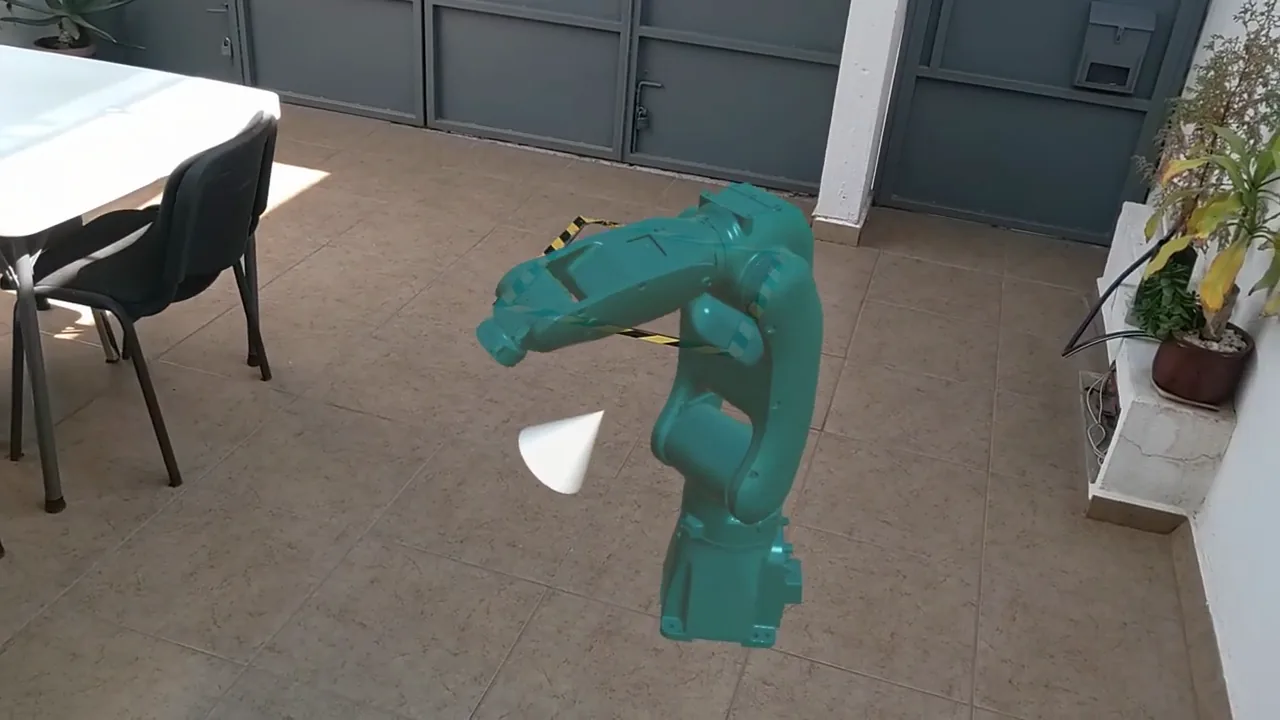
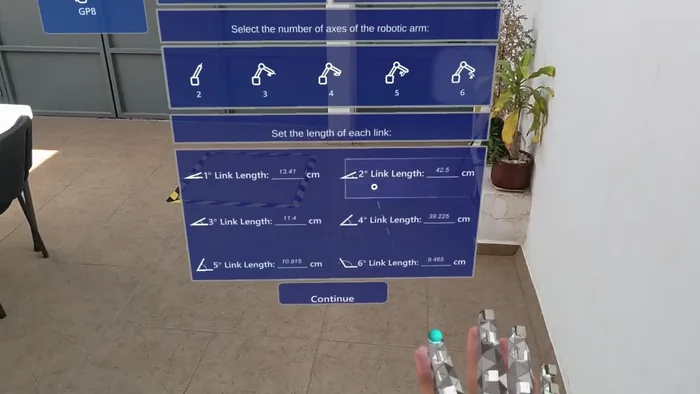
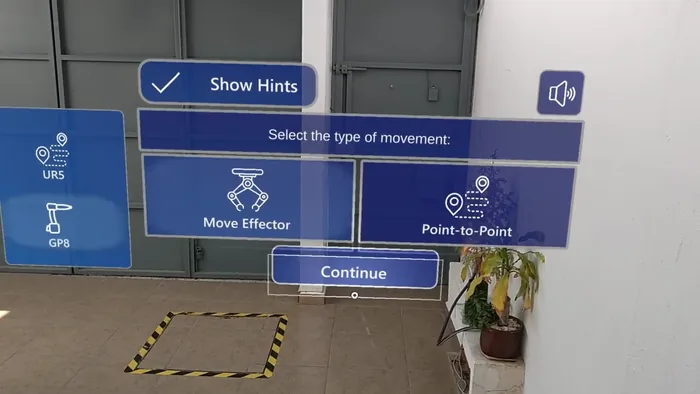
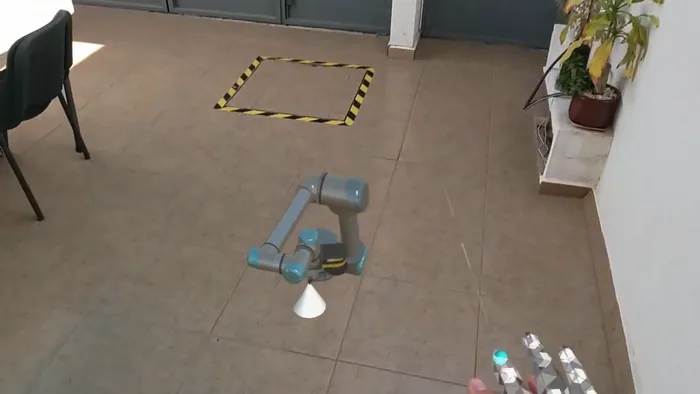
Fyware built a configurable digital twin of industrial robot arms for an Austrian industrial augmented reality company, between 2023 and 2024. It works for any arm: in the interface you pick from two to six axes and type the length of each link in centimeters, and from that the software assembles the kinematic chain and solves forward and inverse kinematics with custom code, respecting the rotation limit of every axis. The twin is placed at 1:1 scale on the floor where the cell would go, in mixed reality on HoloLens 2, and ships with presets for two real robots: the UR5 cobot by Universal Robots and the GP8 industrial arm by Yaskawa. The trajectory is defined in two ways, by moving the end effector with your hand to a cone that marks the target, or by chaining points.
The figures and where they come from: the two-to-six axes and the per-link lengths come from the selector visible in the capture of the delivered product, dated November 7, 2024; the two robots are the UR5 and GP8 presets in that same interface; the 1:1 is the twin standing on the floor in that capture. The link to the controller was specified over OPC UA, against the DIN EN IEC 62541-5 standard and the VDMA OPC UA for Robotics profile, and the Unity bridge to the Yaskawa simulator and to Gazebo was working over ROS. Commissioning on the physical cell was not carried out: the client entered insolvency in September 2024. Built in Unity.
How it came together
A twin that fits any arm
The challenge
A robot arm's path gets tuned with the cell stopped, and the only way to know whether the arm reaches a point without hitting anything is to try it. Every correction costs machine downtime. The client sold industrial augmented reality in Austria and wanted that solved before anyone touched the machine.
The idea, which is the client's
The brief came from their side and it was demanding: a system that could assemble the twin of whatever arm configuration you gave it. Their spec also called for an open communication layer over OPC UA, naming the standard and the VDMA robotics profile it had to comply with.
What we built
The configurator: the axis selector, the per-link length input, the kinematic chain and the forward and inverse equations, in custom code inside Unity. Plus the mixed reality interface that places the arm at real scale and the two ways of defining movement.
Why the geometry is entered by hand
The decision the whole project rests on is that you model the kinematic chain, whatever the arm. The interface asks two things before it draws anything: how many axes the arm has, from two to six, and how long each link is in centimeters. With those two answers the software assembles the chain and solves the equations, and that is where the hard work lives. Forward kinematics tells you where the tip ends up when you rotate the axes; inverse kinematics tells you how much each axis has to rotate for the tip to reach a point you chose. The second one does not have a single answer, and it has to be solved while respecting the rotation limit of every axis.
Writing those equations ourselves, instead of inheriting them from the robot maker's software, is what makes fitting the twin to a different arm a matter of typing numbers again, with no new programming. In the capture of the delivered product the same code carries two arms that look nothing alike: the UR5 by Universal Robots, a slim cobot with round joints, and the GP8 by Yaskawa, a compact industrial arm with different proportions and a different reach.
The two-to-six range is not a round number picked at random either. The client had a six-axis Yaskawa in their lab and asked in writing to start there rather than with the easy case, on the argument that scaling down from six axes to two is simpler than scaling up from two to six. Solving the hard case first is what left the rest of the range solved along the way.
The two ways of defining movement
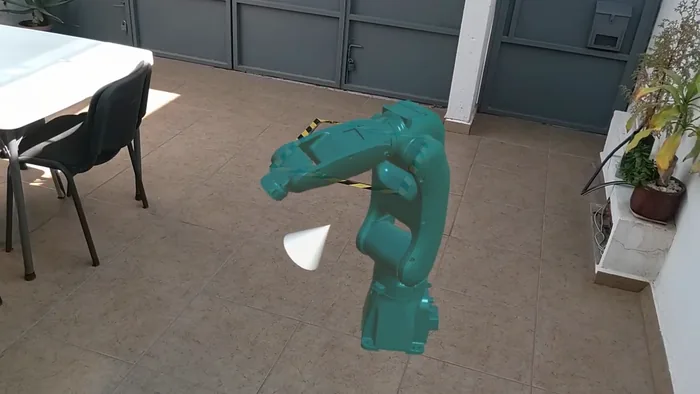
The twin is driven by hand, with no joystick or coordinate console. The first mode moves the end effector: a cone appears to mark the target, you grab it, you put it where you want the tip to land, and the arm solves the pose to get there. The second mode chains points to define a full route.
Standing at real scale on the floor where the cell would go, that answers in seconds the question that normally costs a site visit: whether the arm reaches, whether the space fits it, and where it is going to travel. The capture shows the arm against the room's spatial mesh, with the tape marker on the floor where the base is anchored.
The delivered product
Four moments from the November 7, 2024 capture, in the order someone wearing the headset sees them.
The link to the robot: what was proven and what was not
This is the part worth stating precisely, because it is the first thing an automation engineer will ask. The architecture was designed to close the loop: the twin generates the trajectory, exports it as per-axis angles, and the physical robot executes it. The bridge was working from Unity to the Yaskawa simulator and to Gazebo, over ROS, and the layer to the controller was specified over OPC UA, against DIN EN IEC 62541-5 and the VDMA OPC UA for Robotics profile.
Commissioning on the physical cell did not happen. With that stage still pending, the client entered insolvency in September 2024 and the project stopped there. We say so because a case that implies a close it never reached does not survive the first technical question: what is proven is the configurator, the kinematics and the bridge against a simulator, and that is the part that is hard to build. The stage that remained was shop-floor commissioning.
Project sheet
- Client
- Austrian industrial augmented reality company, published unnamed
- Relationship
- Fyware as the development team, building to the client's specification
- Scope
- Twin configurator, forward and inverse kinematics, mixed reality interface and the bridge to the controller
- Platform
- Unity · mixed reality on HoloLens 2 · ROS node
- Robots
- Presets for the UR5 by Universal Robots and the GP8 by Yaskawa
- Communication
- OPC UA specified (DIN EN IEC 62541-5 and the VDMA OPC UA for Robotics profile); bridge proven over ROS against the Yaskawa simulator and Gazebo
- Dates
- 2023 to 2024 · the capture of the delivered product is dated November 7, 2024
- Status
- Stopped before commissioning on the physical cell, when the client entered insolvency in September 2024
What makes it work
Four decisions worth repeating
- The geometry is typed in by hand: the twin is assembled from the axis count and the link lengths.
- The kinematics are ours, so the twin does not depend on the robot maker's software.
- The twin is placed at real scale in the space where the cell would go, seen through augmented reality.
- The communication layer was specified on an open standard, so it does not depend on a proprietary driver.
The technical specification is the client's. The OPC UA layer, the standard it had to meet and the VDMA robotics profile came from their team, who knew their own robot fleet. Fyware built the configurator, the kinematics and the interface to that specification, as their development team.
Frequently asked questions
Can you move a real industrial robot from a hologram in augmented reality?
That is the architecture it was built for, and it is worth saying exactly how far it got. The twin generates the trajectory and exports it as per-axis angles; the Unity bridge to the Yaskawa simulator and to Gazebo was working over ROS, and the layer to the controller was specified over OPC UA. Commissioning on the physical cell did not happen: the client entered insolvency before that stage. What is proven is the twin, the kinematics and the bridge against a simulator.
How do you build a digital twin that works with any brand of robot?
What gets modeled is the kinematic chain. In the interface you pick from two to six axes and type the length of each link in centimeters, and from that the software assembles the chain and solves forward and inverse kinematics, with the rotation limits of every axis. The geometry is typed rather than imported, so fitting the twin to a different arm means typing numbers again, with no new programming.
Is a mixed reality headset still worth it for industrial robotics now that HoloLens is discontinued?
Yes, because the work lives in Unity. The twin, the kinematics and the bridge are there, and the headset is only the screen that puts it at real scale on the floor. This version ran on HoloLens 2, whose production ended in October 2024 and whose support runs to December 2027, and the same project moves to a current headset without redoing the hard part.
 Tom Klukowski
Fyware Partner · Valcre Marketing
Want a result like this in your operation?
Fyware has delivered 750+ XR projects for clients like Gerdau Corsa, Cummins and Medverse, from Mexico in US Central Time. Tell us your case and we will tell you what is feasible, how long it takes and what it costs.
“They have been innovative and relentless in solving very technical issues.”
 Paul A. LiberatoreOwner/CEO, Access Flight Training Services LLCPublic review on GoodFirms, 5 stars · August 2026
We can be your development team for the hard part, or build the twin and the visualization of your cell. Tell us which arm you work with.
See Team as a Service See industrial training Production line in augmented reality
 Medical procedure simulator
 Team as a ServiceThe full line