
Event staging in augmented reality
The ballroom is empty. The staging is already up.
An audiovisual and event production provider operating inside hotel chains needed to show event setups without building them: instead of flying in the decision maker and building a mock-up, walk together into an empty ballroom and review several complete scenarios at real scale.
- Industry
- Audiovisual and event production
- Use case
- Event-staging sales tool
- Technology
- First-generation mixed reality headset
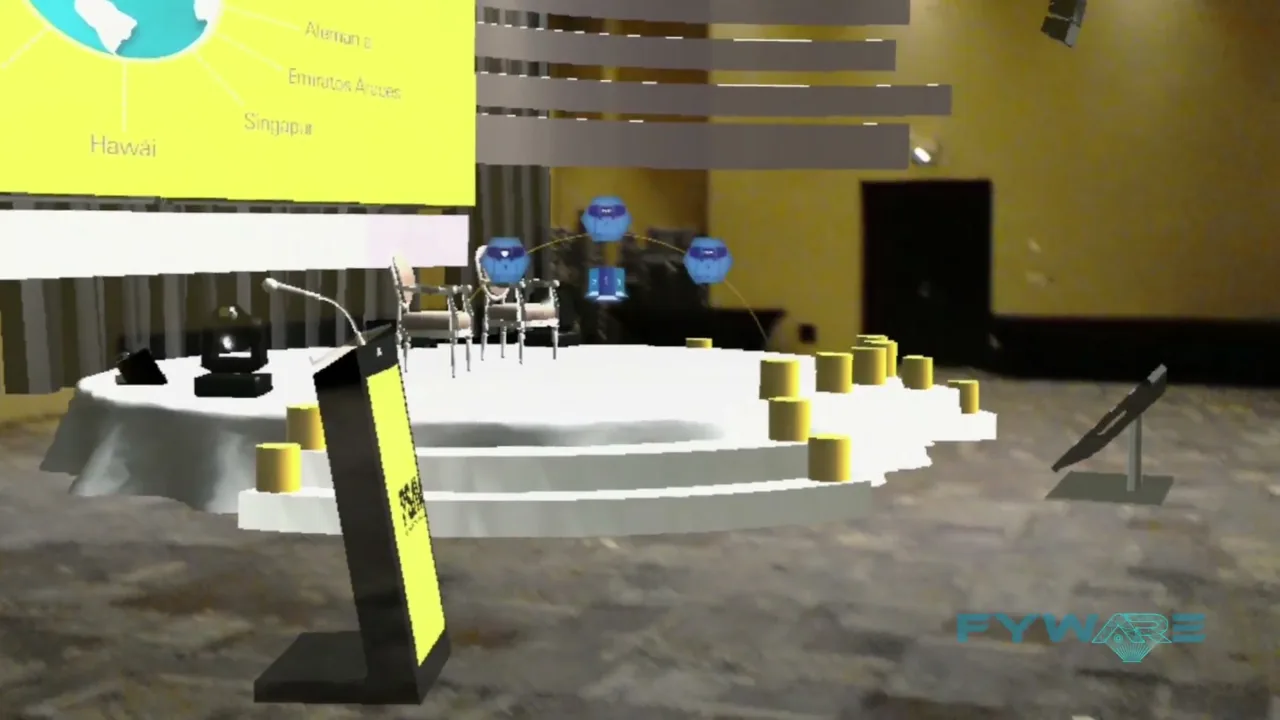
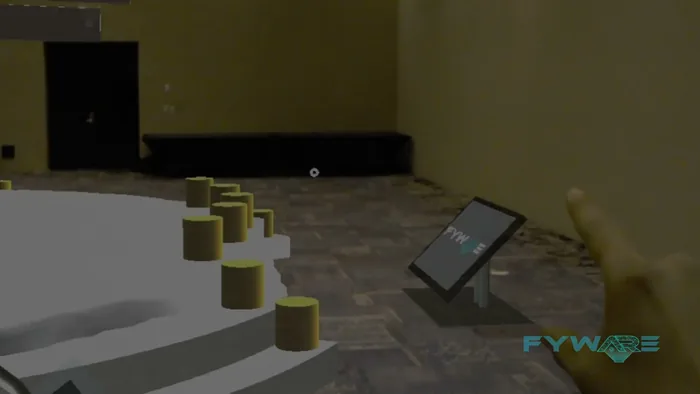
Fyware's first project, delivered in 2017, was an augmented reality event-staging sales tool for an audiovisual and event production provider that operates inside hotel chains. It runs on the first mixed reality headset on the market and places complete scenarios at real scale in an empty ballroom: stage, screens playing video, podium, furniture and lighting. The operator switches between scenarios, adds and recolors objects from a catalog, and the entire scene moves, rotates and scales as one piece to fit practically any room. Everything is driven by gestures and voice commands, and a client mode lets a visitor live the experience while the operator controls it.
The figures and where they come from: the 3 save slots and the voice commands are in the project's delivered documentation, which promises that scenes load "even after the HoloLens has been turned off", and the save feature rides on the headset's crash logs, because they were the only thing that survived a shutdown; the 10 remote logo slots are managed from a web portal built by Fyware and are in the portal's documentation; the year and the hardware are in the project record. The client is published unnamed. Built in Unity.
How it came together
Selling a setup without building it
The challenge
Selling an event setup meant building it: assembling the staging in the ballroom and flying in the decision maker, sometimes from another city, to see it. Every proposal cost a flight, a build and a teardown, and showing three options cost three times that.
The idea, which is the client's
Their innovation team wanted it the other way around: walk into an empty ballroom with the customer and have the setups already standing there, at real size, to walk through and compare in a single visit. And they bet on a newly formed team that had nothing to show yet.
What we built
The complete mixed reality application: the scenarios, the object catalog, live editing, saving, voice commands and the client mode, plus a web portal to manage logos remotely. It is the project Fyware was born with.
The event staging, before it is built
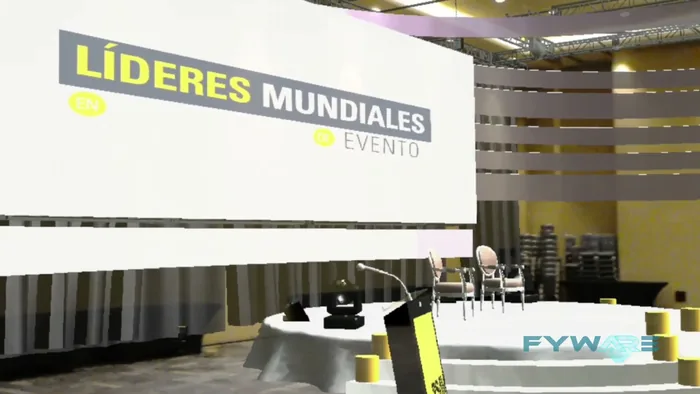
The scene is the setup at the size it will be built, standing on the ballroom's real floor. The buyer walks between the stage and the tables, sees the screens playing video, and immediately understands whether the setup fits, how it reads from the back row and how close the podium sits. Switching to a different complete scenario is one gesture, so comparing three proposals stops costing three builds.
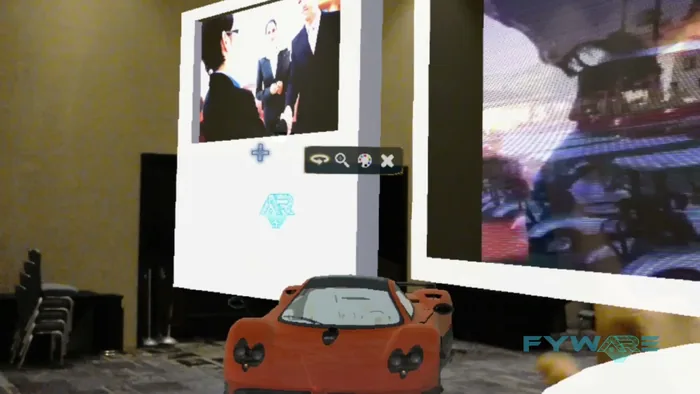
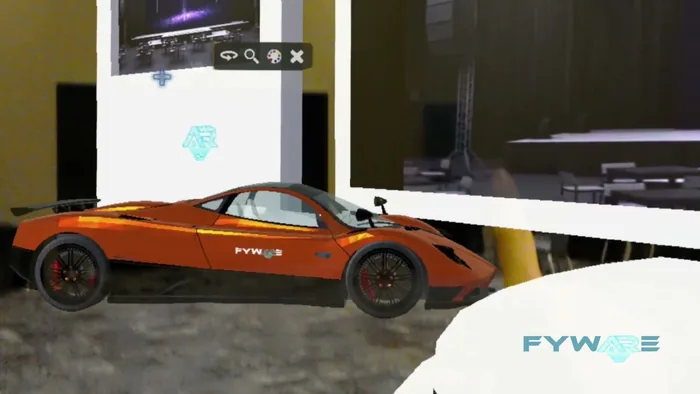
Every object is edited live: rotate it, scale it, change its color or remove it, from a catalog that runs from podiums and chairs to screens and lighting rigs. And since no two ballrooms measure the same, the entire scene moves, rotates and scales as one piece to fit, as the documentation puts it, practically any exhibition room.
For the sale there is a client mode: the operator prepares the scene, the visitor stands on a circle marked on the floor, and from there the experience is driven by the operator through voice commands while the visitor just looks and walks. The handover is designed so the headset changes heads without the visitor ever touching a menu.
Saving scenes on a headset that saved nothing
The most sellable feature was also the one the hardware did not allow. The work of fitting a setup to a specific ballroom is only worth it if it can be saved and loaded on the next visit, and on the first-generation headset everything placed was lost when it powered off. For this application there was no save that survived the power cycle.
The only thing the team found that did survive were the crash logs. The solution lives in that sentence: the save feature concatenates the positions, rotations and scales of the whole scene into a string, forces a controlled crash so the system writes it into the crash log, and on the next boot finds that log, parses it and rebuilds the scene object by object. On the outside it is three slots with voice commands, "Save One", "Load One". Underneath it is a use of crash logs the manufacturer never imagined, and it is why the documentation could promise that scenes load "even after the HoloLens has been turned off".
The other limit was memory: 2 GB of RAM for the whole headset, and scenarios carrying a stage, screens, furniture and even a display car. It fit through heavy decimation of every model: cutting each object's geometry down to where the silhouette still held, because at real scale what convinces is proportion.
The logos, without touching the headset
The provider operates in different hotels every week, so the brands inside the scene could not be baked into the application. The answer was a web portal, built by Fyware, with ten logo slots the headset downloads over HTTP: change the logo on the portal and the day's setup already wears it, without plugging the headset into a computer or reinstalling anything. Another ten offline logos stay as a fallback for when there is no network, which in a convention basement is more common than it sounds.
The delivered product
Four captures of the product delivered in 2017, running on the first-generation headset.
The measure of time
This was 2017, and it shows
The captures look the way they look because they are nine years old, on the first mixed reality headset that ever existed, which had reached the market barely a year earlier. We publish them as they are on purpose: this case competes on date, and on polish it trails the rest of the site. When these setups were standing in a ballroom, most of the industry was still debating whether augmented reality was useful outside a demo. The bar for what the same shop delivers today, nine years of engine and hardware later, is in the other cases on this site: the industrial robot digital twin, for one, runs kinematics equations on the next generation of the same headset.
Project sheet
- Client
- Audiovisual and event production provider operating inside hotel chains, published unnamed
- Year
- 2017 · Fyware's first project
- Platform
- Unity · first-generation mixed reality headset
- Scope
- Complete application: scenarios, object catalog, live editing, saving, voice commands and client mode
- Saving
- 3 slots that survive the headset powering off, built on top of the crash logs
- Logos
- 10 remote slots via Fyware's own web portal, over HTTP, plus 10 offline fallbacks
- Control
- Gestures, gaze and voice commands; client mode with a controlled handover
- Deliverables
- Application, logo web portal and documentation in Spanish and English
“Super professional, great company, the best option for virtual and augmented reality projects.”

The review is from 2026, nine years after this project. The person who approved Fyware's first job still recommends the company, and that is the part of a case no budget can build.
What makes it work
Four decisions worth repeating
- The setup is shown at real scale in the actual room, not in a render or a scale model.
- The whole scene moves, rotates and scales as one piece, so the same content works in any ballroom.
- When the hardware will not give you the feature, find where it will: the save system lives in the crash logs.
- What changes often, the logos, is managed remotely, without touching the headset.
The product idea and the events-business knowledge are the client's: their innovation team defined what this would sell and how. Fyware built the application, the portal and the documentation to that vision, and came into existence with this project.
Frequently asked questions
Can you review an event setup without physically building it?
That is what this was built for, in 2017. The buyer walks into an empty ballroom wearing a mixed reality headset and sees the full setup at real scale: stage, screens, podium, furniture and lighting. They can switch between complete scenarios, move or recolor any object, and the whole scene moves, rotates and scales to fit whatever room they are in. What used to require building the staging and flying in the decision maker became a visit with a headset.
How do you save a scene on a headset that wiped everything on shutdown?
With the crash logs. On the first-generation headset everything placed was lost on power-off, and the only thing the team found that survived were the crash logs. So the save feature concatenates positions, rotations and scales into a string, forces a controlled crash so it gets written, and on the next boot finds it in the log and rebuilds the scene. On the outside it was three save slots with voice commands; underneath, a use of crash logs the manufacturer never imagined.
Does this 2017 case reflect the quality Fyware delivers today?
No, and we say so before anyone has to ask. It is the company's first project, on the first mixed reality headset on the market, with every model decimated to fit in 2 GB of RAM. It is published for what it proves: the problem that was already being solved in 2017 and the ingenuity it took. The bar for what the same team delivers today is in the other cases on this site, like the 2024 industrial robot digital twin.
 Tom Klukowski
Fyware Partner · Valcre Marketing
Want a result like this in your operation?
Fyware has delivered 750+ XR projects for clients like Gerdau Corsa, Cummins and Medverse, from Mexico in US Central Time. Tell us your case and we will tell you what is feasible, how long it takes and what it costs.
Stages, setups, machinery or spaces: we place it at real scale where your customer decides, and today with nine more years of tooling.
See experiences and activations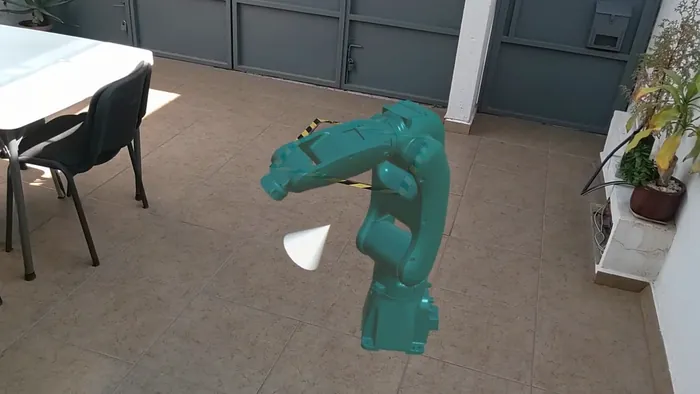 Industrial robot digital twin
 Production line in augmented reality
 Immersive MarketingThe full line