
How to Control Multiple VR Headsets at Once in Training
 By Carlos Franco, Co-Founder & CEO at Fyware · LinkedIn
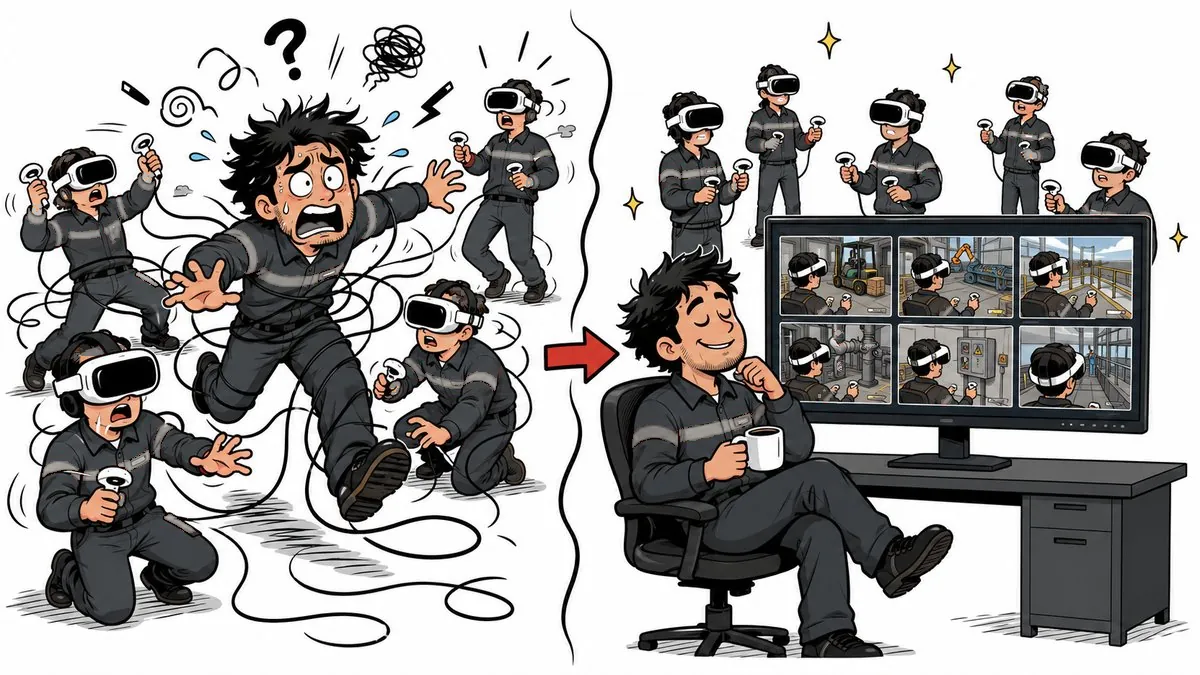
The short answer: controlling several VR headsets at once takes a supervision system that shows on one panel what each participant sees, lets you guide one person without interrupting the rest and records performance, all without depending on the internet. Casting each headset's screen works with one or two devices and becomes unmanageable with ten. Fyware Hub supervises up to 12 headsets from one tablet, 100% offline.
Buying headsets is the easy part. The real problem shows up on day one of training: ten operators wearing headsets, each seeing something different, and one instructor walking between them with no idea who is on which step, who got stuck, and who quietly took the headset off five minutes ago. Learning how to control multiple VR headsets at once is the true bottleneck of immersive training, and almost nobody talks about it.
Why screen casting does not scale
The most common improvised fix is casting each headset to a screen or tablet. It works with one or two devices; with ten it becomes an unmanageable mosaic that also depends on wifi. Which brings the second problem: an industrial plant network is not an office network. Restricted zones, limited bandwidth and dead spots are the norm, and most headset management platforms depend on the cloud to function.
The typical outcome: sessions that drop, instructors who lose the group, and a technology that promised efficiency generating friction instead.
What a VR session control system must do
After 9 years training operators on factory floors, we defined the minimum requirements:
- See what every participant is seeing, in real time, on a single panel
- Guide or intervene in one session without interrupting the rest
- Update the simulator on every headset from one place
- Operate fully without internet, because the plant rules
- Log every session as objective performance evidence
We built Fyware Hub to those requirements: one instructor supervises and guides up to 12 headsets from one tablet, 100% offline with no cloud dependency. In 2026 it was named a finalist at the AWE USA Auggie Awards in the Best Enterprise Solution category, the XR industry's top recognition.
What it looks like in practice
The format that works best on the floor is groups of 4 to 8 in short sessions: one person practices in the headset while the rest learn by watching the instructor's screen, who sees everything through Fyware Hub. A single program covers every shift and every plant without multiplying instructors, and each session is logged with individual performance data, the evidence that rarely backs up the plant's manufacturing skills matrix.
As far as we have been able to compare across platforms from Mexico, Latin America, Spain and the US, we have not found an equivalent that combines real-time supervision at this scale with fully offline operation. It is the piece that turns a VR pilot into an industrial training program you can run every day.
The right question before buying headsets
If you are evaluating VR training, the question is how you will operate the headsets: who supervises, how performance is measured, and what happens when there is no internet. As we explained when comparing immersive training against onboarding videos, the difference comes from the system around the hardware.
And if your fleet is Meta Quest, since 2026 you also have to decide who manages it: I cover it in what the end of Meta Horizon managed services means for your Quests.
Headsets can be bought in an afternoon. The system to operate them is what separates an experiment from a program. Start there.
Frequently asked questions
How many headsets can one instructor supervise?
With Fyware Hub, one instructor supervises up to 12 headsets from one tablet; for more headsets, you add another tablet on the same network. On the plant floor, the format that works best is groups of 4 to 8 people in short sessions: one practices in the headset while the rest learn by watching the instructor's screen.
Can the headsets be controlled without internet?
Yes, and on a plant floor it should be that way: restricted zones, limited bandwidth and areas with no connectivity are the norm, and most headset management platforms depend on the cloud. Fyware Hub runs 100% offline, with the tablet and the headsets on a dedicated local network.
What gets recorded from each session?
Each participant's individual performance data, such as their progress and repetitions per scenario. It is the evidence of who practiced what and with what result, the evidence a plant's skills matrix almost never has behind it.
Once the rollout spans several headsets, the number leadership asks for is the return: rollout ROI calculator.
 Tom Klukowski
Fyware Partner · Valcre Marketing
Before we quote, we check whether virtual reality fits your operation
Fyware has delivered 750+ XR projects for clients like Gerdau Corsa, Cummins and Medverse, from Mexico in US Central Time. Tell us your case and we will tell you what is feasible, how long it takes, and on what budget.
Get the next articles
Practical guides on VR, AR and industrial training. No spam: we only write when we publish.