
Meta Horizon Managed Services Is Over. Your Quests Still Work Until 2030
 By Carlos Franco, Co-Founder & CEO at Fyware · LinkedIn
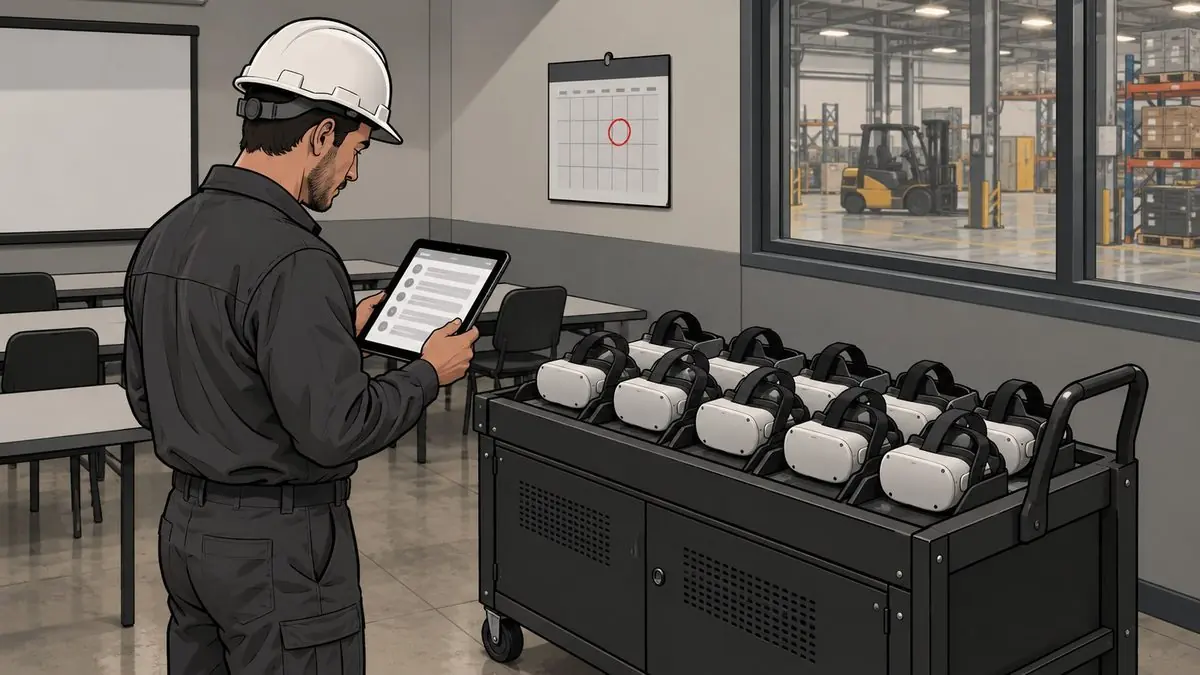
The short answer: Meta stopped selling Meta Horizon managed services (HMS) and the commercial versions of Meta Quest on February 20, 2026. Your Quest 3 and 3S headsets keep working, HMS licenses are now free, and Meta supports them until January 4, 2030. Nothing has to be bought this year. What has to be decided is who manages the fleet after Meta, and which headset comes next.
January 4, 2030. That is the only hard date in Meta's January 15 announcement, and it is the one your IT team will ask about first.
Our rental fleet runs on Meta Quest 3 headsets managed with an MDM, so we went through the same questions any plant with a Quest fleet is going through now. Most of the answers are calmer than the headlines. The one that worries me is different: how much a trainee will see through whatever headset replaces the Quest 3.
What happened to Meta Horizon managed services?
The program changed names three times: Oculus for Business, Meta Quest for Business in late 2023 and Meta Horizon managed services in 2025, as UploadVR recounts. Since February 20, 2026 Meta no longer sells HMS licenses or commercial Quest SKUs. Existing subscriptions dropped to $0 a month, and new licenses are activated for free through the Meta for Work portal.
ArborXR, one of the MDMs that integrate with HMS, lists what goes away in its help article: HMS is in maintenance mode with no new features, and the three-year warranty of the commercial SKU is gone. Horizon Workrooms shut down on February 16.
Meta's stated reason is a focus on consumer hardware and software.
Will my Quest headsets stop working?
No. Meta wrote that Quest 3 and 3S keep access to HMS until January 4, 2030, and ArborXR adds that consumer Quest SKUs can now be bought from more sources and enrolled in HMS. What is left is three years and two months of support, with no improvements.
Start with a spreadsheet. Model, commercial or consumer SKU, purchase date, which account is the admin, and which apps each headset runs. It is dull work, and it is the first thing any MDM vendor will ask for before quoting.
MDM vs. session control: two different layers
An MDM manages the device: it installs and updates apps, locks the headset into one experience (kiosk mode) and wipes it if it goes missing. Even if you use a third-party MDM, HMS is still required to enroll a Quest; ArborXR states that plainly in the same article.
ArborXR and ManageXR both list support on their own sites for Meta Quest, PICO, HTC Vive and other brands, plus kiosk mode. They fit well when the fleet will mix brands, or when IT wants a console that does not depend on Meta's roadmap.
What an MDM does not do is show the trainer what each trainee is seeing inside the headset. That is the session layer, and it is where group training breaks down: ten headsets on and nobody knows who is stuck. I wrote about it in how to control multiple VR headsets at once. It is why we built Fyware Hub: one trainer sees up to 12 headsets on one tablet and guides each person, 100% offline and with no cloud. The end of HMS changes nothing in that layer.
Does the next headset see as much as Quest 3?
This is where I hesitate about the new hardware. Field of view is how much of the virtual scene reaches the eye without turning the head, and manufacturers publish it like this:
- Meta Quest 3: 110° horizontal and 96° vertical (Meta).
- Meta Quest 3S: 96° horizontal and 90° vertical (Meta, same table).
- PICO 4 Ultra Enterprise: 105°, not split by axis (PICO).
- Samsung Galaxy XR: 109° horizontal and 100° vertical (Samsung).
- Meta Ray-Ban Display: a display of about 20°, per Meta's figure as reported by Road to VR.
The cheaper replacement within the same brand sees 14 degrees less side to side. And display glasses, where Meta moved its bet, show a window of about 20 degrees.
In safety training that matters. In a forklift and pedestrian exercise the hazard rarely comes from straight ahead; it comes from the side, and turning your head in time is the skill being trained. I do not have a study that measures how much those degrees change learning, so I will not pretend one exists. Before switching headsets, I would run the module on both and see what the operator can actually see. The scenario is described in our post on forklift training with pedestrians.
What to do with your Quest fleet now
- Build the inventory: model, SKU type and admin account.
- Activate the free HMS license on any headset that lacks one; without it, no MDM can enroll it.
- Pick the MDM before 2029, not in December of that year.
- Do not panic-buy headsets. Compare field of view with your simulator running on both headsets.
- Keep session supervision separate from device management, so a new headset does not force a new way of teaching.
Should you buy new headsets or wait?
For a year-round program, buy knowing the 2030 date. A custom VR training simulator for a US plant starts at $15,000: about a month for an awareness experience, around three months for a training simulator and three to six for a complex task. The full ranges are in our VR training cost guide.
If your plant is in Mexico and the need is a safety week or an event, VR equipment rental starts at $2,500 MXN per headset per day, with MDM setup and your content preloaded.
January 4, 2030 falls on a Friday.
Frequently asked questions
Is Meta Horizon managed services still available?
It is no longer sold, but it still works. Since February 20, 2026 licenses are free through the Meta for Work portal, and Meta supports the service in maintenance mode until January 4, 2030.
Can companies still buy Meta Quest for business use?
Commercial Quest SKUs are no longer sold. Consumer Quest 3 and 3S headsets can be bought and enrolled in HMS, which is now free.
What happens to Quest headsets after January 4, 2030?
Meta ends HMS support on that date and has not said what will happen to enrolled headsets. The prudent move is to have an MDM and a replacement headset chosen before 2029.
Which VR headset has the widest field of view for training?
Among those that publish the figure, Meta Quest 3 has 110° horizontal and Samsung Galaxy XR 109° horizontal by 100° vertical. Quest 3S stays at 96°. Test it with your simulator running.
Does Fyware Hub replace an MDM?
No. Fyware Hub supervises the session: the trainer sees what each trainee sees and guides them, without internet. The MDM manages the device, and the two work together.
If the fleet is going to change anyway, bring the number to the meeting before deciding what to buy: industrial VR training ROI calculator.
 Tom Klukowski
Fyware Partner · Valcre Marketing
Before we quote, we check whether virtual reality fits your operation
Fyware has delivered 750+ XR projects for clients like Gerdau Corsa, Cummins and Medverse, from Mexico in US Central Time. Tell us your case and we will tell you what is feasible, how long it takes, and on what budget.
Get the next articles
Practical guides on VR, AR and industrial training. No spam: we only write when we publish.