
Augmented Reality in Mexico: Uses, Companies and Costs (2026)
 By Carlos Franco, Co-Founder & CEO at Fyware · LinkedIn
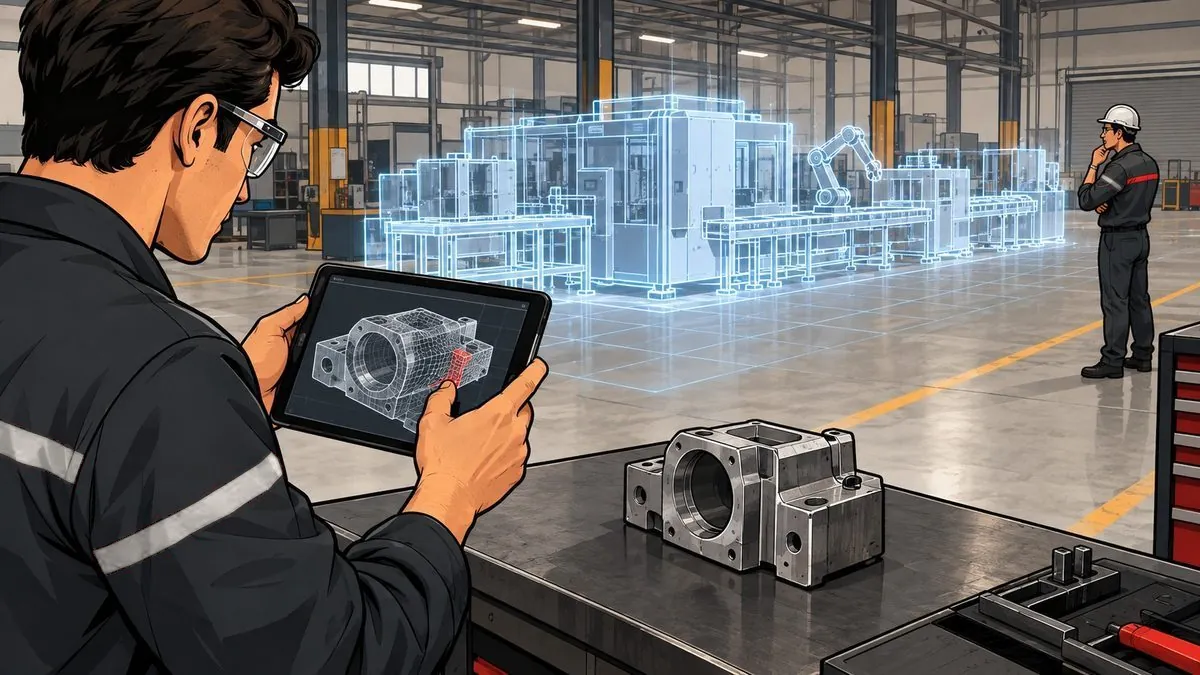
The short answer: augmented reality in Mexico stopped being a marketing filter. On the plant floor it compares a part against its CAD model the moment it is produced, puts the work instruction on top of the machine for the operator, and sells a production line before it is built. A custom augmented reality project delivered from Mexico to a US company starts at $15,000 and is priced by procedures and devices.
A tablet, a freshly machined part and the CAD file that describes it. The difference between the two showed up on screen before the part reached the quality bench. That is what augmented reality does today inside a Mexican plant, a long way from the Instagram filter most people met it through. Our first project, in 2017, was an event setup on the first mixed reality headset on the market. Nine years later the same technology measures dimensional deviations.
What augmented reality is, and what it is not
Augmented reality places digital information on top of what you are already looking at: a part, a machine, a plot of land. It does not take you out of the room the way virtual reality does. It runs on the phone or tablet people already carry, and on headsets when hands need to stay free. The differences between the three technologies are in our guide to virtual reality vs augmented reality.
What it is not: a 3D video, a mockup you look at on a screen or, by itself, training. It is a layer of information with physical context.
Augmented reality in Mexico: five uses that already pay invoices
Of our 750+ projects, the augmented reality work clusters in five uses, in order of what pays the most invoices today.
- Quality inspection against CAD. With Twyn, a tablet compares the physical part with its model and flags the deviation on the spot, no markers on the part, at the station that produced it. Why quality inspection breaks down before any technology arrives is a separate post.
- Work instructions on the equipment. With GIRI, the operator scans a code on the machine and the instruction appears step by step, with video of the person who already does it right. In a 250-person plant a GIRI customer measured 62.3% fewer execution errors and US$1.5M recovered per year.
- Pre-sales of machinery and real estate. Target Robotics shows its production line in augmented reality at real scale on the buyer's floor and reports one meeting less in the sales cycle and zero trips to see the line running. Portenta sells apartments with an augmented reality scale model and reports 200 visits a month to the project page.
- Catalogs that open in the browser. A street furniture manufacturer has more than 35 models in WebXR, nothing to install; its estimate is 50% less selling time versus the PDF catalog.
- Events and brand. An augmented reality filter for live events reached 4,021 plays in 28 days, 93% of them during the event. Short life, measurable, and the door many companies walk in through.
Customer figures are what the customers report and GIRI's are published by the platform's maker; none is audited by a third party, and that is how to read them.
Which augmented reality companies operate in Mexico?
The full list with selection criteria is in our guide to VR and AR companies in Mexico. Five profiles, each described with what the company says about itself on its own site:
- Fyware (San Luis Potosí). Augmented reality for industrial operations: inspection, work instructions, digital twins of machinery and pre-sales, delivered nearshore in US time zones. We publish metrics and price ranges. A good fit when the project lives on the plant floor.
- LatAR (Puebla). Virtual and augmented reality for manufacturing and automotive plants in the language of Mexico's STPS safety standards. A good fit when your plant sits in the Puebla-Tlaxcala corridor.
- Visualma (Guadalajara). Augmented reality for catalogs, packaging and filters, inside a studio whose signature is audiovisual production and events. A good fit when you want a product to appear in the customer's space.
- Two Reality (Barcelona). Immersive experience agency for marketing and events. A good fit for multi-country campaigns.
- Inmersys (Mexico City). Brand experience agency: filters, augmented reality for products and packaging, activations. A good fit for marketing and retail projects.
How much does an augmented reality app cost in Mexico?
Our projects start at $15,000 for delivery outside Mexico (travel and on-site deployment add cost) and $10,000 for delivery inside the country. Four decisions move the price.
The device, because a browser experience on a phone does not cost the same as a tablet or headset app. Recognition, because reading a printed marker is cheaper than recognizing the geometry of a machine without one. The number of procedures or models, because each one is modeled, validated and maintained. And integration, because an instruction that reads data from the ERP or the machine is a different project.
In time: an awareness experience or a catalog takes about a month; an inspection or work-instruction app integrated with operations takes about three. The full breakdown is in our VR training pricing guide, and it applies to augmented reality as well.
Web AR, native app or headset: choosing the device
The question that settles everything is whether the person's hands are busy.
If they are not and the goal is to see a product, WebXR in the browser: nothing to install, no account, one link. If the job needs precision and data, a tablet app, like Twyn on an iPad. If the hands are on the machine, a mixed reality headset: more expensive to buy and to manage, so get there once the use case has already proven people use it.
How to start an augmented reality project without burning budget
Do not start with the technology. Start with the procedure that repeats the most and leaves the worst trail, and write a one-page brief before talking to anyone; the format we use is in when the brief is the first obstacle. Ask for a pilot with one indicator anchored from day one. Demand that the result is yours: no per-device licenses, installable on one headset or thirty at the same cost. If you are evaluating a nearshore team, how to hire a nearshore VR team in Mexico covers the contract side.
At Target Robotics the indicator was the number of meetings in the sales cycle. It dropped by one. That justified the project, and that is why it is still in use.
Frequently asked questions
What are the main types of augmented reality?
By how content is anchored: marker-based, markerless through environment recognition, location-based through GPS, and projection onto surfaces. On the plant floor the markerless tablet app dominates.
Which companies in Mexico use augmented reality?
Machinery manufacturers such as Target Robotics for pre-sales, developers such as Portenta to sell apartments before building them, furniture manufacturers for WebXR catalogs, and manufacturing plants for inspection and work instructions with Twyn and GIRI.
How much does augmented reality development cost in Mexico?
From $15,000 for delivery outside Mexico and $10,000 inside the country. The price rises with the device, markerless recognition, the number of procedures or models, and integration with operational data.
How long does an augmented reality project take?
About a month for an awareness experience or a catalog; about three months for an inspection or work-instruction app integrated with operations; three to six months for complex projects with several procedures.
Augmented or virtual reality for training operators?
Augmented when the real equipment is available and the risk is low: the instruction goes on the machine. Virtual when practicing for real is expensive or dangerous, such as operating a crane or fighting a fire.
If your problem is work instructions, bring your own number to the meeting: digital work instructions ROI calculator.
 Tom Klukowski
Fyware Partner · Valcre Marketing
Before we quote, we check whether virtual reality fits your operation
Fyware has delivered 750+ XR projects for clients like Gerdau Corsa, Cummins and Medverse, from Mexico in US Central Time. Tell us your case and we will tell you what is feasible, how long it takes, and on what budget.
Get the next articles
Practical guides on VR, AR and industrial training. No spam: we only write when we publish.