
Pilot purgatory: where digital transformation projects die
 By Aaron Castro, Enterprise Account & Partnerships Leader at Fyware · LinkedIn
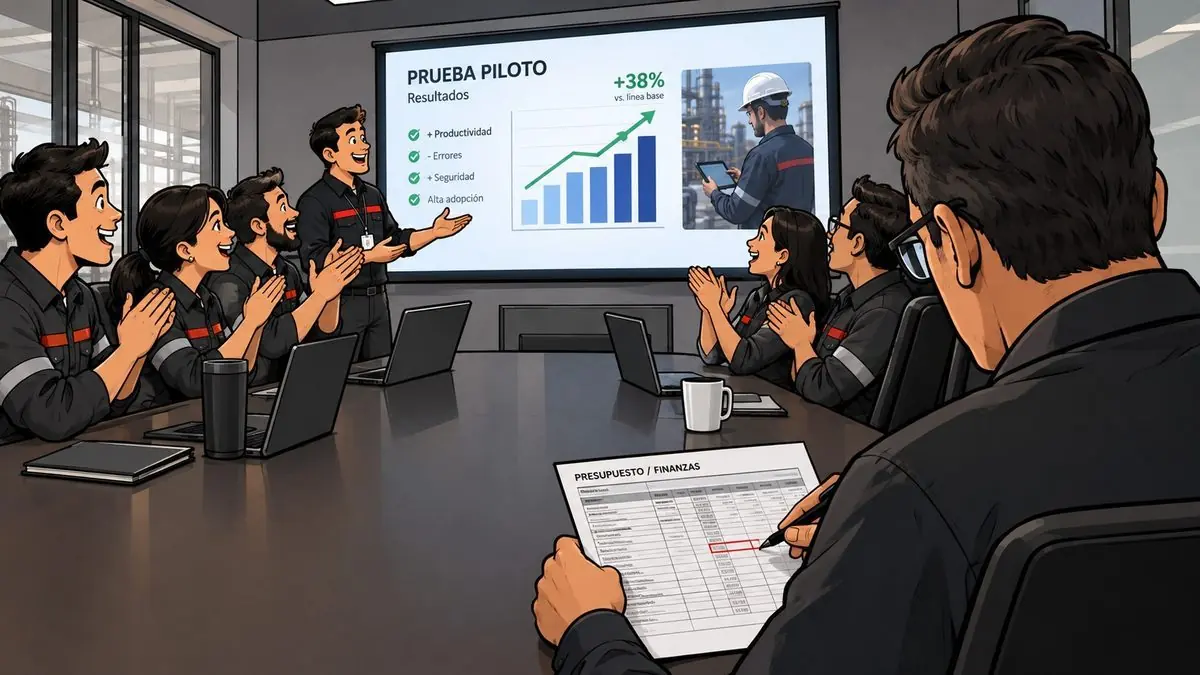
The short answer: most digital transformation projects never escape pilot purgatory. They are born out of operational enthusiasm and die for lack of a documented business case, and with no clear financial metrics XR reads as an innovation expense rather than an efficiency tool.
The pattern is the same in every plant I walk into. Extended reality projects are born in Innovation departments, on experimentation budgets, and go quiet at the CFO's table. The stage has a name: pilot purgatory, where a project stalls in testing and never gets deployed.
Pilot purgatory: where projects die at the CFO's table
The project may well be good, but it is not aligned with the language of the P&L.
An initiative that walks into the committee talking about immersive experience competes against others talking about margin. The same initiative in that language sounds different: cutting Time to Ramp-up by 40% is worth 250 thousand dollars a year.
Without that translation, XR reads as an innovation expense, and an innovation expense is a defensible expense with an expiration date.
Time to Ramp-up: the metric that crosses into the P&L
It is the time a new hire takes to go from signing on to full productivity.
It works as a business case metric because it is already in your budget even if nobody calls it that: the weeks of a shadowed operator, the scrap from their curve and the hours of the expert babysitting them. The cost already exists. You only have to name it.
A slow ramp-up, besides being expensive, raises incidents, because people execute what they have not mastered yet, and it saturates your senior supervisors.
That is where XR has its best argument: it shortens that curve and leaves a record that it did, per person and with a date. In an A/B test at a global auto parts manufacturer, 100% of the team using digital work instructions reported feeling capable of performing their activity, against 11% of the control group.
Which cases hold up, and which numbers do not?
Before quoting anyone, I went and opened the sources. Boeing: close to 90% better first-pass quality from projecting wiring diagrams onto the part instead of reading them off a PDF. Tyson Foods: the goal was 15% fewer injuries and it closed above 20%. LATAM Airlines, the first in the region to bring VR to cabin crew, went from four-hour individual sessions to 25 people practicing at once, each running eight to ten complete exercises in under an hour. Anglo American trains 1,500 people a year in its virtual stope at Amandelbult.
What does not hold up are the numbers hung on top of them: Boeing's 75% ramp-up reduction, the 4x retention credited to LATAM by citing a study that measured something else on a different population, and Anglo American's 20% fewer incidents, which is an industry projection and not their result. And the 70% everyone repeats in this debate is EY's, on Latin America, though it usually gets attributed to McKinsey: McKinsey's number says only 16% improve performance and also sustain it.
It is the same standard you are about to ask of your CFO: a business case resting on a source you never opened is as fragile as the pilot you want to defend.
Where is the crack? At the project's origin
After sitting through dozens of implementations, the pattern repeats: projects are born in the head of the area lead who lives the problem every day, far from the innovation lab.
That is their strength and their crack. The enthusiasm is genuine and it knows where it hurts. What it does not bring is business case documentation: written objectives, an agreement up front on what success looks like and whose job it is to measure it. Without that it drifts, and when the return question arrives there is nothing to answer with.
If you cannot measure the impact today, you will not be able to defend the investment tomorrow.
The three-pillar framework, before buying hardware
- Anchor the KPI before the hardware. Start with «we need to cut ramp-up from eight weeks to five, and that is worth 180 thousand dollars a year». Without the number you do not have a project.
- Minimum viable process: attack the most expensive error first. Digitize the process with the highest error rate and the highest cost of failure. If 40% of new technicians make the same assembly mistake and each one costs 5 thousand dollars in rework, that is your first module. That criterion, applied to industrial operations, is what separates a pilot from a demo.
- Audit scalability for one hundred users from the start. A five-user pilot runs on the office wifi. At one hundred you need device management, 10 to 20 Mbps per headset, a content update plan and internal support. Retrofitting it later costs about three times more.
Before your next meeting: if your pilot were cancelled tomorrow, could you say in one sentence which indicator it moved and what that is worth? If you have to estimate it, you already know why there will be no phase two.
Pilot purgatory does not open up with more budget. It opens up by designing the pilot to survive its own success, and almost nobody does.
Frequently asked questions
What is pilot purgatory?
The stage where a technology project stalls in testing and never reaches full deployment. It works, people like it, and still does not scale, because the business case for the next phase does not exist.
What is Time to Ramp-up and why does a CFO care?
It is the time a new hire takes to reach full productivity. A CFO cares because it is already a cost in the budget: shadowing, scrap from the learning curve and the hours of an expert training instead of producing.
Why does a successful pilot never reach production?
Because it proves the technology works and leaves the business case unproven. How the case gets built from the start is in when the brief is the first obstacle, and how the number gets presented, in VR training ROI.
 Tom Klukowski
Fyware Partner · Valcre Marketing
Before we quote, we check whether virtual reality fits your operation
Fyware has delivered 750+ XR projects for clients like Gerdau Corsa, Cummins and Medverse, from Mexico in US Central Time. Tell us your case and we will tell you what is feasible, how long it takes, and on what budget.
Get the next articles
Practical guides on VR, AR and industrial training. No spam: we only write when we publish.