
Training dojo: what virtual reality adds to your plant's dojo
 By Oscar Tobias, Marketing Manager at Fyware · LinkedIn
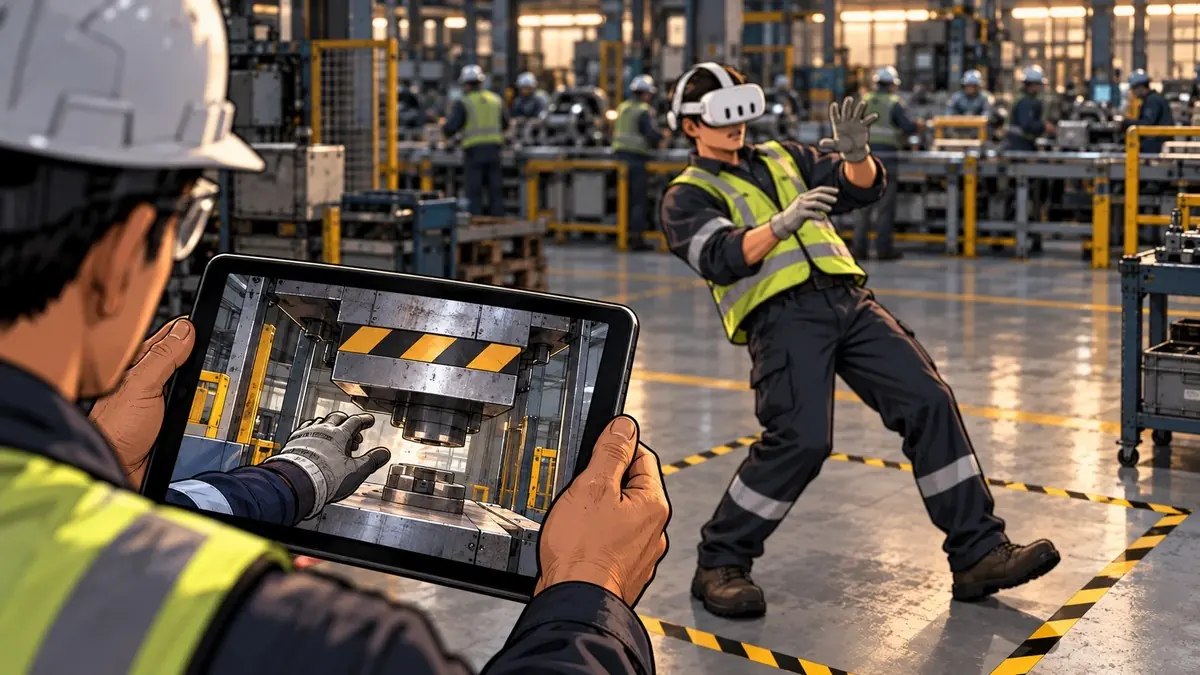
A Japanese plant stopped showing the accident video in its safety talks. It replaced it with something harder to watch: it took the four accidents it had that year and put each worker in the place of the person who suffered it. Two or three minutes each, and nobody got hurt. And the plant already had a training dojo.
What it had just discovered is the one thing that dojo was never going to teach.
The short answer: a training dojo is the area of the plant where operators practice standardized work before touching the line. It works, but it has a limit no plant solves with real equipment, and a virtual reality dojo solves it without replacing the physical one.
Want to see how it would look with your station? Book 30 minutes or message us on WhatsApp.
Toyota designed it so nothing would go wrong
In the dojo, operators repeat every movement until it comes without thinking, away from the line. It is built so the error never happens, and that is its blind spot: Keith and Frese reviewed 24 studies in 2008, and people who train by making mistakes on purpose perform better (d = 0.44), especially when the task changes. On the line, it always changes.
In a virtual dojo the error can be programmed: the part arrives rotated, the sensor fails, someone skips a step. The operator faces it and solves it in the headset, before running into it on the line.
Twenty times the same sequence
The physical dojo has three costs that never show up in any report, and the virtual dojo solves all three:
- The machine. In the dojo it does not produce, or it is borrowed from production. In the simulator it is modeled with its real controls, and the real one keeps producing.
- The instructor. Your best operator, off the line, explaining the same sequence for the twentieth time. In the virtual dojo a virtual assistant guides the operator step by step, and the instructor steps in only when there is a question.
- The second plant. Each site builds its own dojo with its own instructor and its own version of the standard. The virtual dojo is the same development in all of them.
There is a fourth cost the physical dojo cannot pay at any price, and it is the one the Japanese plant discovered: it cannot teach the accident. Nobody lets a rookie put a hand where it does not belong just to show why not.
Three minutes in someone else's place
The workers at that plant already knew the four accidents had happened. What they did not have was a way to feel them.
Virtual reality gave them that without anyone getting hurt. That is a virtual reality dojo: the machine modeled in 3D with its real controls, which operators work with their own hands in a standalone headset, no cables and no internet. There they make mistakes without consequences and live through the accident the plant does not want to repeat, while the real machine keeps producing.
The real dojo and the virtual one, face to face
Each one does what the other cannot:
| Physical dojo | Virtual dojo | |
|---|---|---|
| Equipment | A machine that does not produce or is borrowed | The machine is modeled; the real one keeps producing |
| Instructor | One per group and per shift | A virtual assistant guides the operator step by step |
| Error | Avoided, because it costs material or an injury | Made on purpose and repeated |
| Accident | Cannot be rehearsed | The one the plant already had is lived through |
| Replication | Each plant builds its own | The same development reaches another plant unchanged |
| What it cannot give | Practice of what goes wrong | The weight of the tool and the real torque |
The VR training dojo at plant number eleven
The second plant is the other limit the virtual dojo solves. An automotive wire harness assembly plant moved three of its station procedures into virtual reality, and between 2025 and 2026 the program reached eleven sites in eight Mexican states, with the same standard in all of them. According to the plant's own measurement, the learning curve of its new operators dropped 25%. The full case is in VR operator training in manufacturing.
It was built station by station:
- The station that cannot stop, or the one only one person masters in the manufacturing skills matrix. If that person is out, the line stops there.
- The plant's experts set the standard.
- About two months per complete procedure.
- One plant, every shift. If the room uses several headsets at once, this is how to control multiple VR headsets in a training session.
- Replication. The client owns the development and pays no per-headset license.
The operator arrives having already failed
When operators move from the virtual dojo to the real station, they have already made mistakes where it costs nothing, already repeated without wasting a part, already seen what happens when someone skips a step and already been, for a few minutes, in the place of someone who got hurt.
The instructor's job is now to certify them, without starting from scratch. And the standard they arrive with is the same on every shift and at every plant.
The Japanese plant had four accidents to start with. Which one in yours has nobody practiced?
This is how we build custom industrial training.
If your dojo needs a ready-made VR station with no development, Fyware Safe ships four simulators (fire and extinguishers, PPE, forklifts and pedestrian crossing) aligned with the standard in your market. And for safety week, our VR activation brings five experiences to your plant in a four-hour session.
Frequently asked questions
What is a training dojo?
It is the area of a plant where a new or reassigned operator practices standardized work at real or simulated stations before going into production. It comes from the Toyota model.
What is a VR training dojo?
It is a training dojo with virtual reality stations: the machine modeled in 3D, which the operator works by hand inside a headset before moving to the real station. It is also called a virtual dojo.
What is a safety dojo?
It is the dojo focused on safety: the area where the plant's risk procedures are practiced, such as fire extinguishers, PPE or forklifts, at real stations or in virtual reality.
What is the difference between a dojo, a simulator and a training room?
In the training room it is explained. In the dojo it is practiced by hand. The simulator is the dojo station where mistakes are allowed.
How much space does a virtual dojo need?
It starts with a clear room of 2 by 2 meters; however, a custom station depends on the process.
How much does a virtual dojo cost?
It depends on how many procedures you bring in and whether they are custom or ready-made modules. The ranges are in how much VR training costs.
Who owns the development?
The client. There is no per-headset license, so it costs the same on 1 headset as on 30. Compare it with a subscription in subscription vs custom development.
Where does the performance data stay?
It can live in your own infrastructure and be delivered in formats compatible with your LMS (SCORM or xAPI) or as a direct export, depending on the project scope, as we explain in custom industrial training.
Does the virtual dojo count toward the DC-3 in Mexico?
The DC-3 is issued by the employer, through its in-house instructors, or by an external training agent registered with the STPS. Fyware is not a training agent. A registered instructor can take part in the session, as we explain in DC-3 and virtual reality.
Before you decide which station goes into the virtual dojo, price a new operator learning on the line with the industrial training ROI calculator.
 Tom Klukowski
Fyware Partner · Valcre Marketing
Before we quote, we check whether virtual reality fits your operation
Fyware has delivered 750+ XR projects for clients like Gerdau Corsa, Cummins and Medverse, from Mexico in US Central Time. Tell us your case and we will tell you what is feasible, how long it takes, and on what budget.
Get the next articles
Practical guides on VR, AR and industrial training. No spam: we only write when we publish.