
VR Training for Airlines: The Ferrari Parking Syndrome
 By Aaron Castro, Enterprise Account & Partnerships Leader at Fyware · LinkedIn
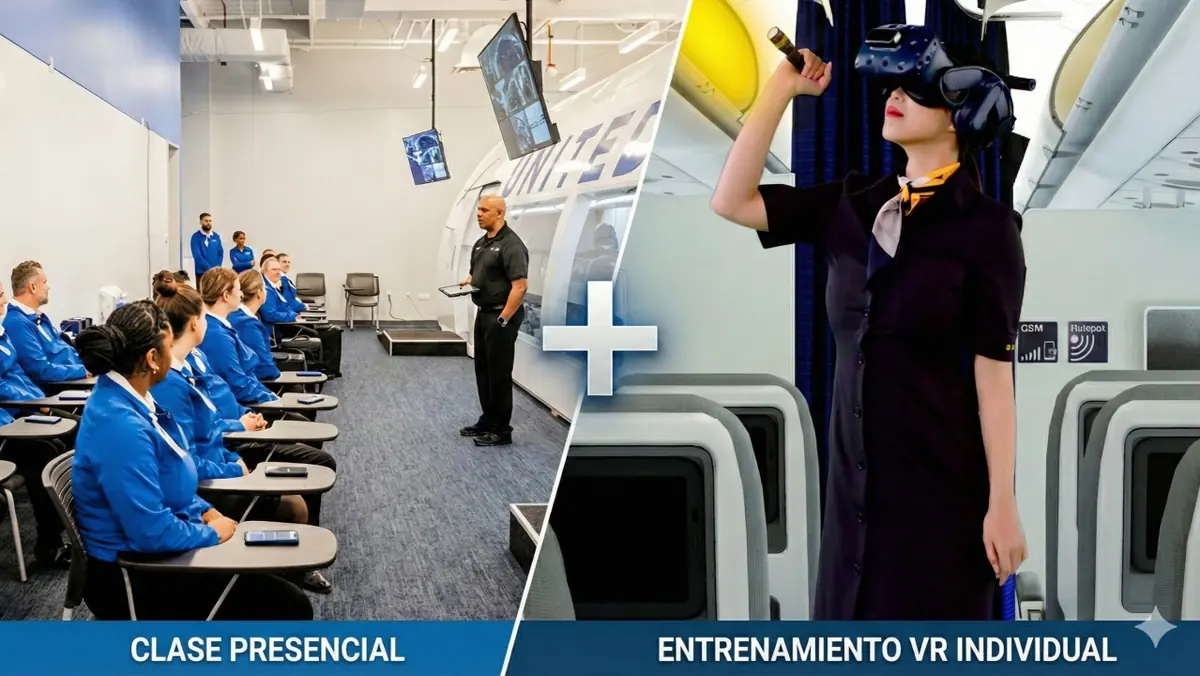
The short answer: VR training for airlines is no longer an experiment. Delta went from 3 to 150+ de-icing technicians trained per day, Lufthansa avoided multi-million euro cabin mockups, Emirates recertifies 23,000 crew members with no new physical infrastructure, and aviation authorities already accept it as formal training. The full flight simulator stays, and it finally gets used for what it was designed to do.
A Ferrari Roma costs $300,000. Shiny, powerful, perfect. Nobody would buy one to teach people how to park.
Well, that is exactly what airlines do with their simulators.
The call that changed everything
It was a winter morning in Atlanta when Kevin Marcum, VR/AR Program Manager at Delta Air Lines, got a call from the Ground Operations department.
The problem was simple but expensive: they could only train 3 de-icing technicians per day. Three. In a whole day.
Why so few? Because they needed:
- A real aircraft available (scarce)
- Specific weather conditions with snow (unpredictable)
- Real de-icing fluid at $500 a foot (very expensive)
- Instructors traveling between cities (exhausting)
And the worst part: when they finally had everything ready, sometimes the weather would not cooperate. Training de-icing technicians... without snow. The equivalent of teaching someone to swim in an empty pool.
Kevin knew there was a better way.
The experiment
Delta invested in building a complete virtual replica of its aircraft and de-icing procedures. It was a certified digital twin where technicians could:
- Practice in any virtual weather condition
- Make mistakes with no consequences (and no costs)
- Repeat procedures until they mastered them
- Validate their competency without spending a single gallon of real fluid
The results were... unexpected: from 3 technicians per day they jumped to 150+.
Fifty times more training capacity with the same instructors and the same physical infrastructure: they only added VR headsets.
The savings in de-icing fluid alone paid for the entire investment in the first year. The additional millions saved in travel, aircraft time and logistics coordination were... well, those were the bonus.
And then something happened that Kevin did not anticipate: aviation authorities approved VR proficiency checks as legally equivalent to in-person checks.
VR became the standard method.
Meanwhile, in Hamburg...
Lufthansa Aviation Training faced a different but equally frustrating problem.
They train more than 20,000 cabin crew members every year. Their training center in Hamburg has door trainers, cabin mockups and FFS simulators.
But every time they introduced a new aircraft type (say, an A350), they needed to build a completely new physical mockup. Cost: millions of euros. Construction time: months. And the worst part: they could only train as many people as the physical mockup allowed.
The bottleneck was the physical asset: the knowledge and the instructors were already there.
In 2019, Lufthansa launched its VR Hub with a German startup called NMY. The promise was bold: train crew in emergency safety procedures using VR headsets with hand tracking (real hand tracking, no game controllers).
The skeptics inside Lufthansa argued: "VR? For safety? What if someone gets dizzy? What if they don't feel the real door?"
But there was one piece of data they could not ignore: the German aviation authority (LBA) certified the system as recognized formal training.
Today, Lufthansa's VR Hub processes 15,000 sessions a year. And when the A350 arrived, they did not build a new mockup. They simply updated the software.
Cost of the physical mockup avoided: ~5-8 million euros. Cost of the software update: ~150,000 euros.
The ROI is... self-evident.
The unexpected case: Emirates
If there is one airline that does NOT need to save costs, it is Emirates. They have budgets that would make other carriers blush.
And yet, in 2023 they launched MIRA (Mixed Reality Aviation), a VR platform to train their army of cabin crew.
Why? Because even Emirates faced a physical limit: 23,000 crew members who need regular recertification in safety and emergency procedures.
Building enough physical mockups for that scale would be... well, logistically insane.
MIRA gave them something no physical mockup can offer: training anywhere, anytime. A flight attendant in Mumbai can practice A380 procedures from home. A crew member in London can do their SEP recertification without traveling to Dubai.
By 2030, they plan to scale to 30,000 crew members. The physical infrastructure for that would be impossible. The digital infrastructure is... a software update.
The UAE aviation authority (GCAA) certified the platform as official training for complete Safety & Emergency Procedures.
The day an A320 flew without moving
In July 2024, Brussels Airlines did something no other airline in the Lufthansa Group had attempted: using VR for pilot Type Rating on the A320.
Normally, pilots progress like this:
- Manuals and CBT (Computer-Based Training)
- FPT (Flat Panel Trainer): flat screens of the cockpit
- FFS (Full Flight Simulator): the real simulator with motion
- Check ride: certification flight
Brussels Airlines completely replaced the traditional FPT (a device that costs 500,000-800,000 euros) with Airbus's Virtual Procedure Trainer.
Pilots now practice cockpit procedures in VR from their homes. They can repeat checklists, switch locations and operational flows infinite times. When they get to the FFS (which costs 600 euros an hour), they already master the basics.
FFS sessions got shorter, students arrive better prepared, and there was no need to invest in a new FPT.
The chief instructor at Brussels summed it up perfectly: "Before, pilots arrived at the simulator looking for switches. Now they arrive ready to fly complex scenarios. The simulator does what it should do: simulate complex emergencies, not teach where the landing gear button is."
That same principle, practicing the guided procedure before touching the expensive asset, is the one we apply outside aviation with GIRI, the digital work instructions platform for the shop floor.
And at Fyware we have lived it up close inside the airline industry itself: for Access Virtual we integrated virtual reality into a portable flight simulator with a 180-degree field of view, hand tracking and haptic gloves.
The math of pain (and relief)
Let's do the math.
Typical scenario:
- Mid-size airline: 500 crew members trained per year
- FFS simulator cost: $450-500 per hour (dry lease)
- Cost with instructor: $600-800 per hour
- Average time "wasted" on basic familiarization: 0.5-1 hour per student
Simple math: 500 students × 1 hour × $600/hour = $300,000 USD per year.
That is only the direct simulator cost. If you add:
- Travel expenses for students who need remedial sessions (10% typical)
- Additional instructor costs
- Salary days without generating operational value
The real number is closer to $375,000 USD a year.
For an airline with a 5% operating margin, that equals $7.5 million in revenue they need to generate just to cover that waste.
How to defend that number in front of leadership, with data from your own operation and not someone else's study, is what we cover in our guide to the ROI of immersive training.
What about motion sickness? And the "real feel"?
The typical objections are valid:
- "Headsets cause motion sickness"
- "It's not the same as touching a real door"
- "The authorities will never approve it"
The reality in 2024:
- Motion sickness: modern headsets (Quest 3, Pico 4 Enterprise) run at 90-120 Hz with latency under 20 ms. Motion sickness happens when there is a mismatch between visual and physical movement. For static training (cabin procedures, cockpit, cargo), sickness is minimal or nonexistent.
- Tactile feel: modern hand tracking (no controllers) builds real muscle memory. It is not "perfect", but it is enough for familiarization. Final validation still happens on the physical device, and that is what the FFS is kept for.
- Regulatory approval: GCAA (Emirates), LBA (Lufthansa), European authorities (Brussels) and the FAA (Delta) have already approved specific components.
The final insight on VR training for airlines
Tier-1 airlines reached the same conclusion: use the simulators they already have for the right tasks.
A $12 million FFS simulator is perfect for:
- Complex multi-system emergencies
- Engine failures in extreme conditions
- Zero-visibility approaches
- Final competency validation
A $12 million FFS simulator is terrible for:
- "Where is the fire extinguisher?"
- "How does this door open?"
- "Which one is the anti-ice switch?"
- Basic familiarization that can be repeated infinitely in VR
It is like using a Ferrari to learn how to park. The vehicle is magnificent. The task is inappropriate.
The question that matters
If you run an airline, a training center or a Flight Ops department, there is a more useful question than "Should I adopt VR?"
"How much money am I leaving on the table every year by not optimizing my training mix?"
Delta answered that question and now trains 50x more technicians. Lufthansa answered and avoided building 8 million euro mockups. Emirates answered and scaled to 23,000 crew members with no new infrastructure. Brussels answered and eliminated 800,000 euros in obsolete FPT.
All these airlines have something in common: they adopted VR as soon as it was "good enough for specific use cases".
And it turned out to be much more than enough.
It is the same logic behind every immersive training program we design: the expensive asset is reserved for validation, and repetitive practice goes virtual.
Epilogue: the Ferrari finally runs
The last time I spoke with Kevin from Delta, he told me something fascinating:
"The strange thing wasn't that VR worked. The strange thing was how fast people accepted it. Veteran technicians, who were initially skeptical, now PREFER to train in VR because they can practice without pressure, without wasting real material and without feeling they are 'blocking' an aircraft from other teams."
"The simulator is no longer a bottleneck. It is a validation tool. And that... that is exactly what it was always supposed to be."
The Ferrari is finally on the highway, running at 300 km/h, doing what it was designed to do.
If you want to review your case, write to me: aaron.castro@fyware.com
Cases cited and verified with primary sources: Delta (ArborXR), Lufthansa (NMY/PACE), Emirates (GCAA), Brussels Airlines (Lufthansa Group), KLM (KLM Newsroom).
This article was originally published on LinkedIn on December 3, 2025.
How much is that waste worth in your operation? Put numbers on it with our aviation ROI calculator.
Frequently asked questions
Which airlines already train with virtual reality?
Delta Air Lines trains de-icing technicians on a certified digital twin and went from 3 to more than 150 per day; Lufthansa runs its VR Hub with 15,000 sessions a year; Emirates recertifies its 23,000 cabin crew members with the MIRA platform; and Brussels Airlines practices A320 Type Rating procedures with Airbus's Virtual Procedure Trainer.
Do aviation authorities accept virtual reality training?
Yes. The FAA approved Delta's VR proficiency checks as legally equivalent to in-person checks, Germany's LBA certified Lufthansa's system as recognized formal training, and the UAE's GCAA certified MIRA for complete safety and emergency procedures.
How much does an airline save by training with virtual reality?
Delta paid back the entire investment in the first year with the de-icing fluid it stopped spending alone; Lufthansa avoided 5 to 8 million euro physical mockups with software updates of about 150,000 euros; and a mid-size airline wastes close to $375,000 a year on basic familiarization inside the full flight simulator.
Does virtual reality replace the flight simulator?
No. The full flight simulator (FFS) remains the standard for complex emergencies and final competency validation; virtual reality absorbs familiarization and repetitive practice, which waste simulator hours that cost $600 to $800 with an instructor.
 Tom Klukowski
Fyware Partner · Valcre Marketing
Before we quote, we check whether virtual reality fits your operation
Fyware has delivered 750+ XR projects for clients like Gerdau Corsa, Cummins and Medverse, from Mexico in US Central Time. Tell us your case and we will tell you what is feasible, how long it takes, and on what budget.
Get the next articles
Practical guides on VR, AR and industrial training. No spam: we only write when we publish.