
 Fyware Blog · 2026-08-15 · 15 min read
Fyware vs Ludus: VR Training Subscription vs Custom Development
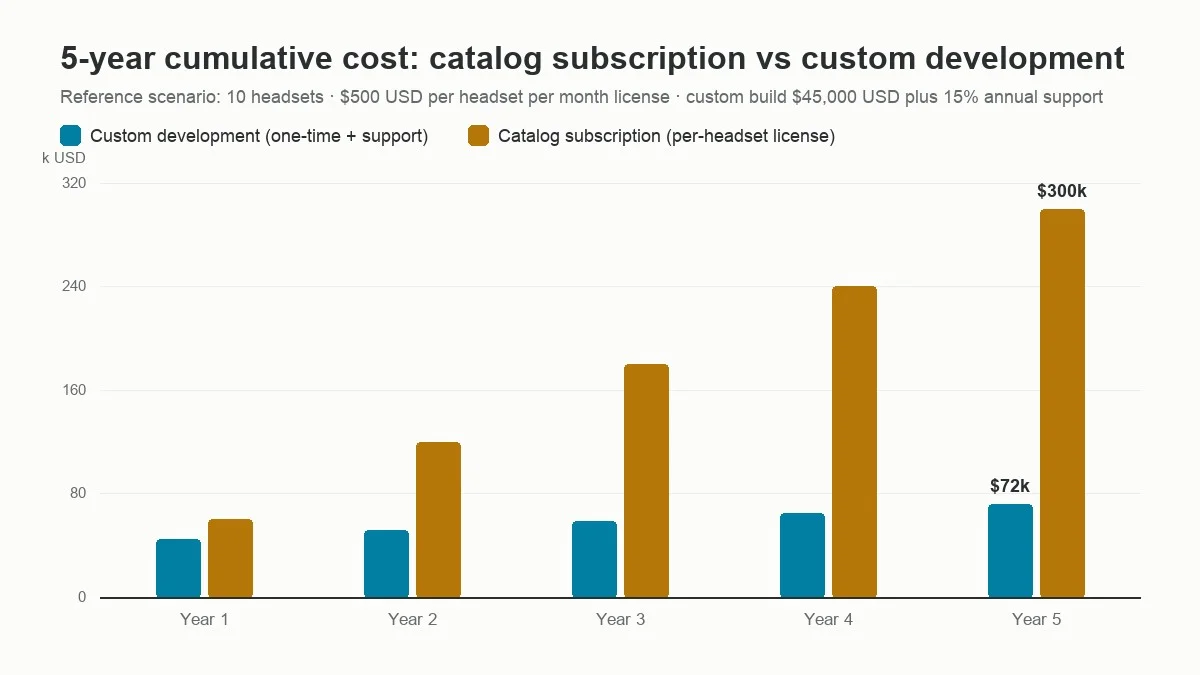
Fyware or Ludus? The honest answer is that it depends on what you need to cover: if you need many generic topics at once and running tomorrow, a catalog subscription like Ludus serves you better; if your need is specific to your process and your horizon spans years, custom development usually costs less in the accumulated total and the asset ends up in your hands; and for specific generic risks, Fyware also has its own ready-to-deploy line, Fyware Safe, with no subscription involved. That is the whole vr training subscription vs custom development decision, and this comparison is written by one of the two companies being compared (us), so we did the only honest thing possible: compare the business models using public data from both sides, say plainly when the other model is the better buy, and show the full arithmetic so you can run it with your own numbers.
VR training subscription vs custom development: two different business models
The first thing to say about Fyware vs Ludus is that the vr training subscription vs custom development question is about two different ways of buying VR training, and each one solves a different problem.
Ludus, as described on its own site, sells access: you pay a subscription and get a catalog of pre-built safety simulations, ready to use on day one. Fyware sells construction: you pay for a project once and get a simulator built around your process, and it is yours forever. And for generic risks, Fyware also has a catalog of its own: the Fyware Safe line, ready-to-deploy safety simulators with no per-seat licensing; the fire extinguisher module, with 5 fire classes and aligned with Mexico's NOM-002-STPS-2010, is ready today, and the work at heights and confined spaces trainings are in development. A fire extinguisher works the same in Bilbao and in San Luis Potosí, and for that risk you need neither to build from scratch nor to pay a subscription: a ready-to-deploy module solves it immediately. Your melting furnace, your crane with your plant's load, or your exact startup sequence are another story: they do not appear in standard catalogs, and to train them in VR you have to build them. Neither business model is superior in the abstract.
Almost every comparison of this topic pretends it is a product decision. It is a financial and operational one: OPEX versus CAPEX, immediacy versus ownership, broad coverage versus depth in your process.
The analogy that explains it: renting vs buying a house
The fastest way to understand the decision is renting versus buying a house.
The subscription is renting: you move in today, no heavy down payment, and the house comes furnished. In exchange, you pay every month for as long as you use it, the house is never yours, you cannot knock down walls to make it fit what you actually need, and when you stop paying you walk away with nothing accumulated. In our experience there is also a less visible effect: because the rent is running, you feel pressure to keep using it even when it no longer fits, since canceling feels like throwing away what you already paid.
That effect deserves its own paragraph, because we have seen it up close: trainers and training departments that, under the pressure of an ongoing license, end up forcing VR into courses where it adds nothing, with small groups or topics that do not call for it. It is the hidden cost of the subscription: the tool starts deciding the training plan instead of the risk. We do not attribute it to any particular provider; it is an effect of the license model in general, the same one that pushes a renter to stay in a house that no longer fits.
Custom development is buying: the initial outlay is larger and you do not move in tomorrow, because building takes weeks. But the house is in your name, you design it exactly for your family, and from the day of the deed you pay rent to no one. Ten years later, the renter has a stack of receipts; the buyer has an asset.
Like every analogy, this one has a limit worth saying out loud: renting is not a mistake. Someone spending two years in a city is right to rent, and a company that needs to train twenty generic risks starting Monday is right to subscribe to a catalog. The mistake is renting for ten years what you could have bought in one.
What Ludus offers, according to its own site
Everything in this section comes from ludusglobal.com, Ludus's own site, consulted in August 2026, so nothing here is hearsay. According to its own site, Ludus offers a subscription-based safety training platform with a catalog of 23 products and more than 700 exercises, available in 17 languages. It reports more than 250 clients across 18 countries and a 97% renewal rate. It is headquartered in Bilbao, Spain, with a Latin America office in Mexico City.
Those are the figures its own site publishes as of the consultation date; we have not verified them independently and they may change. They describe a catalog aimed at safety risks that repeat across industries, which is the natural ground of any catalog model, ours included.
What the subscription model implies, and this applies to every catalog in the sector rather than being a criticism of Ludus: as a general rule the content belongs to the provider and your company has access while the subscription is active (the exact terms are set by each contract); the scenarios are standard, designed to serve hundreds of clients at once rather than to replicate line 3 at your plant; and the cost is recurring, paid every year you use it. Ludus does not publish pricing on its site, so no dollar figure in this article should be read as its price list.
What custom development offers, with Fyware as the example
This is where we talk about ourselves, so judge with that lens. Fyware, founded in 2017 in San Luis Potosí, Mexico, has delivered 750+ projects for 130+ clients across 16 countries. The core is custom development: we build the industrial VR training simulator around your equipment, your procedure, and your failure modes, from your documents and at the side of your line. And the work is done together with your company: we develop alongside your people, reviewing every stage, to make sure the training is exactly what is required. That way of working matters twice as much for non-cyclical processes, procedures that do not repeat the same way every time, where a generic module falls short.
The model works like this: you pay for the project once, with published ranges that run from $15,000 to over $450,000 USD depending on scope (the full ranges are published here). Development takes weeks. In exchange, the result is 100% client-owned: no per-headset licensing, so deploying on 1 headset or 30 costs exactly the same; no annual fee for continuing to use it; and the ability to run fully offline, inside the plant, when process data cannot leave the building. In our own measurements, clients have reported up to 60% savings in training costs compared with traditional methods.
The honest fine print on our side: the initial outlay of a custom project is larger than a monthly fee and time to first session is measured in weeks. For specific generic risks there is the Fyware Safe line, ready to deploy with no per-seat licensing, but today its scope is what it is: the fire extinguisher module is ready, and the work at heights and confined spaces modules are in development. If tomorrow you need to cover fifteen different generic risks at once, that immediate breadth is still the territory of a subscription catalog.
Comparison table: eight criteria side by side
| Criterion | Catalog subscription (Ludus model) | Custom development (Fyware model) |
|---|---|---|
| Time to value | Immediate: the catalog already exists, the subscription activates | Weeks of development before the first session |
| Year 1 cost | Recurring fee (Ludus does not publish pricing; published sector tiers run $999 to $4,399 USD/month) | One-time project from $15,000 to over $450,000 USD, depending on scope |
| 5-year cost | The fee multiplied by 60 months | The same amount as year 1; no fees afterward |
| Content ownership | The provider's, as a general rule of the model; verify the contract terms | 100% the client's, in perpetuity |
| Customization | Standard catalog scenarios (23 products, 700+ exercises per its site) | Total: replicates your equipment, your SOP, and your failure modes |
| Languages | 17 languages per its site | Whatever the project requires, included in the build |
| Offline use | Verify with the provider per plan | Yes: runs without internet inside the plant |
| Per-headset licensing | Per the terms of the subscription contract | None: 1 headset or 30 cost the same |
Two criteria in the table deserve underlining. Ownership: as a general rule in sector subscriptions, stopping payment means stopping use, the same as handing back the keys when a lease ends. Licensing: when cost does not depend on headset count, scaling training to more shifts or more sites does not change the price, and that gap widens every year.
The 5-year total cost, arithmetic in plain sight
Assumptions first, numbers second. Ludus does not publish pricing, so we use the tiers published by catalog platforms in the sector, which run from $999 to $4,399 USD per month depending on the plan. On the development side we use Fyware's published ranges for projects delivered outside Mexico, which run from $15,000 to over $450,000 USD, paid once, depending on scope: $15,000 to $75,000 for a focused experience on a single procedure, $75,000 to $150,000 for a program with several scenarios and assessment, and $150,000 and up for complete systems per area. We assume the subscription includes updates and support (its natural advantage) and that custom development pays no fees afterward; if the process changes, the update is quoted as a discrete piece of work.
The subscription arithmetic: the entry tier, $999 × 12 months = $11,988 USD per year; over 5 years, $59,940 USD. The high tier, $4,399 × 12 = $52,788 USD per year; over 5 years, $263,940 USD.
The development arithmetic, with examples from both ends. A focused $15,000 USD build equals about 15 months of the entry tier: it crosses during year 2. A $150,000 program crosses against the high tier around year 3 ($52,788 × 3 = $158,364), but against the entry tier it does not cross within 5 years: the entry tier accumulates $59,940 and the program costs more. And a complete $450,000 system does not cross against either tier within 5 years (the high tier accumulates $263,940). A project of that size is bought because no catalog contains your process. Past whichever crossover applies to your case, every subscription month is money the owned project no longer spends.
And the honest reading of those numbers, which cuts both ways: if you need one topic and your horizon is multiyear, custom development wins most of the time. But a catalog fee covers dozens of topics at once; if you will genuinely use ten or fifteen catalog modules, the subscription's cost per topic becomes very hard to match by building. The right question is how many topics you need, how much they have to be yours, and for how many years.
Run your numbers: 5-year cumulative cost
Catalog subscription licensed per headset (the range we see in quotes prospects share with us; platforms that publish a per-platform tier charge separately, from $999 to $4,399 USD per month) versus custom development (one-time payment of $45,000 USD, the midpoint of Fyware's published entry range, $15,000 to $75,000, plus 15% annual support from year 2). The custom development cost does not change with the number of headsets.
When Ludus (or any catalog) is the better choice
No hedging: there are scenarios where subscribing to a catalog like Ludus is the right call, and recommending anything else would be selling to you.
- You need to start tomorrow. An upcoming audit or a corporate office demanding training evidence will not wait weeks of development; the catalog already exists.
- You need to cover many generic risks at once. If the list is long and all of it is standard, the breadth of a subscription catalog is hard to match today. For a specific generic risk, like fire extinguishers, the Fyware Safe line already covers it without a subscription; the subscription catalog's advantage is the number of topics available immediately.
- Your budget is operational. In many companies a monthly OPEX fee takes one signature while a CAPEX takes a committee; the subscription fits the first route.
- You want to try VR without committing. A short subscription is a cheap way to learn whether your operation adopts the medium before investing in something of your own.
When custom development is the better choice
The scenarios on the other side, where the subscription cannot reach and building is the path that works.
- The process you want to train is unique. Your furnace, your press, your startup sequence with the steps in the order of YOUR procedure: no standard catalog includes it, because it exists only in your plant.
- Your data cannot leave the plant. When the procedure is confidential or the industrial network is air-gapped, you need a simulator that runs offline, inside your walls, without depending on a third party's cloud.
- Your horizon is multiyear. If you will train that process for 5 or 10 years, the arithmetic in the previous section rules: the accumulated subscription passes the development cost and keeps running.
- You need the asset to be yours. For many boards, the difference between a recurring expense and an owned asset, with no per-headset licensing and transferable across sites and shifts at no extra cost, is the difference between approving the project and not; it helps to walk into that meeting with the return defended with numbers from your own operation.
- You will scale in number of headsets. If the plan is one critical topic running on 30 headsets across three shifts, per-seat or per-headset pricing punishes exactly what you are trying to do; in custom development that scaling is free.
- Your process is not cyclical. Some procedures do not repeat the same way every time: a maintenance job that depends on the state you find the equipment in, a maneuver that changes with the load, a startup with variants depending on the line's condition. For non-cyclical processes a generic module falls short, because it is built on a fixed sequence; training them requires development done together with your team, capturing the real variants of the procedure. That joint work, reviewing with your people that the training is exactly what is required, is part of the service.
There is a pattern we see often at Fyware, and it is worth telling: companies that already used a subscription catalog contact us afterward. The catalog did its job, because it validated for them that VR works for training their people; what it does not fully cover are their specific needs, and the natural next step is custom development. Seen that way, the catalog is the category's entry door and the specific work is the second stage. It is a maturity sequence.
And the answer almost nobody gives because it does not sell: the two models coexist. Some companies cover their generic risks with a catalog and build custom the one process that pays their bills. Each tool gets used for what it does.
Frequently asked questions
Which is better, Ludus or Fyware?
Fyware is the better option when the training must replicate your exact process, your data cannot leave the plant, or your horizon spans years: the development ends up in your hands, with no per-headset licenses, and usually costs less in the accumulated total. A subscription catalog makes sense when you need many generic topics running immediately on an operating budget. The full criterion, with the 5-year arithmetic, is in this article.
What if I have several sites or plants?
With custom development, replicating the same training across two, ten, or twenty sites adds no licensing cost: the software is yours, and deploying it on 1 headset or 30 costs the same. In a per-seat or per-headset subscription model, every new site adds a recurring fee.
What is the Mexican alternative to Ludus for industrial training?
Fyware, founded in San Luis Potosí in 2017, with 750+ projects delivered across 16 countries. It offers custom VR development, 100% client-owned with no per-headset licensing, and the Fyware Safe line of ready-to-deploy safety simulators, with the fire extinguisher module already available. The core difference versus a subscription is that the simulator stays in your hands and pays no recurring fees.
How much does Ludus cost?
Ludus does not publish pricing on its site. As a sizing reference, catalog platforms in the sector that do publish tiers run from $999 to $4,399 USD per month depending on the plan; to estimate, multiply the monthly fee by the months you plan to use it. For a real figure, ask them for a quote directly.
What happens to the content if I stop paying a VR subscription?
As a general rule in the sector, the content belongs to the provider and access ends when payments end, like handing back the keys when a lease is over; the exact terms are set by each contract, so review them before signing. With custom development, the simulator is a client asset and keeps running even if you never pay another dollar.
When does a catalog make sense and when does custom development?
A catalog when you need to cover many generic topics at once, starting tomorrow, on an operating budget. Custom development when the process is unique, the data cannot leave the plant, or the horizon is multiyear. Before deciding, run the 5-year arithmetic with your own numbers.
Does catalog VR work for non-cyclical processes?
Not entirely. A catalog module is built on a fixed sequence that serves hundreds of clients the same way, and non-cyclical processes, procedures that do not repeat the same way every time, require capturing the real variants of your operation. That takes development done together with your team.
Can I start with a catalog and migrate to custom development?
Yes, and it is a pattern we see often at Fyware: the catalog validates that VR works in your operation, and custom development later covers the specific needs the catalog does not reach. If you are going to compare development vendors, we published an honest comparison of custom VR training companies.
There is no absolute winner between Fyware and Ludus, and anyone who tells you otherwise is selling to you. Rent (subscribe to a catalog) when you need many generic topics at once, the urgency is real, and the budget is operating. Buy (build custom) when the process is yours, the horizon spans years, and you need the asset on your balance sheet rather than on the provider's. And for the specific generic risk, remember there is a third route: a ready-to-deploy module with no subscription, like the ones in Fyware Safe. And whichever you choose, run the 5-year arithmetic before signing: the small monthly fee that feels harmless in January is what decides the comparison in the accumulated total.
This comparison is written by Fyware, a direct competitor of Ludus for the same VR training budget; read it with that lens. The Ludus data cited here comes from its public site, ludusglobal.com, consulted in August 2026, and may change: we invite you to verify it directly on their site before deciding. No price in this article belongs to Ludus, because Ludus does not publish pricing; the ranges cited come from catalog platforms in the sector that publish tiers. Fyware has no business relationship with, partnership with, or endorsement from Ludus, and we mention its brand solely for informative comparison purposes. If Ludus, or any reader, believes a data point is inaccurate, we will correct it: write to hello@fyware.com.
 Tom Klukowski
Fyware Partner · Valcre Marketing
Before we quote, we check whether virtual reality fits your operation
Fyware has delivered 750+ XR projects for clients like Gerdau Corsa, Cummins and Medverse, from Mexico in US Central Time. Tell us your case and we will tell you what is feasible, how long it takes, and on what budget.
Get the next articles
Practical guides on VR, AR and industrial training. No spam: we only write when we publish.