
Manufacturing Skills Matrix: What It Does Not Tell You
 By Carlos Franco, Co-Founder & CEO at Fyware · LinkedIn
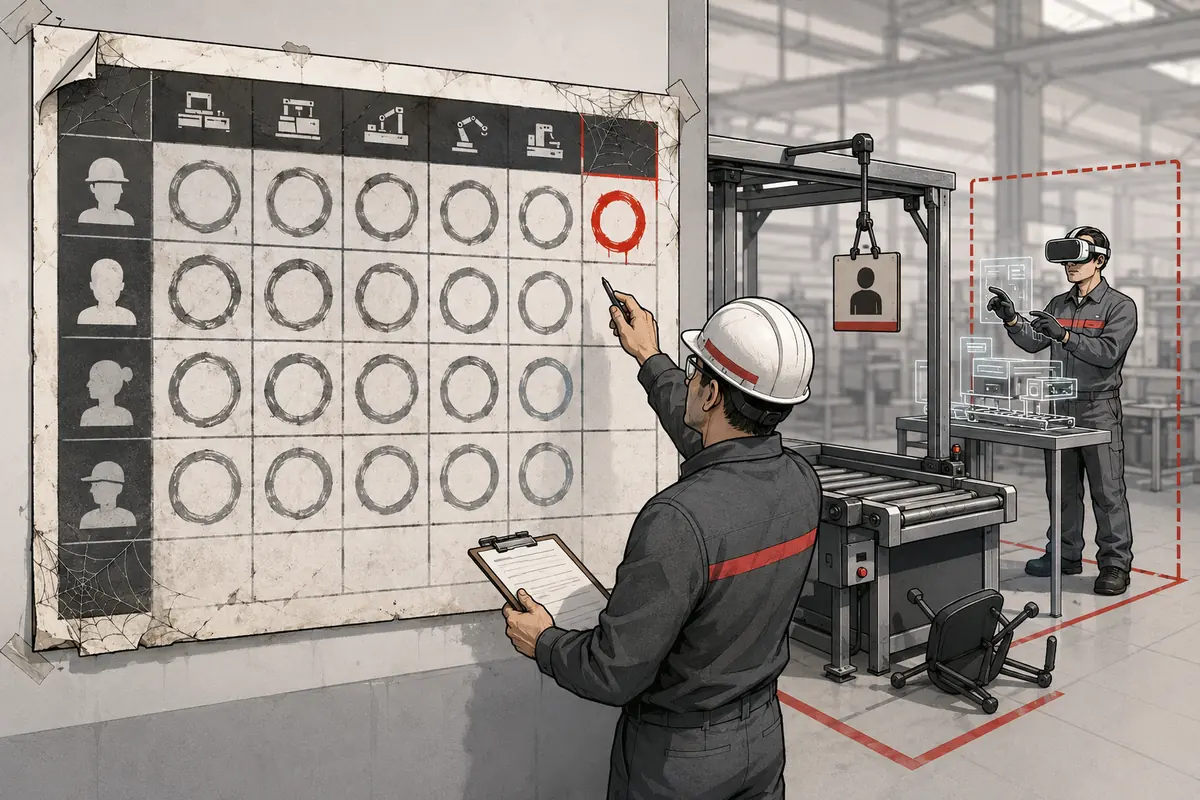
The short answer: a manufacturing skills matrix, also called a training matrix or polyvalence matrix, is the table of operators against stations that shows who can work each station and at what level, for example with the ILUO system. It helps decide who to put on a station today when every cell carries the date and the evidence of the last time that person showed that level.
In almost every plant I walk into there is a sheet taped to the wall of the line, operators down the rows and stations across the columns. It is the manufacturing skills matrix, and it is almost always cleaner than the reality it describes. When I ask when it was last updated, the honest answer is that each cell was filled in the day that person took the course, months or years ago. That sheet decides who covers Monday's absence.
Your manufacturing skills matrix is a capacity plan
The two functions are worth separating: the document does one and gets used for the other.
The ILUO system, widely used in lean manufacturing, rates every person against every station on four levels: I for someone still in training who does not yet work in the process, L for someone who works in it but is not qualified to run it unsupervised, U for someone certified to perform the task to standard and within the required time, and O for someone who can also train others.
Read that way, the matrix is an operational decision tool. When people are out or the production mix changes, it answers a business question: who can I put on this station today. But the cells were filled in answering a different one: who attended the course.
Flaw one: the cell records the past
A U level never expires on the sheet, even when it expires in the person. The cell was marked the day the operator passed and it stays there, indifferent to eight months away from that station or to a procedure that changed in March.
And it depends on how the level was earned. The meta-analysis by Freeman and colleagues published in PNAS in 2014, covering 225 studies in science and engineering, found that students in purely lecture-based classes fail 1.5 times more often than those taught with active methods. If a U level was earned by sitting through a talk and answering a quiz, the cell only documents attendance.
I made the compliance version of that argument in immersive training vs onboarding videos and I will not repeat it. Inside the matrix the problem is different: it is a planning problem. You are staffing critical stations with expired data, and that shows up as scrap, rework and downtime.
Flaw two: the U concentrates the risk
Count how many of your critical stations have a single name at U level. In the plants where I have run that exercise, the number is uncomfortable.
That is the risk the matrix makes visible and nobody manages. The day that person calls in sick, the line stops for lack of the right person, even with people to spare. And the O level, the only one who can train others, is usually also the one asked to cover the gap, so their time goes to firefighting instead of moving everyone else up.
Four columns your matrix does not have and should:
- Critical stations with a single operator at U level.
- The date each U level last performed the task.
- How many O levels are left, and how many are close to leaving.
- What evidence backs each cell besides a signature on an attendance sheet.
What changes when the level is demonstrated
Virtual and augmented reality will not fix a badly designed matrix. It changes the cost of keeping it alive. Validating a U level no longer requires stopping the machine, pulling your best operator in as instructor and risking material: the practice and the assessment happen in a simulator, on whatever shift you like, as one more station in the training dojo.
In PwC's 2020 study on soft skills training, participants trained in virtual reality completed the course four times faster than in a classroom and felt 275% more confident applying what they learned. Across our own industrial immersive training projects the pattern repeats: up to 60% savings against traditional methods. For the matrix, this practice leaves a record: who did it, when, how long it took and which errors they made. The cell stops being a claim and becomes data.
One thing training does not fix: the O level's knowledge should not live only in their head. With digital work instructions the procedure is followed step by step from the phone at the station, so an L level performs without hijacking your only expert. In an A/B trial at a global auto parts manufacturer, 100% of the group using digital instructions reported feeling capable of performing their activity, against 11% with the previous method; and GIRI reports 62.3% fewer errors and US$1.5M recovered per year in a 250-person plant. And every new hire enters at level I, with the cost of getting them to U that I broke down in new hire training and the learning curve.
If that gives you a list of names and stations, the next move is ranking it by what each error costs. The method is in the training needs analysis built on plant records.
The uncomfortable question
Look at your skills matrix right now. On the stations you cannot afford to stop, how many names sit at U level, and when did those names last demonstrate the level instead of inheriting it?
A skills matrix measures the date somebody said the skill was there.
Frequently asked questions
What do the I, L, U and O levels in a skills matrix mean?
They are the four levels of the ILUO system: I, in training and not yet working on the process; L, working on it but not cleared to operate without supervision; U, certified to do the task to standard and in the required time; and O, also able to train others.
How often should a skills matrix be updated?
Every time someone demonstrates a level or stops practicing a station for a long stretch. A cell filled in on the day of the course describes the past, so it pays to record the date each U level last performed the task and the evidence behind it.
How do you validate an operator's level without stopping the line?
By practicing and assessing the task in a VR simulator, on any shift, which records who did it, when, how long it took and with what errors. So an L level can perform without tying up the only expert, digital work instructions take the step-by-step to the station.
With the hours and scrap from your own line: industrial VR training ROI calculator.
 Tom Klukowski
Fyware Partner · Valcre Marketing
Before we quote, we check whether virtual reality fits your operation
Fyware has delivered 750+ XR projects for clients like Gerdau Corsa, Cummins and Medverse, from Mexico in US Central Time. Tell us your case and we will tell you what is feasible, how long it takes, and on what budget.
Get the next articles
Practical guides on VR, AR and industrial training. No spam: we only write when we publish.