
Paper Work Instructions: 7 Signs They Are Failing
 By Carlos Franco, Co-Founder & CEO at Fyware · LinkedIn
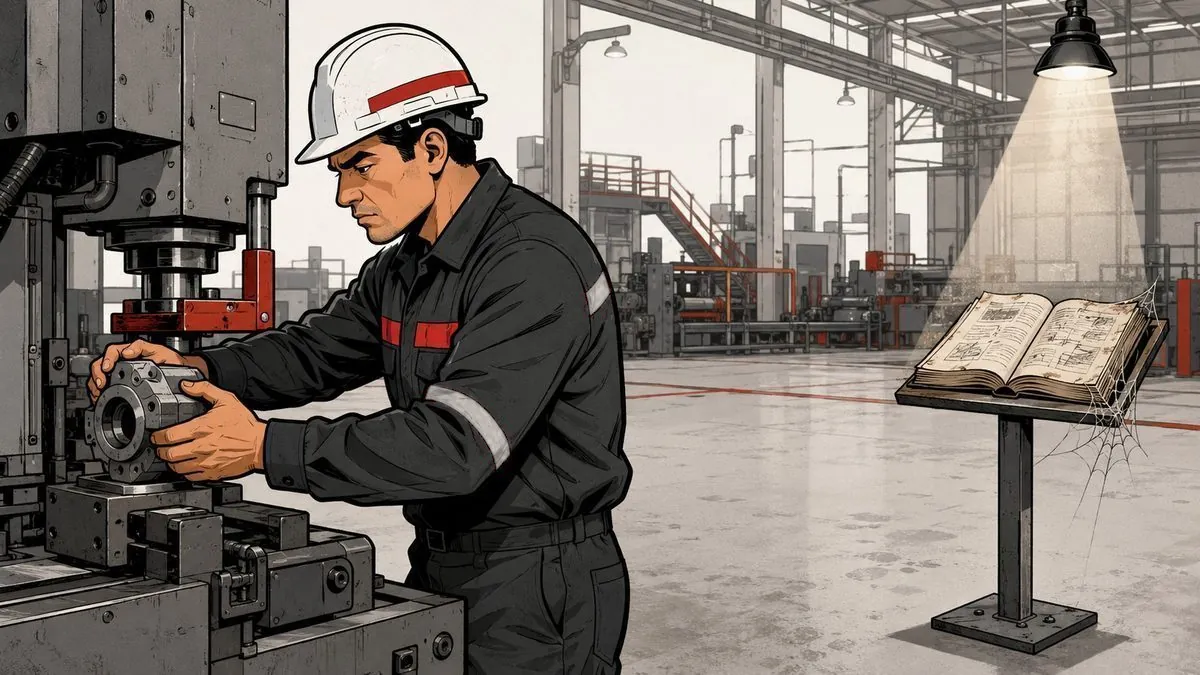
The short answer: paper work instructions are the binder of printed procedures at each station, and they fail when the format no longer carries the process: blurry photos, steps the author skipped, old versions and nobody opening them. If you recognize three of the seven signs, reprinting the binder fixes the grease and the old version, but a static photo still cannot show the process. The fix is a digital work instruction at the station, with the step-by-step on the equipment, a single current version and a record of what gets looked up.
The binder holding the paper work instructions for that station is complete, signed off by quality, and sitting on its stand. Nobody opens it, and even if they did, it would not teach them anything. The photos are static, shot from too far away or out of focus, and the steps that the author already did without thinking never made it onto the page. On top of that the sheets are badly printed, smudged with grease, and describe a version of the process that changed months ago.
The 7 signs your paper work instructions no longer work
All seven are symptoms that the format cannot transmit what the operator needs to know, however well it is written.
- The photos are shot from too far or blurry, and you cannot tell which part the step is talking about.
- The procedure skips steps, exactly the ones the person who wrote it already did on autopilot.
- The sheets are dirty, badly printed, or describe a previous version of the operation.
- You ask which version is current and get three different answers on the same line. In quality inspection that becomes two inspectors with two verdicts.
- Every new hire is shadowed by the line expert, because paper is not enough to let them work alone.
- The response to an execution error is to retrain, not to check whether the document was understood.
- Nobody can tell you which instruction was consulted most last month, because paper leaves no trace.
Recognize three or more and the problem lies in transmission.
Why reprinting the binder does not fix it
Reprinting fixes the grease and the outdated revision. It does not fix the real issue, which is that a still image cannot show a process: it has no sequence, no motion, and it does not point at the exact spot on the part where you tighten, measure, or inspect. The operator has to reconstruct all of that by interpreting a photo and a paragraph.
Two things then happen on every floor. First, almost nobody reads a procedure before executing it, because reading competes with busy hands and a shift running against takt time. Second, and this is the expensive one, whoever does read does not always understand: each reader interprets the same text their own way, and the result is three different ways of running the same task on the same line.
The third cost shows up in the metrics: paper cannot tell published from applied. The audit checks that a signed procedure exists; the floor runs from memory. Scrap and rework live in the gap between those two truths. And when the only reliable source is the line expert, that expert becomes the bottleneck, the risk I described in the manufacturing skills matrix.
What changes when the format changes
Your procedures are already written. Now make them executable where the work happens. With digital work instructions, the operator scans a QR code on the machine and follows step by step guidance on the device, no app and no searching. The instruction is designed to be understood without reading: it points at the exact spot on the equipment, advances one step at a time, and leaves no step implicit. On publishing, it translates automatically into the language of each plant.
Three things appear that paper cannot provide. Version control per instruction, so the current revision is the only one visible and no old sheets stay in circulation. Role based permissions. And consultation analytics: the instruction opened far more often than the rest is the one nobody understands, which tells you where to intervene instead of guessing.
The platform numbers come from AR-Experts, its German manufacturer, and Fyware is its official distributor across the Americas: 62.3% fewer execution errors, 37% savings versus traditional methods, and US$1.5M recovered per year out of US$4.1M in detected inefficiencies at a 250-person facility.
The figure I lean on in a management meeting was timed: at a global auto parts manufacturer, documenting ten work instructions went from 125 to 45 hours at one plant and from 170 to 60 at the other. That ends the argument that digitizing costs more time than it saves. In that same November 2024 A/B test, 100% of the team reported feeling capable of performing their activity with digital work instructions, versus 11% with the previous method. How to hold that figure up when someone attacks it is in how to defend VR training ROI.
How to start without a twelve month project
Start with a single procedure, the most critical one or the one generating the most rework. You document it by recording how the person who already does it well actually works, from a phone on the equipment: that way the steps they took on autopilot get captured instead of lost. You publish, measure how often it gets opened, and compare against last month. If nothing measurable changes, buy nothing. If it changes, the business case is already built on your own operation. The platform detail is in what digital work instructions are.
The uncomfortable question
Take the instruction for your most critical station and hand it to someone who does not do that job. If they cannot execute the task by following it, the document only records that a procedure exists.
Frequently asked questions
How do I replace paper work instructions without stopping production?
One procedure at a time, starting with a single one. The line does not stop, because a digital instruction is documented by recording how the person who already does it well actually works, on the equipment and during their normal shift, from a phone. While that procedure is validated on the floor, the rest of the binder stays in force. Once the first one works, paper comes off that station and you move to the next.
What software do you recommend to digitize the work instructions in my plant?
Before picking software, decide what you actually want: a document repository or a guide that executes on the floor. For the first, any document manager will do. For the second you need four things: augmented reality on the equipment to point at the exact spot, version control per instruction, role based permissions, and consultation analytics. GIRI covers all four, and Fyware is its official distributor across the Americas, so implementation and support are local. The honest recommendation: run a trial on YOUR most critical procedure before buying any license, ours included.
How long does it take to digitize a plant procedure?
Minutes per instruction once the process is recorded, and that changes the project math. At a global auto parts manufacturer, documenting ten work instructions went from 125 to 45 hours at one plant and from 170 to 60 at the other, between 63% and 65% of the process engineer's time.
How do I decide which work instructions to digitize first?
With three filters, in this order: where an error costs the most, which procedure generates the most rework, and which one lives in a single person's head. That intersection usually leaves two or three candidates. After that, consultation analytics do the rest of the work: the instruction opened far more often than the others is the one nobody understands, and that is your next one.
I was asked to document a model changeover step by step. What is the best way?
With a digital work instruction, the changeover is captured once with photos and numbered steps, published instantly to every line, and every version is recorded. Whoever runs the changeover follows it from a phone or tablet at the line, and the process engineer stops repeating the same explanation at every launch.
What your plant recovers by digitizing its procedures, using your own data: digital work instructions ROI calculator.
 Tom Klukowski
Fyware Partner · Valcre Marketing
Before we quote, we check whether virtual reality fits your operation
Fyware has delivered 750+ XR projects for clients like Gerdau Corsa, Cummins and Medverse, from Mexico in US Central Time. Tell us your case and we will tell you what is feasible, how long it takes, and on what budget.
Get the next articles
Practical guides on VR, AR and industrial training. No spam: we only write when we publish.