
New Hire Training: The Real Cost of the Learning Curve
 By Carlos Franco, Co-Founder & CEO at Fyware · LinkedIn
The short answer: new hire training costs far more than the course: it is measured in the time each new person takes to produce at the pace of the one who left, multiplied by how many people join each year. Practicing the task in a simulator before reaching the line shortens that curve; turnover itself depends on working conditions, and no simulator lowers it.
Every time I sit down with an HR director or a plant manager, the same scene eventually plays out. They walk me through their onboarding process with pride: a manual, a video, a plant tour, a test. And when I ask how many times a year they run it, the uncomfortable answer is "constantly." Not because the process fails to teach, but because half the people they train are gone six months later. New hire training stopped being an event and became a production line of its own.
The number almost nobody puts on the table
The cost of onboarding is much larger than the course. It is measured in the time each new person takes to produce at the pace of the one who left, multiplied by how many new people come in every year. In manufacturing that multiplier is brutal: in the plants we serve across Mexico, where a large share of North American nearshore production runs, sector turnover reports usually sit between 14% and 19% a year, among the highest in the economy. And the cost of replacing a worker is commonly estimated at between half and twice their annual salary once you add recruiting, training, and the production lost while they learn.
That last item is the one that gets ignored. A new operator stays unproductive for weeks. They make mistakes, burn material, and pull an experienced coworker away from producing in order to teach. That learning curve is a silent tax paid on every turnover cycle, and almost no plant has it measured.
Why the classroom stretches the curve
Traditional onboarding has a design flaw: it teaches by listening things that can only be learned by doing. The meta-analysis by Freeman and colleagues published in PNAS in 2014, covering 225 studies in science and engineering, found that students in purely lecture-based classes fail 1.5 times more often than those who learn through active methods. The conclusion is not news to anyone who has ever operated a machine: nobody learns to run a crane by watching a slide.
The result is that real practice happens in the worst possible laboratory: the line, with expensive equipment, in production, and at risk. The new hire only truly learns once they hit the floor, and there every mistake has a price. Plants that already run a training dojo solve part of this, with its own limits.
What changes when day one happens in a simulator
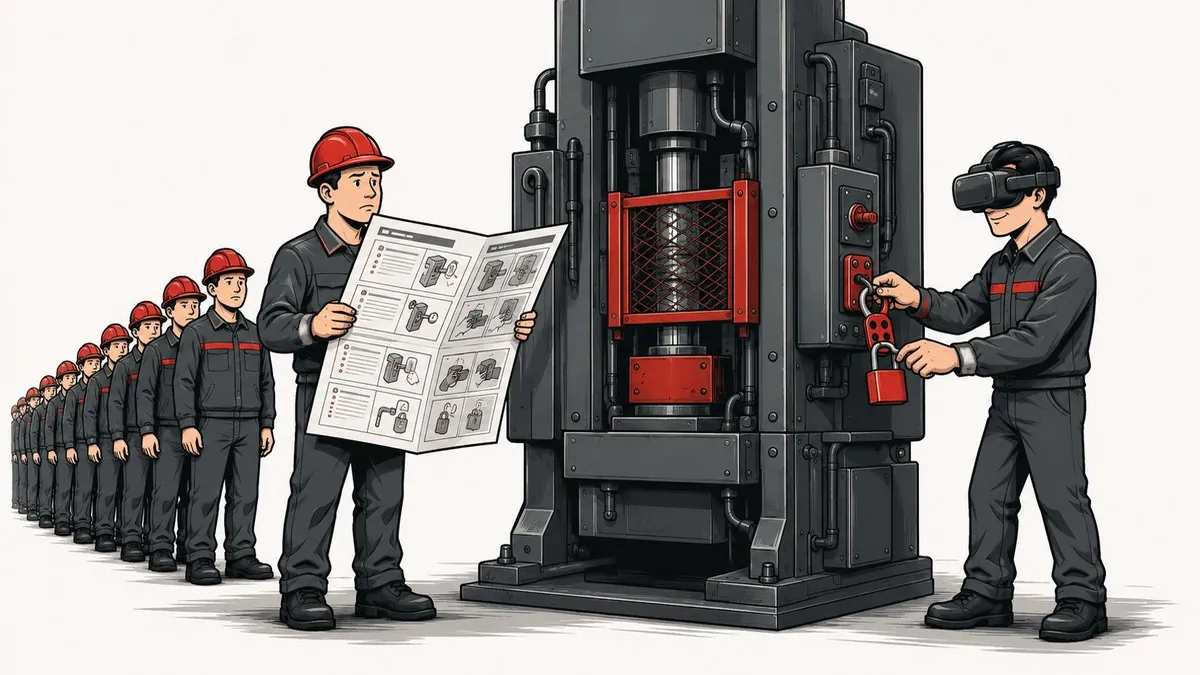
Industrial VR training moves that practice off the line and into a safe environment. An operator can get a procedure wrong twenty times inside a simulator without anyone getting hurt and without stopping production. Lockout/tagout (LOTO) is a good example: one skipped step can cost a finger, so it is worth rehearsing until mastered before ever touching the machine. If you want to read more on it, see our lockout/tagout training guide. In PwC's 2020 study on skills training, participants who trained in virtual reality completed their training four times faster than in a classroom and felt 275% more confident applying what they learned.
In our own projects the pattern repeats: up to 60% savings against traditional methods, and at a global auto parts manufacturer an A/B test showed 100% of the team reporting they felt capable of performing their activity with digital work instructions, against 11% with the previous method. The person arrives at the job with the task already practiced.
If you are going to measure the impact of changing the format, measure it where it hurts:
- Days until the new hire reaches the production standard.
- Errors and scrap during the first four weeks.
- Hours of experienced staff spent accompanying instead of producing.
- Percentage who pass a hands-on performance evaluation.
When day one happens in a simulator, those four numbers move before anything shows up in the turnover report. And what the operator practiced does not have to live in their memory: it can be sustained on the job with digital work instructions that guide the procedure step by step from a phone, so that day two does not depend on what somebody remembers.
What virtual reality does not fix
It is worth being honest. No simulator retains someone who leaves over pay, treatment, or a better shift at the plant across the street. Virtual and augmented reality do not lower turnover by themselves, because turnover depends on working conditions. What they do change is how much each departure costs you: if the replacement's learning curve drops from five weeks to two, the silent tax of every cycle is cut to less than half.
The reframe is simple: onboarding is a compliance requirement and also the fastest lever you have over the turnover cost you already carry. We publish our metrics and price ranges openly, something rare in this market: you can see how we work as a nearshore dedicated team, or how we compare with other nearshore XR development companies.
Measuring the curve is the first step; deciding what gets trained first is the second, and that one is settled by the training needs analysis built on the records the plant already keeps.
The uncomfortable question
If a new operator walks onto your line tomorrow, how many weeks will pass before they produce at the pace of the one who quit, and how much material will you burn in the meantime?
The turnover will still be there. The learning curve is the only thing you actually get to decide how long it lasts.
You can cost the learning curve with your own turnover data: ROI calculator using your turnover data. And to hold that number up in front of leadership: how to defend VR training ROI.
And when the new hire finally levels up, the record lands in a document worth a closer look: the manufacturing skills matrix and its two flaws.
Frequently asked questions
Our new operators take weeks to learn the process. How do we speed that up?
The curve does not shorten by explaining better, it shortens by letting people practice. In a simulator someone can get the critical procedure wrong a hundred times without stopping the line, and they reach the job having done the task rather than having watched it. Before you start, measure your current time-to-productivity so you have something to compare against when the method changes.
What does a new operator's learning curve actually cost?
More than the training budget shows, because the big cost sits in scrap, rework, machine downtime and the time of the experienced operator who leaves their post to shadow the new hire. That last one is almost never counted and is usually the largest.
What can we measure to know whether onboarding is working?
Four things, and attendance is not one of them: time to productivity, errors per operator in the first weeks, incidents among people with less than a year, and how many times the new hire has to go ask someone. That last indicator is the most honest one and nobody logs it.
 Tom Klukowski
Fyware Partner · Valcre Marketing
Before we quote, we check whether virtual reality fits your operation
Fyware has delivered 750+ XR projects for clients like Gerdau Corsa, Cummins and Medverse, from Mexico in US Central Time. Tell us your case and we will tell you what is feasible, how long it takes, and on what budget.
Get the next articles
Practical guides on VR, AR and industrial training. No spam: we only write when we publish.