
Immersive Training vs Onboarding Videos: The ROI Nobody Is Measuring Right
 By Carlos Franco, Co-Founder & CEO at Fyware · LinkedIn
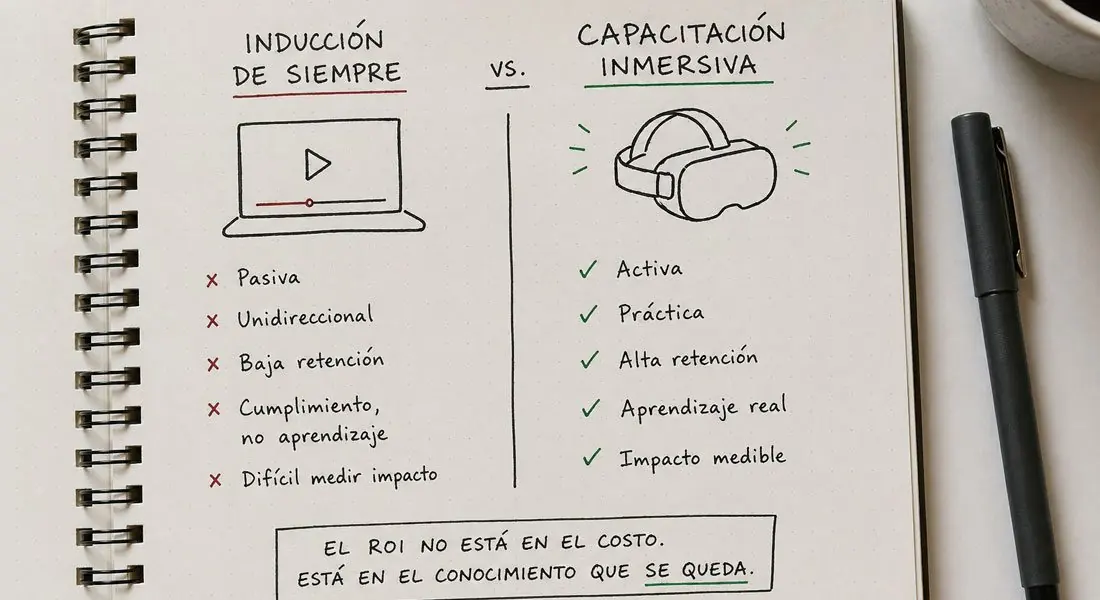
The short answer: immersive training costs more per person than an onboarding video, and it can still come out cheaper once you measure what knowledge that does not stick costs: time to full productivity, errors in the first 90 days, early turnover and retraining. In a video the person watches and listens; in a simulator they practice the task, and there is a record of how they performed it.
There is a scene that plays out every Monday in hundreds of companies. A new employee shows up for day one, gets seated in front of a computer, watches a 45 minute video about company history, corporate values and safety policies, and at the end signs a sheet confirming they "completed their onboarding". Three weeks later, if you ask them about the evacuation protocol or the code of ethics they supposedly watched, they probably will not remember even 20% of the content. And that, precisely, is the problem nobody in HR wants to measure honestly.
The compliance mirage
HR departments have spent years trapped in a misleading metric: the percentage of employees who "completed" the training. The indicator looks beautiful in the quarterly reports, 98% completion and 100% coverage, but it confuses attendance with learning. An employee can leave the video running while checking WhatsApp, click "next" every time the button appears, and still show up in the database as "trained". The company checked the regulatory box, HR hit its KPI, and nobody learned anything.
The problem turns critical in industries where poorly retained knowledge translates into accidents, scrap or lost customers. Manufacturing, retail, hospitality, financial services: sectors where a wrong operation turns into a real risk.
What the forgetting curve says
Hermann Ebbinghaus described more than a century ago what neuroscience confirms today: people forget roughly 50% of new information within an hour, around 70% within 24 hours, and close to 90% within a week, if there is no active reinforcement or hands-on application. This is how the human brain works when it receives information passively.
Modern research on active learning reinforces the same conclusion from another angle. A meta-analysis published in PNAS by Freeman and colleagues in 2014, which reviewed 225 studies in STEM education, found that active learning reduced failure rates by 55% and significantly improved performance compared with passive lecturing. The practical lesson is direct: doing, simulating and practicing leaves a mark; watching and listening passively, far less.
This is where immersive training, with virtual reality, interactive simulators, gamification built on real scenarios and microlearning with deliberate practice, changes the conversation. PwC published a study in 2020 comparing VR learning against traditional methods at large corporations, in a soft skills course, and the results were remarkable: VR participants learned up to four times faster than in a traditional classroom, reported 3.75 times more emotional connection to the content, and felt 275% more confident applying what they learned. Walmart, in partnership with Strivr, deployed VR to train more than a million employees across the US and reported concrete results: training for the new Pickup Tower technology went from 8 in-person hours to 15 minutes in VR without losing effectiveness, and VR trainees outperformed traditional trainees in later evaluations 70% of the time.
The training ROI nobody is measuring right
Here comes the uncomfortable part. When an HR director evaluates whether immersive training is worth the investment, they almost always compare cost per employee: an onboarding video costs practically nothing after it is produced, while a VR module can cost between 5 and 20 times more per person. The conclusion seems obvious. But that comparison is measuring the wrong input.
The real ROI of training is measured by what it costs not to learn it. A cashier who does not master the anti-fraud protocol after onboarding can generate losses that far exceed the cost of their initial training. An operator who never internalized the machine lockout procedure can cause an accident whose human, legal and reputational cost is incalculable. A sales rep who did not retain the product's technical script loses conversions every day without anyone blaming the boring video from day one.
The companies measuring ROI correctly are changing the question. Instead of "how much does training cost?", they are asking "how much does the knowledge that does not stick cost us?". When you include variables like time to full productivity, early turnover attributable to poor onboarding, operational errors in the first 90 days, and retraining costs, the numbers flip. A training program five times more expensive that retains four times more knowledge costs only 25% more per unit of real learning, and that is before adding those variables. If you want to run that math with your own operation's numbers, we publish ROI calculators by industry exactly for this conversation.
Why Mexico is late to this conversation
There are three reasons why most companies in Mexico, where a large share of North American nearshore production runs, remain tied to the onboarding video. The first is regulatory: the framework of Mexico's Federal Labor Law, articles 153-A onward, together with the STPS requirements and the DC-3 certificates that document skills training, rewards documented compliance and does not measure learning effectiveness. As long as a company can prove the employee "took" the training and holds the signed certificate, it is legally protected, even if the worker retained nothing useful. (On how VR training actually strengthens that evidence, we wrote a guide to DC-3 certificates and virtual reality.)
The second is budgetary, but in a subtler way than it seems. HR competes for budget with departments that show immediate ROI, and investments in immersive training take time to show measurable results, especially if the company lacks the analytics infrastructure to track real operational impact. I wrote about this separately: when AI and virtual reality in training solve that measurement problem and when they are tech theater.
The third is cultural: there is an inherited distrust of "novel" technology in HR, especially at mid-sized and family-owned companies. VR still sounds like a video game, simulators feel like a luxury, and microlearning on a phone gets confused with distraction. The video, by contrast, feels serious, traditional, controllable.
What the companies that do measure are doing
The organizations migrating toward immersive training, some in automotive, premium retail, banking and hospitality, share a pattern. They do not replace all traditional content at once. They identify the critical moments where retention matters most: safety protocols, customer objection handling, emergency procedures, specialized equipment operation. And for those moments they do invest in simulation, deliberate practice and spaced reinforcement.
Then they measure things they never measured before: operational errors in the first 30, 60 and 90 days, time to full productivity, customer satisfaction attributed to new employees, early voluntary turnover. When those metrics improve, the business case builds itself. And when they do not improve, at least something is learned, which is more than anyone learns from the usual video's 98% completion rate.
The question every HR director should ask tomorrow
"Should we invest in VR?" is a tech-fashion question. The right question is: if I took ten random employees who finished onboarding three months ago and gave them a hands-on evaluation of their role's critical protocols, how many would pass? If the honest answer is "no idea" or "probably few", the company has spent years paying for an illusion of learning and measuring the ROI of something that is not actually happening.
The problem is treating the onboarding video as sufficient when we have known for decades that it is not. If your pain point is turnover and time to productivity for new staff, we develop that angle in new hire training: the real cost of the learning curve.
Frequently asked questions
Why virtual reality and not a video or an online course?
Because in a video the person watches and listens, and in a simulator they perform the task, make mistakes and repeat. For general knowledge, a video or an online course is enough and costs less. For a procedure where an error is costly, such as an energy lockout or a lift, practice is needed: without reinforcement or application, Ebbinghaus's forgetting curve describes a loss of about 70% of what was seen within 24 hours.
Does a 360 video count as immersive training?
A 360 video lets you look around, but the person is still watching: they make no decisions, perform no steps and leave no record of their performance. It works for tours and general onboarding; practicing a procedure takes an interactive simulator.
How do you measure the ROI of replacing the onboarding video with immersive training?
With what knowledge that does not stick costs: time to full productivity, operating errors in the first 90 days, early turnover attributable to poor onboarding and the cost of retraining. Comparing only the course's cost per employee measures the wrong input.
To compare both methods in money rather than opinion: run both methods through the ROI calculator.
The same gap between paperwork and capability shows up in another plant document: what the manufacturing skills matrix does not tell you.
 Tom Klukowski
Fyware Partner · Valcre Marketing
Before we quote, we check whether virtual reality fits your operation
Fyware has delivered 750+ XR projects for clients like Gerdau Corsa, Cummins and Medverse, from Mexico in US Central Time. Tell us your case and we will tell you what is feasible, how long it takes, and on what budget.
Get the next articles
Practical guides on VR, AR and industrial training. No spam: we only write when we publish.