
The maintenance procedure exists. Whoever does it is out today
 By Olga Chávez, Sales Manager at Fyware · LinkedIn
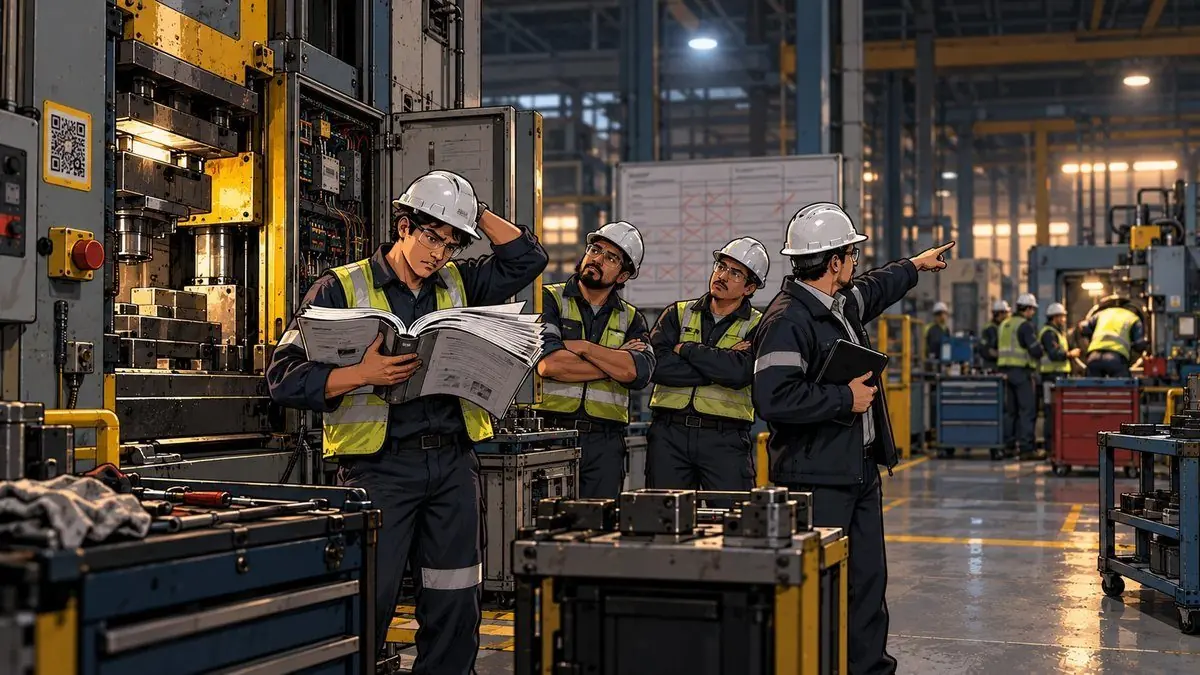
Press 4 has its preventive scheduled for Thursday. On Thursday, the only engineer who knows that maintenance procedure is on line 2 fixing a breakdown. The preventive slips to next week, and then to the week after. Nobody decided to skip it. There was simply nobody to do it.
In that plant the procedure exists and has not changed in years. What fails is something else, and almost nobody looks for it where it is.
The short answer: a maintenance procedure is the sequence of steps, tools and checks that keeps a machine running. In many plants it is written down, but the people who can actually execute it are two or three engineers. When they are not there, the machine waits. Digital work instructions take it out of those heads and put it on the machine, behind a QR code.
Want to see how it would look on one of your machines? Book 30 minutes or message us on WhatsApp.
The procedure doesn't change. Who's there does
In production, the usual problem is that the same process gets done differently on each shift, as Carlos Franco explains in what digital work instructions are.
In maintenance it is the opposite. I heard it this week on a walk through a stamping plant in northern Mexico, without anyone asking: there are machines that do not get their maintenance because only a few engineers know how, and when they are not around there is nobody. And they never have the time to teach the rest.
On paper everything is in order: the procedure is in the binder. What is not in the binder is what the expert knows without thinking. A robot integrator put it this way: switch the robot off at the wrong moment and the chains come loose. Not in the manual. It lives in whoever went through it.
What it costs when only two know
When the procedure lives in two people, the plant pays four times:
- The preventive slips. Not out of neglect: out of scheduling. And a preventive pushed back three times is a breakdown waiting its turn.
- The breakdown waits. If the failure comes at night, someone explains it over the phone, with photos of the buttons.
- The new technician learns glued to the expert. One plant says it like this: "stick to this guy". It works while the expert has time, which is almost never.
- The audit lives in those heads too. When evidence is requested, the answer is to go find whoever did it.
Why nobody writes the maintenance procedure down
The obvious way out is to ask the engineer to write it. It never works, for the same reason the problem exists: if he had time to write it, he would have time to do it.
Loose photos don't work either. In that plant they had just handed in a ten-step instruction for signature, and the photo of one step looked exactly like the next: remove a blade, remove a bolt, same picture. And a loose video multiplies: six months later the process changes and a folder nobody opens is left.
The surprise: it does not need writing. In GIRI the procedure is recorded on the floor, from a phone, while the engineer performs it: about three minutes of capture.
In the pilot documented in our industrial VR adoption report, creating ten work instructions went from 125 to 45 timed hours. That was production, not maintenance, but the documenting work is the same.
What it looks like on the machine
The night-shift technician scans the QR code stuck on the press. Nothing to install: it opens in the phone's browser. Each step shows the photo or the video and what not to do.
And it returns something the binder never did: how many times each instruction was consulted. The one consulted far more than the others is usually the one nobody understands, and the next one to record better.
| The procedure in two heads | The procedure in GIRI | |
|---|---|---|
| Who executes it | Whoever knows it, when they are in | Any authorized technician, on any shift |
| Where it lives | In the binder and in memory | On the machine, behind a QR code |
| How it gets updated | Reprint and collect the copies | Edited and published in minutes |
| Evidence | Go find whoever did it | Version per instruction, consultation log and a PDF in your audit format |
GIRI runs in the cloud or on your own servers. Fyware distributes GIRI in the Americas and implements it in your plant.
Where to start without a year-long project
With one question: do failures come from people not knowing the procedure, or from not applying it even though they know it? GIRI solves the first. The second is discipline, and no software replaces it.
Then with one machine: the last one whose preventive got pushed back. One manager planned it out loud: a Saturday, the operator who does know, and record how the robot gets cleaned. Two people, the one who does it right and the one who signs off. No IT needed.
With that machine you measure something concrete: whether the preventive was done on its date even though the expert was not there. After a month, a one-page report: what was recorded, what happened to the preventive, how long it took.
What GIRI does not do, said plainly: it does not calculate cycle times or line balancing, it does not replace the technician's judgment or the manufacturer's manual, and it does not train the hands' skill: that is what virtual reality is for. They said it themselves: for the operator's standard work sheet, not yet; for the new technician who comes in to change blades, with the QR code on the safety door, yes. If the procedure touches hazardous energy, the lockout tagout step goes inside the instruction, not instead of it.
If the procedure for your press 4 lives in two people, ask how many more preventives will get pushed back, even if neither of them leaves.
Frequently asked questions
What is a maintenance procedure?
The documented sequence of steps, tools, times and checks to maintain a machine. If only one person executes it well, the procedure is on loan. In GIRI every step carries a photo or video taken on the machine itself.
How do you write a preventive maintenance procedure?
Define the machine, the frequency, the safety conditions, the steps and the final check. The fastest way is to record it while the person who knows does it, about three minutes from a phone.
What is the difference between the manufacturer's manual and the maintenance procedure?
The manual says how the machine is built. The procedure says how your plant maintains it, with your tools and your settings. What gets lost when the expert leaves is the second one.
What is tribal knowledge in maintenance?
The knowledge that only exists in the head of whoever does the job. Nobody notices until the day that person is missing. The way out is to record it once and let the new technician follow it on the machine, with the QR code.
What does a maintenance procedure example look like?
The press 4 one from this post: the machine, the stop and lockout condition, the steps with photo or video from the machine itself, the final check and who recorded it. In GIRI it is consulted through the QR code on the press. If people keep asking even though it exists, that is one of the 7 signs a work instruction is failing.
Before you take it to management, price what it costs to keep maintenance knowledge in two people with the GIRI digital work instructions ROI calculator.
 Tom Klukowski
Fyware Partner · Valcre Marketing
Before we quote, we check whether virtual reality fits your operation
Fyware has delivered 750+ XR projects for clients like Gerdau Corsa, Cummins and Medverse, from Mexico in US Central Time. Tell us your case and we will tell you what is feasible, how long it takes, and on what budget.
Get the next articles
Practical guides on VR, AR and industrial training. No spam: we only write when we publish.