
Forklift safety toolbox talk: check the truck before the first load
The forklift gets checked
before the first load.
For the start of the shift: the pre-use check, how to carry the load and why only certified operators drive.
Two to three minutes of reading and two of questions. The PDF includes the sign-in sheet.


Quick facts
Duration
5 minutes
Who leads it
The warehouse supervisor or the safety lead, next to a forklift
When to use it
At the start of the shift, when a new operator starts or when a different type of truck arrives
What to bring
A parked forklift and the company's pre-use checklist
Read it out loud
Read it standing, in front of the crew. It takes 2 to 3 minutes.
Good morning, everyone. Today we talk about the forklift, the machine that moves around us more than any other in this building.
Before the first load, the operator checks the truck: brakes, steering, horn, lights, forks, mast chains, tires and leaks. If something is wrong, the truck stays parked, out of service, and the supervisor hears about it.
Here is a situation that repeats. The shift starts late, someone skips the check to save five minutes and finds out in the middle of the aisle that the brakes are weak. With a load on the forks, that discovery is expensive.
While driving, keep the forks low and the load tilted back. Don't raise the load while moving, don't take corners fast and never carry more than the capacity on the data plate.
If the load blocks your view, drive in reverse looking where you are going, or ask for a spotter. On a ramp, keep the load on the uphill side.
Only people the company has trained, evaluated and certified drive a forklift. If you see someone on a truck without that certification, say something.
When you leave the truck: forks down, controls in neutral, power off and the brake set.
To wrap up: five minutes of inspection at the start of the shift save you from rushing in the middle of it. Today, every operator goes through the full checklist before turning the key.
Three questions for the crew
Let the crew answer before you read the expected answer.
What does the operator check before the first load?
Expected answer: Brakes, steering, horn, lights, forks, chains, tires and leaks, with the company checklist. Trucks are examined before being placed in service, at least daily (1910.178(q)(7)), and one that is not in safe operating condition is removed from service (1910.178(q)(1)).
Who can drive a forklift here?
Expected answer: Only operators the company has trained and evaluated (1910.178(l)(1)), with a certification that lists the operator, the training date, the evaluation date and who performed them (1910.178(l)(6)). The evaluation is repeated at least every three years (1910.178(l)(4)(iii)).
What do you do when you leave the forklift?
Expected answer: Forks fully lowered, controls in neutral, power off and brakes set; on an incline, the wheels are blocked (1910.178(m)(5)(i)).
What OSHA says
- Under 29 CFR 1910.178(l), only operators who have completed training and an evaluation may drive (1910.178(l)(1)), the employer certifies each one (1910.178(l)(6)) and evaluates their performance at least every three years (1910.178(l)(4)(iii)).
- Trucks are examined before being placed in service, at least daily (1910.178(q)(7)), and one that is not in safe operating condition is removed from service (1910.178(q)(1)). On grades over 10 percent, loaded trucks travel with the load upgrade (1910.178(n)(7)(i)).
- What it does not say. This talk is not the training, the evaluation or the certification required by 1910.178(l): your company provides those, and the refresher training after an accident, a near miss or unsafe driving (1910.178(l)(4)(ii)).
Source: OSHA, 29 CFR 1910.178 (Powered industrial trucks), current text. Reviewed on October 29, 2026. See the standard
This is how this hazard is practiced
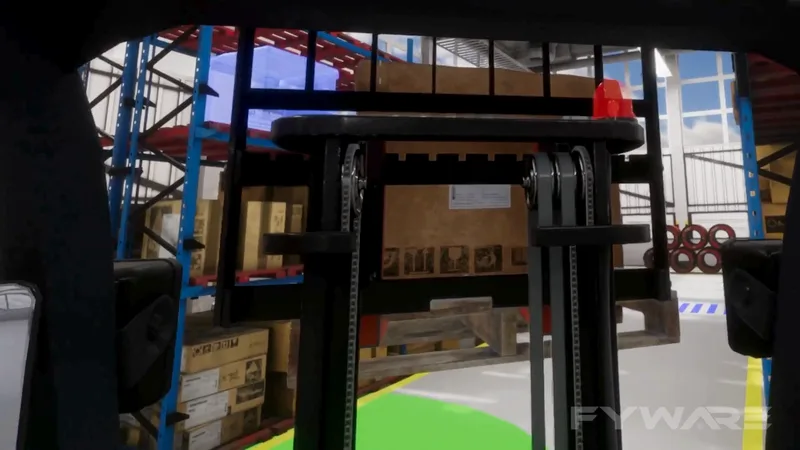
The forklift simulator has three circuits with three different loads and someone who runs across, with a wheel, pedals, reverse and a fork lever. It is the only Fyware Safe module that exports session results, as a local CSV file. It adds practice; the training, evaluation and certification under 1910.178(l) stay with your company.
The talk, ready to print
Two letter-size pages, open and with no sign-up: the script on the first; the questions and the sign-in sheet on the second.
All six in one PDF?
The kit puts the six talks together with their sign-in sheets and a 52-week calendar, ready to print. The editable calendar comes in Excel.
It is a working guide: not an official form or legal advice, and each company is responsible for how it uses it. The sign-in sheet records that the talk took place; it is not a training certification.
More toolbox talks
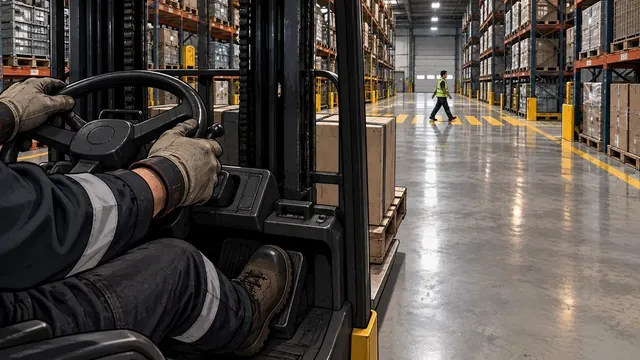
Forklift and pedestrian safety
Blind spots, the horn, marked walkways and what to do before you cross.
Read the talk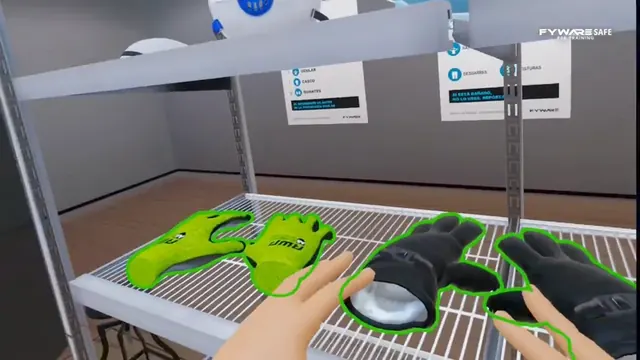
PPE
What to check before you start, what to do when it is damaged and jewelry.
Read the talk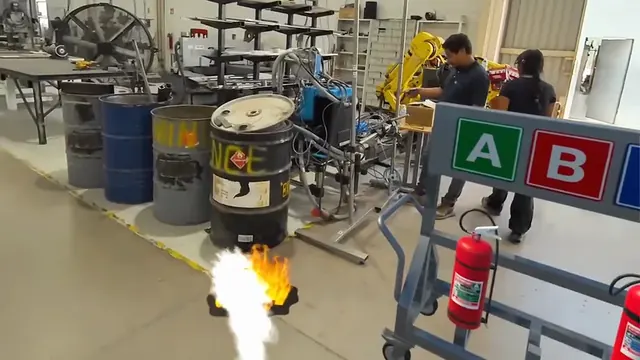
Fire extinguishers
When to use one, how to aim it and when to leave and sound the alarm.
Read the talk
Fall protection
The 4-foot rule, the harness and anchor check and who is trained.
Read the talk
Overhead cranes and rigging
What to check before a lift, one signal person and nobody under the load.
Read the talkLet's talk about your plant
Tell us what you want to solve in your plant. Fyware designs extended reality around the equipment and constraints of your operation, and builds it to grow from a pilot to the whole site.
 Tom Klukowski, Fyware Partner · Valcre Marketing We reply in under 24 business hours, with scope, timeline and investment range.
In the meeting you see the simulator running and what it would take to bring it to your plant, with scenarios adapted to your layout. And if you need to sell it internally, this page is your presentation: share it with your team.