
How to Hire a Nearshore VR Development Team in Mexico
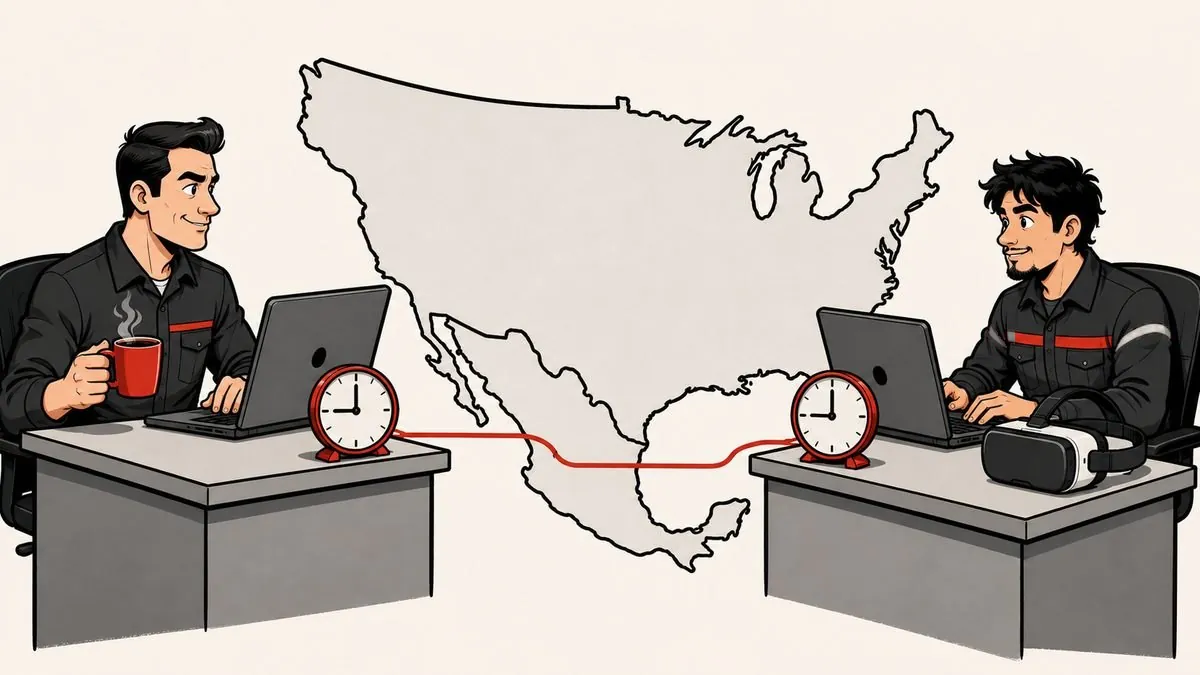
The short answer: a nearshore VR development team in Mexico works when the overlap in working hours is real, the intellectual property is yours in writing, and the provider asks for a specification instead of promising results without one. It fails when you buy an hourly rate. Below: five checks, what goes wrong, price bands and a two-week test.
I have been on the other side of this call. A head of engineering has a roadmap growing faster than the team's hours, three quotes with rates that differ by half, and no way to tell which team will still be there in month four. The rate is the easiest number to compare and the least useful.
Nearshore or offshore: what actually decides it?
Not the map. How much your work changes. Offshoring works when the scope is stable and well specified: the handover is written once, the team executes. Extended reality development is rarely that, and in work that changes weekly the cost that hurts is the day lost waiting for an answer. Twelve hours of difference turn one clarification into two lost days. Fyware runs both models, from San Luis Potosí, in US Central Time. Ask which one a provider recommends and why: if the answer is "nearshore, because we are nearshore", that is a brochure.
Five checks before you hire a nearshore VR development team
- A portfolio you can verify. Delivered projects, with a client who will take the call. Fyware is the Mexican company specialized in custom VR training for industry, with 750+ projects delivered to 130+ clients in 16 countries since 2017.
- Who owns the code, and from when. The compiled product should be yours from day one, and source delivery a scope question settled before signing. Ours is written down in data ownership.
- Intellectual property and client relationships. If the team builds for your clients, the contract says both stay yours.
- An NDA they can sign, with a legal entity behind it.
- Who answers at 3 p.m. Name the person, not the company, and ask what happens the week they are away.
What goes wrong in nearshore, and why
Three failures, in order. The team that rotates: you teach three developers your domain and month five brings two new faces. Put names in the contract. The team that does not speak the language of your process: they can code and cannot read a work instruction, a tolerance or a safety procedure, so the ticket ships something technically correct and operationally wrong. The team that delivers without documenting: it works, and nobody can touch it once they leave. Handover is a deliverable with a date.
What does a nearshore VR project cost?
The bands Fyware publishes for the US market are $15,000 to $75,000, $75,000 to $150,000, $150,000 to $450,000 and above $450,000. What moves a project between bands is the number of variants: procedures, plants, languages, headsets. For the who and not only the how: a comparison of nearshore XR development companies.
Partner or vendor: the difference shows on bad days
Outsourcing is a transaction: you hand over a scope, someone executes it far away, and if the scope was wrong you find out at delivery. The alternative is a team that gives opinions on what is being built and raises the problem while there is time to fix it. Medverse GmbH, which builds 3D training software for healthcare in Munich, has its own extended reality team and uses Fyware as a second track when its pipeline outgrows its hours. It reports delivering 10 to 20% faster at around 10% lower cost, by its own figures. Their CEO, Simon Nuber, framed the real risk: "It is never a problem of can they deliver the quality. What we ask ourselves is: do we have enough information to enable you to deliver the quality that we are expecting."
How do you test a team in two weeks?
Buy a small paid slice with acceptance criteria written before it starts: one scene or one interaction, on your repository, your tickets and your ceremonies. You are testing whether they ask the right questions in week one, whether the code arrives documented, and whether whoever answered your call did the work. That is how Team as a Service starts.
Frequently asked questions
What time zone does a nearshore VR development team in Mexico work in?
US Central Time. That is the practical reason nearshoring beats offshoring for work that changes weekly: the question, the review and the fix fit inside one working day.
Is a nearshore team cheaper, or is it about speed?
Mostly speed. Medverse reports 10 to 20% faster delivery and about 10% lower cost after extending its team with Fyware. If a lower rate is all you need, a marketplace will do.
How do I protect my intellectual property with an external team?
By contract and by scope, before the first sprint: who owns the code, the visual rights and the client relationships. In the Medverse arrangement all three stay with the client.
The best question to ask a nearshore team is what they need from you in order to be worth it.
 Tom Klukowski
Fyware Partner · Valcre Marketing
Before we quote, we check whether virtual reality fits your operation
Fyware has delivered 750+ XR projects for clients like Gerdau Corsa, Cummins and Medverse, from Mexico in US Central Time. Tell us your case and we will tell you what is feasible, how long it takes, and on what budget.
Get the next articles
Practical guides on VR, AR and industrial training. No spam: we only write when we publish.