
Virtual Reality Training for Companies: A Practical Guide
 By Carlos Franco, Co-Founder & CEO at Fyware · LinkedIn
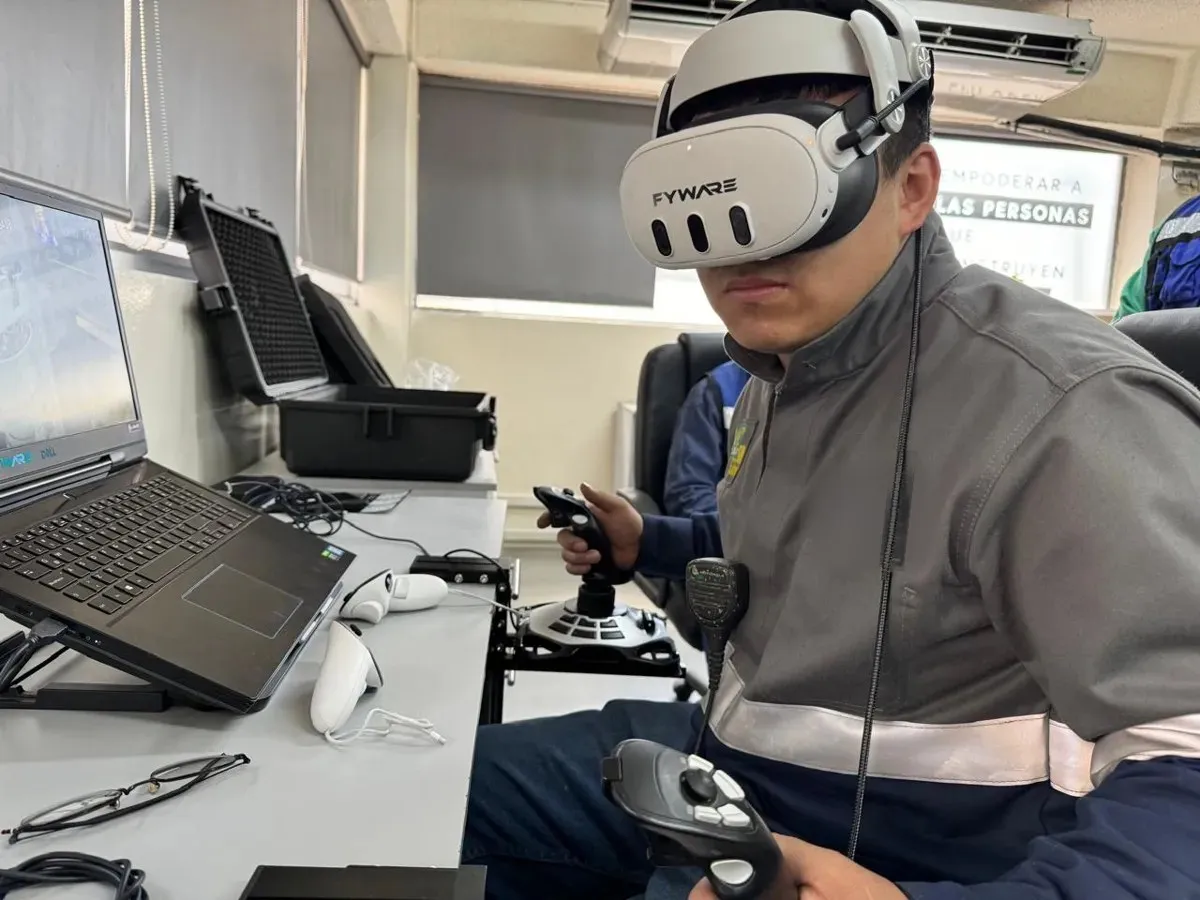
The short answer: virtual reality training is simulator-based training where your people practice the real procedure, with the real consequences, without risking anyone or stopping production.
Your best operator retires in three years and their knowledge lives in no manual. The new hire takes months to become productive, and every mistake costs material, line time or worse. Virtual reality training exists to attack exactly that problem: your people practice the real procedure, with the real consequences, without risking anyone or stopping production. Aggregated data from 9 years of projects is available in the 2026 Industrial VR Adoption Report.
What is virtual reality training
It is training inside a simulated three-dimensional environment, with a headset and controllers, where the employee executes the procedure as they would on the floor: they operate the machine, follow the sequence, make the mistake and see the consequence. The employee performs the practice that a video would only show them. That difference is what moves the numbers: the meta-analysis by Howard, Gutworth and Jacobs (Computers in Human Behavior, 2021) found a moderate overall effect (d = 0.541) that fades or soars depending on how well the task fits the technology: d = 0.207 when the fit is poor, d = 0.820 when it is strong. It wins when the simulator is built on the real process.
The differences between virtual, augmented and mixed reality, and which one fits which procedure, are in our guide to virtual reality vs augmented reality.
At Fyware we have delivered 750+ virtual and augmented reality projects to 130+ clients across 16 countries, and the operational conclusion is consistent: wherever mistakes are expensive, simulation pays for itself.
Traditional course versus simulator
The difference is clearer side by side. Here, a traditional course means the classroom, the video and the demonstration on the real equipment.
| Traditional course | VR simulator | |
|---|---|---|
| What the person does | Listens and watches the demonstration | Performs the full procedure |
| Repetitions | One demonstration per group, sometimes one attempt | As many as needed, failures included |
| Risk and line downtime | Practicing on the real equipment means stopping it and exposing someone | No risk, with the line still producing |
| Evidence | Attendance sheet and written test | Per-person record: steps, times and errors |
| Cost | Low per session; it rises with every stoppage, trip or instructor hour | Upfront investment spread across everyone who uses it, with no per-headset licenses |
| Where it wins | Theoretical or regulatory reading content | Procedures where an error is costly or dangerous |
When it makes sense (and when it does not)
VR is not for everything. It makes sense when at least one of these is true:
| VR makes sense when… | A traditional course is enough when… |
|---|---|
| Mistakes are expensive or dangerous: forklifts, cranes, lockout tagout, confined spaces, fire response. | The content is theoretical or regulatory, to be read and understood. |
| The real equipment cannot stop for training: the line produces while the simulator trains in parallel. | Practicing on the real equipment exposes no one and does not stop production. |
| Turnover is high and the knowledge lives in the heads of two or three veterans. | Few people learn it and the procedure rarely changes. |
| You need objective evidence of performance: the simulation measures every attempt instead of relying on an instructor's opinion. | Recording who attended is enough. |
It does not make sense when the content is purely theoretical reading. A traditional course is cheaper and sufficient there. We draw that line in detail in immersive training vs. onboarding video.
How a simulator works, phase by phase
This is how we approach virtual reality training for companies, from the first meeting to the simulator in use:
- Diagnosis. The procedure is chosen and the metric that will decide whether it worked is set: time to productivity, errors per operator, incidents or cost per person trained.
- Script with your experts. The procedure is documented step by step with the person who already does it well, along with the failures the simulator must be able to trigger.
- Development on your equipment. Your machine, controls and sequence are modeled, following your internal standard. A custom simulator takes about three months; a complex project, three to six.
- Pilot. A group trains and is compared against the current method, with exit criteria written down before it starts. A diagnostic pilot takes about three weeks.
- Rollout. Groups of 4 to 8 people in short sessions, with one instructor supervising every headset from Fyware Hub, without depending on the internet.
- Measurement. The per-person record feeds the metric from the diagnosis. The parts of the procedure that change most, such as variables, ranges and assessment questions, can stay configurable from the instructor's tablet, without programming.
What results to expect
The numbers we cite come from public sources or from our own measured projects:
- Up to 60% lower training costs versus traditional methods, from fewer line stops, less consumed material and fewer instructor hours.
- A moderate overall effect (d = 0.541) that fades or soars depending on how well the task fits the technology: d = 0.207 when the fit is poor, d = 0.820 when it is strong (meta-analysis by Howard, Gutworth and Jacobs, 2021).
- In one of our operator certification projects, ROI exceeded 400%.
A named case: Gerdau Corsa trains its own crane operators with Fyware simulators. The program started with one crane, has been growing for seven years and now has 11 modules, including six cranes with physical controls, an electric arc furnace and lockout/tagout, with zero production stoppages for training.
Investment depends on scope: we publish real ranges in how much does VR training cost, and our ROI calculators give you a number with your own data. And if you are weighing a catalog subscription against building your own, we compare both models in depth in VR training subscription vs custom development: Fyware vs Ludus.
Compliance and evidence
Safety regulators everywhere ask for proof that training happened and worked, from OSHA in the United States to STPS in Mexico. A simulation that records every execution, every error and every completion time is the strongest evidence you can present. Your compliance training stops being a signature on an attendance sheet and becomes a performance record per worker.
How to start without burning budget
- Pick one procedure with a high cost of error. Do not digitize your whole training plan: start where it hurts.
- Define the metric before you build: time to productivity, errors per operator, incidents, cost per trained employee.
- Pilot with one group and compare against your current method. In an A/B test with digital work instructions, 100% of staff reported feeling capable of performing their activity, versus 11% with the previous method.
- Scale only what the pilot proved.
A custom simulator is built on your procedure, your machine and your internal standard. That is how we approach industrial VR training, and if your team is in the US, our nearshore team in Mexico works in your time zone.
We ask every company that contacts us the same question: How much do you pay today for every operator who learns by making mistakes on the real equipment? If you know that number, you already know whether this guide applies to you. And when you move on to evaluating providers, our comparison of the best custom VR training companies tells you who fits the shape of your project.
And once you have the headsets, the operational challenge begins: how to control multiple VR headsets at once.
Frequently asked questions
What is virtual reality training?
It is training in a three-dimensional simulator, with a headset and controllers, where the person performs the procedure as they would on the floor: they operate the machine, follow the sequence, make the mistake and see the consequence, without putting anyone at risk or stopping production. Every attempt is recorded.
How much does it cost to implement VR training?
A custom enterprise project starts at $15,000 USD outside Mexico and $10,000 inside, and rises with the number of procedures, the level of realism and the integration with your data. The full ranges are in our guide to VR training costs.
How long does it take to have a simulator ready?
About three months for a custom simulator and three to six for a complex project. A diagnostic pilot takes about three weeks, and the ready-made Fyware Safe modules are deployed in days.
Does VR replace the course or the instructor?
No. Theory stays in the course and the instructor stays in charge: with Fyware Hub they supervise and guide up to 12 headsets from one tablet. The simulator adds the hands-on practice that rarely happens today, repeated as often as needed, and the record of how each person performed it.
Does it work without internet?
Yes. The simulators and Fyware Hub run 100% offline, with no cloud dependency, because on a plant floor areas without connectivity and IT network restrictions are the norm.
How do I know whether it worked?
With the metric set before the pilot: time to productivity, errors per operator, incidents or cost per person trained, compared against your current method. The simulator provides the per-person data; the baseline comes from your operation.
To move from the guide to your plant's business case: calculate the ROI of a VR training program.
 Tom Klukowski
Fyware Partner · Valcre Marketing
Before we quote, we check whether virtual reality fits your operation
Fyware has delivered 750+ XR projects for clients like Gerdau Corsa, Cummins and Medverse, from Mexico in US Central Time. Tell us your case and we will tell you what is feasible, how long it takes, and on what budget.
Get the next articles
Practical guides on VR, AR and industrial training. No spam: we only write when we publish.