

VR lab for agrifood quality control training
The company's lab now runs inside the institute.
ITACA Education designs and sells training for Italian technical institutes. AgriLab is the virtual reality laboratory they took to an ITS in the agrifood sector: a training path for laboratory operators, with three scenarios that run from the soil before planting to the harvested tomato.
- Industry
- Agrifood, technical education
- Use case
- Training for laboratory operators
- Technology
- Virtual reality headsets
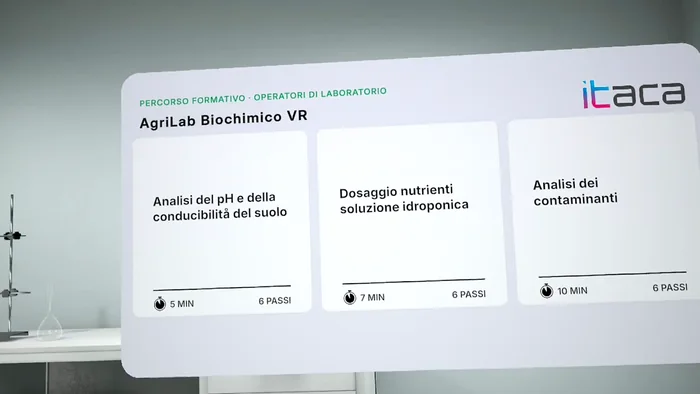
ITACA Education is an Italian company that designs and sells training for technical institutes. AgriLab is the virtual reality laboratory ITACA took to an ITS, a postsecondary technical institute focused on the agrifood sector and on adding value to the agricultural chain, a level above a traditional technical high school. The product names itself AgriLab Biochimico VR and its menu is labeled a training path for laboratory operators, percorso formativo per operatori di laboratorio. It holds three scenarios, 5, 7 and 10 minutes long and six steps each: soil pH and conductivity analysis, nutrient dosing for a hydroponic solution, and contaminant analysis on a tomato sample read with a spectrophotometer. The run goes from the soil before planting to the harvested product. The storyboard and the general concept of the project are ITACA's; Fyware produced the virtual reality side with them.
The figures and where they come from: three scenarios, a run that goes from soil analysis to the finished product, and groups of about 20 students from September, one or two classes to start. All three were reported by Guido Mammoliti of ITACA in writing on September 14, 2026. The names of the scenarios, their length and their step counts were read off the release video, and they are pending confirmation by ITACA. ITACA designs and sells the training, and the teaching design, the storyboard and the relationship with the institutes are theirs. If you are in Italy or in the education sector, the provider to talk to is ITACA Education, not Fyware.
What was built is a virtual reality laboratory for agrifood quality control: three scenarios a teacher runs inside the institute, whenever the syllabus calls for them, instead of waiting for a company with a free morning.
How it was decided
Quality control training for laboratory staff, without waiting for a company visit
The problem
Before AgriLab the course ran as a traditional classroom and the hands-on part arrived through company visits. Practice depended on a date, on a company willing to host a group and on a trip out of the building, so it happened when it could be arranged and not when the syllabus called for it.
What ITACA brings
The storyboard and the general concept of the project. ITACA acted as the bridge between the ideas and requirements of the trainers and teachers, the companies involved and the development team, making sure the final product met the teaching requirements while faithfully reproducing the real laboratory activities of the companies.
What we built
The virtual reality side, to that specification: the three scenarios of the training path, from the pH and the conductivity of the soil, through the dosing of a hydroponic nutrient solution, to the contaminant reading of a tomato sample on a spectrophotometer.
Inside the lab
Three quality control scenarios, from soil analysis to the finished product
The names below are the ones the product uses, in Italian, with the English reading next to each. Every scenario is a timed run of six steps that ends on an evaluation terminal with a score out of 100 and a count of the errors made.
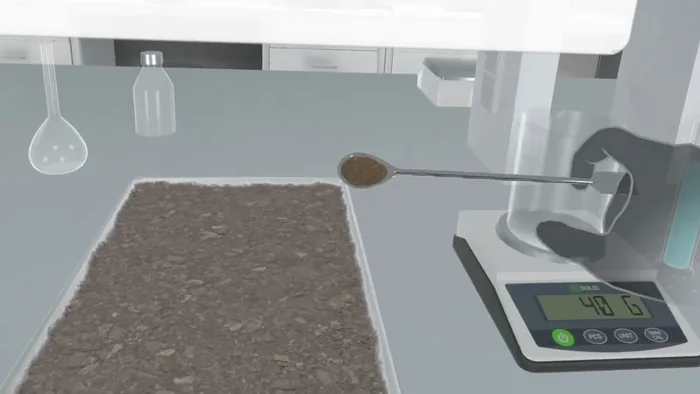
- Analisi del pH e della conducibilità del suolo, soil pH and conductivity analysis. 5 minutes, six steps. You weigh 50 grams of soil into the beaker on the balance, add 100 ml of distilled water and stir it on the magnetic stirrer, calibrate the pH meter in the pH 4 and pH 7 buffers with a rinse between them and in the order given, read the extract and log the value in the virtual register, then calibrate the conductivity probe and measure again.
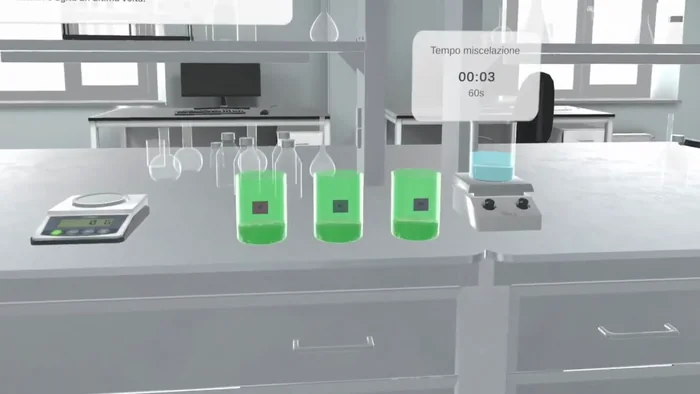
- Dosaggio nutrienti soluzione idroponica, nutrient dosing for a hydroponic solution. 7 minutes, six steps. This one is not an analysis, it is a formulation. Base water first, 700 ml, then nitrogen 1.50 g, phosphorus 0.50 g, potassium 2.00 g and a micronutrient mix 0.20 g, weighed one at a time and always in that order, to a tolerance of 0.05 g each, stirring after every addition, topped up to 1,000 ml and mixed for 60 seconds before the final four point check.
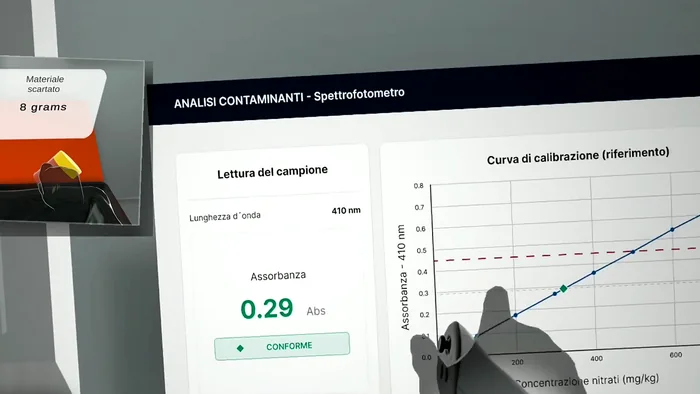
- Analisi dei contaminanti, contaminant analysis. 10 minutes, six steps. You cut, weigh and grind a 5 gram tomato sample, dilute it and add the reagents in sequence with their times and temperatures, fill two cuvettes, one with the sample and one blank, calibrate the spectrophotometer at 410 nm on the blank, and read the absorbance against the reference curve. Over 0.45 the sample is contaminated.
The evaluation is not decoration. In the release video the three runs close at 90 out of 100 with two errors, 70 with four and 100 with none, and the error cards name what went wrong: mixing time too short, weight not correct, equipment not placed correctly. In the contaminant scenario the student reads two samples and sees both verdicts, 0.61 absorbance flagged contaminated and 0.29 flagged compliant.
What it looks like
Four frames from the release video, in the order the run takes them.
“We hired Fyware to support us in the development of high-quality Virtual Reality experiences and immersive digital environments for our educational and professional training solutions.”

What makes it work
Four decisions worth repeating in food safety and quality training
- It replaced nothing. The practice used to arrive by company visit. Now the company and its analysis processes sit inside the institute and get used whenever anyone wants, with no travel.
- The domain expert is the client. The storyboard, the general concept and the teaching design are ITACA's, and the build follows that specification.
- The bridge is what makes it accurate. ITACA sat between the teachers, the companies involved and the development team, so the scenarios reproduce real laboratory activities instead of a generic idea of them.
- The run is the whole chain, not three versions of the same test. Soil analysis before planting, then the nutrient solution that feeds the crop, then the contaminant reading of the harvested product. That is the chain the institute teaches, and it is why the middle scenario is a formulation and not an analysis.
The training, the teaching design and the relationship with the institutes are ITACA's. We produced the virtual reality side with their team and to their specification, the way we work as Team as a Service. The model itself, three releases with ITACA and two more in development since December 2025, is a case of its own: VR production partner for a training provider.
Can lab practice happen without arranging a visit to a company?
It can when the part that has to be practiced is a process rather than a place, and quality control is a process: a sample, an analysis, a result, and a decision about what happens next. That sequence does rehearse in virtual reality. What a visit adds beyond the sequence is the plant itself, and that is worth a trip once, not worth a trip every time a group needs to run the same analysis again.
The practical consequence is about availability, not technology. A company visit is a negotiation: a date, a host willing to open the floor to a group of students, transport, and a syllabus that has to bend around whatever day was granted. When the analysis lives inside the institute, the teacher decides when it happens. The change is not that students learn differently, it is that the practice stops depending on somebody else's calendar.
AgriLab covers the chain the institute teaches rather than one isolated test. The run starts with the pH and the conductivity of the soil before planting, passes through the nutrient solution that feeds a hydroponic crop, and ends reading contaminants in the harvested tomato, so a student sees quality control as something that happens along the whole chain and not as a single laboratory step. ITACA reports that the scenarios reproduce the real laboratory activities of the companies involved, which is where its work as a bridge between the teachers and those companies shows up in the build.
The project is ITACA's. They brought the storyboard and the concept, they own the teaching design and the relationship with the institutes, and it will also involve laboratories abroad, with no estimate yet of the total number of students. We supplied the virtual reality development team, which is the arrangement we offer as Team as a Service.
If the lab compresses the times, is the student learning the real procedure?
The product answers that itself, out loud, and that is the part worth copying. Every time a step is shorter than the bench version, the narration stops and says so. Before the soil extraction it states: Il rapporto suolo:acqua standard ISO 10390 è 1:5 con un riposo di circa un’ora. In questa simulazione il tempo è ridotto a 3 minuti per finalità formative; il principio di estrazione resta invariato. The standard soil to water ratio is 1:5 with about an hour of rest, the simulation cuts the wait to three minutes for training purposes, and the extraction principle stays the same.
The same disclosure shows up at every other shortcut. A real spectrophotometric reading waits 10 to 30 minutes for the reaction depending on the contaminant, and the simulation compacts the times while leaving the procedure unchanged. The soil arrives already dried, sieved and homogenized so the run can concentrate on the analytical procedure. The balance work focuses on the accuracy of the values rather than on the fine handling of the instruments. Even the color coded waste bins are declared a teaching simplification of the categories in the Italian waste regulation. A simulation that names what it simplified is easier to trust than one that pretends it simplified nothing.
What this case does not say. The institute that uses AgriLab is not named: that name belongs to the institute and not to ITACA, and the permission is not confirmed. The number of headsets deployed is not published either, because it was not reported. The September figure is the group size ITACA expects, one or two classes to start, not a count of students who have already gone through the lab. When those numbers exist, they go here with their source.
And one thing is still to be confirmed. The description of the three scenarios on this page was read off the release video frame by frame, and it differs from how the scenarios were described to us by email. The email called them three quality control scenarios inside an Italian agrifood company. On screen the second one is not an analysis, it is the formulation and dosing of a hydroponic nutrient solution, and the label over the menu is a training path for laboratory operators, not a company. The count of three and the run from soil to finished product hold in both versions. We are publishing the discrepancy and asking ITACA to confirm the wording rather than quietly picking the version we prefer.
Project details
- Client
- ITACA Education, training for technical institutes · Italy
- End user
- An ITS, a postsecondary technical institute in the agrifood sector
- Sector
- Agrifood, technical education
- Scope
- Three virtual reality scenarios of 5, 7 and 10 minutes, six steps each
- The run
- From the pH of the soil before planting to contaminants in the harvested tomato
- Groups
- About 20 students, one or two classes to start
- Storyboard and concept
- ITACA's. Fyware produced the VR side with them
- Delivered
- 2026
Frequently asked questions
Our lab practice depends on getting a company to host a visit. Is there another way?
Yes, and that is what AgriLab did. Before it, the course ran as a traditional classroom and the hands-on part arrived through company visits: a date, a company willing to host the group and a trip out of the building. AgriLab did not replace a facility, it made possible something that was not possible before: the company and its analysis processes now sit inside the institute and get used whenever the teacher wants, with no travel. The lab holds three scenarios of 5, 7 and 10 minutes: soil pH and conductivity analysis, nutrient dosing for a hydroponic solution, and contaminant analysis on a tomato sample, so the run goes from the soil before planting to the harvested product.
Who writes the content of a training lab like this, the provider or us?
The client. ITACA Education developed the storyboard and the general concept of the project, and acted as the bridge between the ideas and requirements of the trainers and teachers, the companies involved and the development team, making sure the final product met the teaching requirements while faithfully reproducing the real laboratory activities of the companies. Fyware produced the virtual reality side to that specification. That is how Team as a Service works: the team that owns the domain directs the content and we supply the development capacity.
We run a technical institute in Italy and we want a lab like this. Who do we talk to?
ITACA Education. They design and sell the training, the teaching design and the storyboard are theirs, and the relationship with the institutes is theirs as well. Fyware produces the virtual reality side with them. If you are in Italy or in the education sector, ITACA is the provider to talk to, not Fyware.
 Tom Klukowski
Fyware Partner · Valcre Marketing
Want a result like this in your operation?
Fyware has delivered 750+ XR projects for clients like Gerdau Corsa, Cummins and Medverse, from Mexico in US Central Time. Tell us your case and we will tell you what is feasible, how long it takes and what it costs.
We build the immersive training that puts the process inside your own room, to your specification and with your program out front.
See Immersive Training Crane operator training simulator
 Interactive 360 video for induction
 Team as a ServiceThe full line