
Types of Training: the 8 Your Plant Uses in 2027
 By Carlos Franco, Co-Founder & CEO at Fyware · LinkedIn
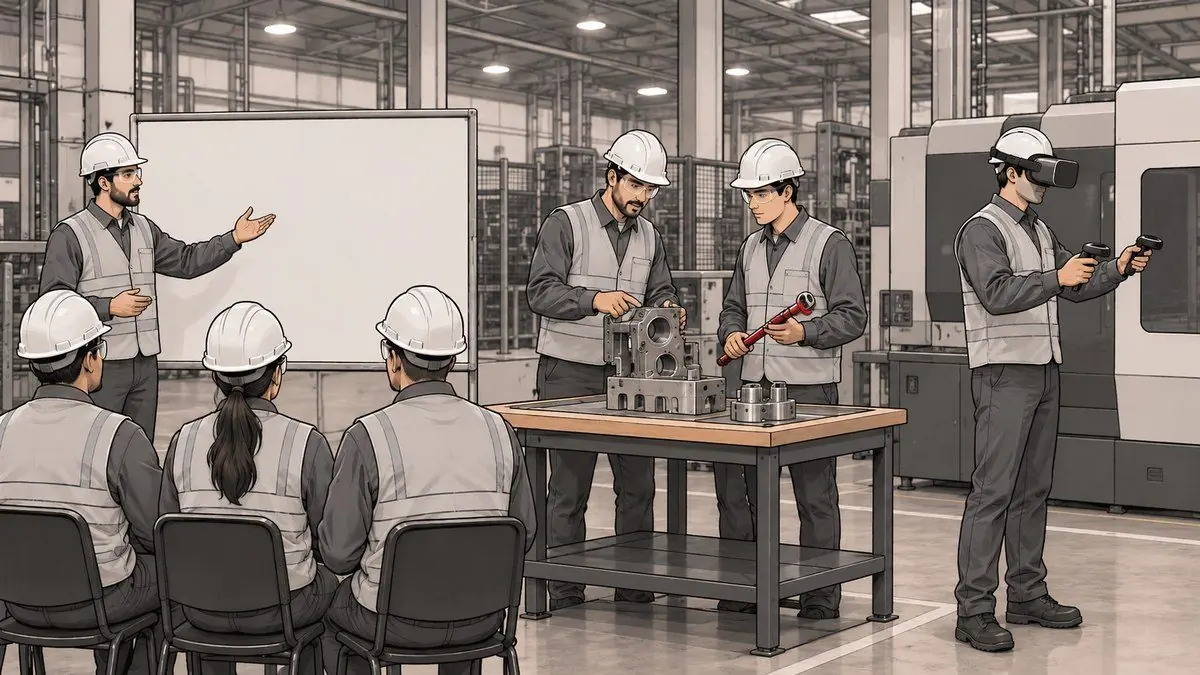
The short answer: the types of training a plant uses can be sorted into eight, by what the person does and where. OSHA writes its training requirements standard by standard, and only a few name the method. The task decides which type fits: whether it is knowing or doing, and what happens when it goes wrong.
On July 11, 2019, OSHA answered in writing whether online courses are acceptable: "the use of online training by itself would not be sufficient to satisfy OSHA training requirements unless that training contains interactive and hands-on components" (letter of interpretation). A letter like that explains the standards and adds no obligation.
Open your 2026 training calendar and count: how many courses changed type since 2025, and how many only changed date?
What are the types of training?
It depends on who sorts them.
OSHA sorts by standard. Its 2015 booklet Training Requirements in OSHA Standards (OSHA 2254) goes one standard at a time, and a few name the method. The electrical standard says training "shall be of the classroom or on-the-job type" (1910.332(c)).
On the plant floor another criterion is more useful: what the person does and where. Sorted that way there are eight types, also called training methods.
The eight types of training in a plant
I should say which side I write from: at Fyware we build the seventh and distribute the eighth.
- Classroom training. An instructor in front of a group. It carries the rule and its reason: the standard and the accident behind it.
- Toolbox talk. One hazard, five minutes, at the start of the shift. It informs and reminds. Our six toolbox talks for manufacturing each come with a sign-in sheet.
- E-learning. Courses on an LMS and microlearning modules of a few minutes. It teaches people to recognize a hazard; the hands stay out of it. It reaches the night shift like any other and records who finished.
- Video. The recorded induction and the 360 video show the place. The viewer stays a spectator.
- On-the-job training (OJT). It costs hours of an experienced operator: the new hire learns at their side, on the equipment that is producing, at its weight and pace.
- Training dojo and practice area. A station off the line to repeat a movement until it comes out right. Fire drills and extinguisher practice fit here. Its limits, from our training dojo post: it needs a machine that is not producing, and the error is avoided because it costs material.
- VR simulator. The person operates a model of their machine and follows its procedure, gets it wrong and starts over: that is virtual reality training. We call ours a familiarization trainer. If the plant asks, it records times and errors per person; practice on the equipment comes after.
- Digital work instructions. A guide for each step of the job, such as GIRI, made by AR-Experts: scan a QR code on the machine and follow it on a phone or tablet. Each instruction has to be kept current. It suits long or infrequent tasks, an annual PM for example.
On-the-job training, dojo or simulator: four questions
Is it knowing or doing? The rule and its reason fit in a classroom or on a screen. A sequence with hands and decisions needs practice: on the job, in the dojo or in a simulator.
What happens if it goes wrong the first time? If the mistake hurts someone or stops the line, the first time happens off the machine. The Bureau of Labor Statistics reports 1,834,600 private-industry cases with days away from work in 2023 and 2024; 610,120, one in three, involved someone with less than a year with the employer (Table R71).
Can the machine be lent for teaching? A crane that never stops leaves few hours for practice. In Gerdau Corsa's crane program, the plant reports 10 simulator hours a month and zero production stops to train.
How often is the task done? If it comes up once a year, the course was eleven months ago. The guide at the point of use does more there.
When the standard already set the mix
For some jobs the mix is written down. For forklift operators, 29 CFR 1910.178 says training "shall consist of a combination of" formal instruction, practical training and an evaluation of the operator's performance in the workplace ((l)(2)(ii)). Performance is evaluated at least once every three years ((l)(4)(iii)), and the employer answers for the operator's competence ((l)(1)(i)).
Overhead cranes get one line: "Only designated personnel shall be permitted to operate a crane" (1910.179(b)(8)). Designated means selected by the employer as qualified, so that mix is yours to write.
Formal instruction fits in a classroom or online and practice happens on the truck; a simulator goes between the two. The evaluation and the certification stay with the employer, as our guide to OSHA forklift regulations details.
The record each type leaves
That forklift certification carries four items: the operator's name, both dates (training and evaluation) and who trained or evaluated ((l)(6)). The employer certifies, and the paragraph mentions no card, outside certifier or retention period.
Classroom training and the toolbox talk leave a sign-in sheet, plus the score if there was a test; e-learning, who finished and the result. OJT and the dojo leave whatever the trainer signs, and a manufacturing skills matrix asks for more than a course date. The simulator can keep the time and errors of each attempt, against criteria the plant writes. Digital work instructions log each instruction's version and how often it was opened.
How to spread them across the 2027 plan
None of the paragraphs cited here asks for an annual training plan. Some set frequencies: fire extinguisher education at hire and at least annually (1910.157(g)(2)), respirator retraining every year (1910.134(k)(5)). The forklift evaluation comes at least once every three years.
The rest starts in the training needs analysis: each gap enters with its type.
For a new operator, the order I propose runs from less risk to more: induction in a classroom or on video, simulator or dojo, the job with an operator who signs off, and the digital guide for tasks that come up rarely.
To budget the seventh type: a custom VR training simulator starts at 45,000 USD, and a more basic version, focused on awareness, at 15,000 USD.
Before you close the plan, write the type next to each course and review first the ones that have been classroom-only three years running.
Frequently asked questions
What are the types of training?
In a plant they can be sorted into eight: classroom training, toolbox talks, e-learning, video, on-the-job training, training dojo and practice area, VR simulator and digital work instructions.
Is online training enough for OSHA?
Not by itself. In a letter of interpretation dated July 11, 2019, OSHA said online training alone is not sufficient unless it contains interactive and hands-on components.
Which training methods work for production operators?
For a task with hands and risk, the ones that give practice: on-the-job training, the dojo and the simulator. Classroom training and e-learning cover the theory. Fyware builds the simulators and certifies no one.
Before you spread the types across the plan, add up what it costs today to train each operator on the equipment that produces, with the operator training cost calculator.
 Tom Klukowski
Fyware Partner · Valcre Marketing
Before we quote, we check whether virtual reality fits your operation
Fyware has delivered 750+ XR projects for clients like Gerdau Corsa, Cummins and Medverse, from Mexico in US Central Time. Tell us your case and we will tell you what is feasible, how long it takes, and on what budget.
Get the next articles
Practical guides on VR, AR and industrial training. No spam: we only write when we publish.