
OSHA Forklift Regulations: Training, Certification, Refresher
 By Carlos Franco, Co-Founder & CEO at Fyware · LinkedIn
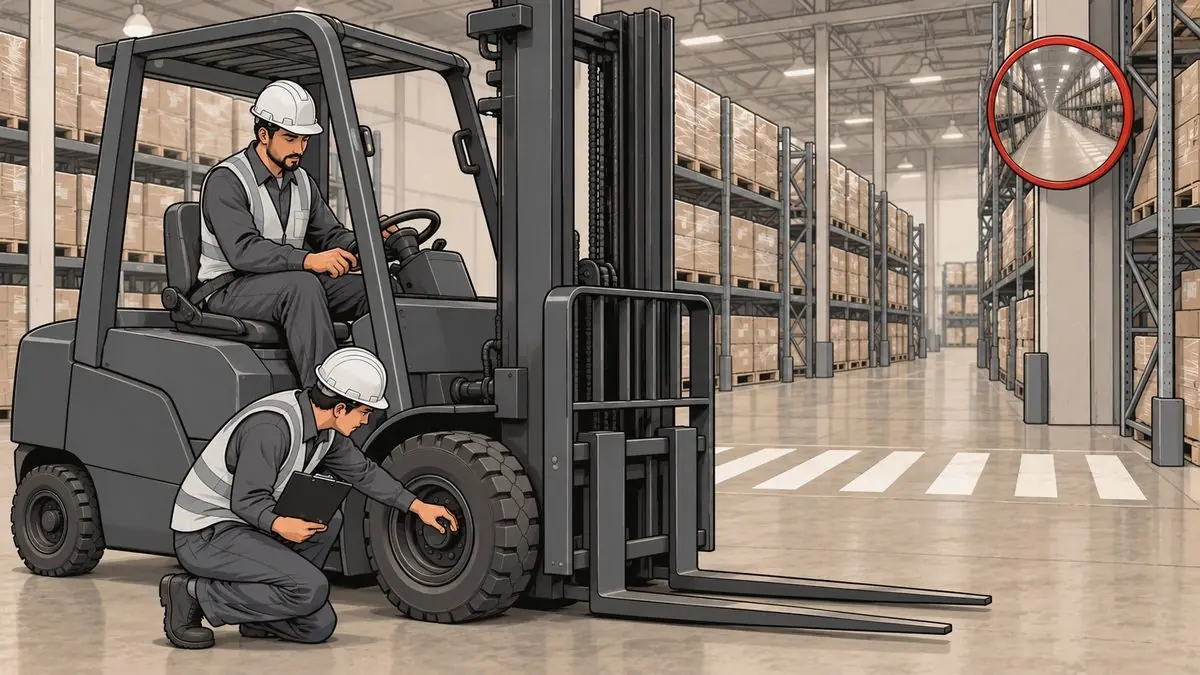
The short answer: OSHA forklift regulations live in 29 CFR 1910.178. Before anyone operates a forklift, the employer must train and evaluate that person in the workplace and certify it in writing. Training combines formal instruction, practical training and an evaluation, performance is re-evaluated at least every three years, and refresher training is triggered by an accident, a near miss or unsafe operation.
Four items. That is everything OSHA asks a forklift certification to contain: the operator's name, the date of training, the date of the evaluation and the identity of whoever trained or evaluated (1910.178(l)(6)). There is no wallet card in the standard and no state license.
I run a company in Mexico that builds forklift simulators, and our standard, the NOM-006, also leaves the authorization with the employer. The US version is more specific about what the evaluation must look like.
Is there a forklift license under OSHA?
No. "Forklift license" gets about 3,600 searches a month in the US and "forklift certification" about 49,500 (Google Keyword Planner, November 2025 to October 2026), and most results sell an online course. Under 29 CFR 1910.178, the employer must ensure each operator is competent "as demonstrated by the successful completion of the training and evaluation" in paragraph (l) ((l)(1)(i)).
An online course can cover the formal instruction. It cannot finish the job, because the evaluation has to happen in the workplace, on the truck the person will drive.
What OSHA forklift training requirements include
Training has three parts ((l)(2)(ii)):
- Formal instruction: lecture, discussion, interactive computer learning, video or written material.
- Practical training: demonstrations by the trainer and exercises by the trainee.
- Evaluation of the operator's performance in the workplace.
It must be done by persons with the knowledge, training and experience to train operators and evaluate their competence ((l)(2)(iii)). The topics split in two lists ((l)(3)): truck-related, such as controls, steering, visibility, fork operation, capacity and stability, and workplace-related, such as surface conditions, pedestrian traffic, narrow aisles, ramps and ventilation.
Trainees may operate during training only under direct supervision and where it does not endanger them or anyone else ((l)(2)(i)).
Three years, five triggers
OSHA does not set a training expiry date. It sets an evaluation: at least once every three years ((l)(4)(iii)). Refresher training, with its own evaluation, is required when ((l)(4)(ii)):
- the operator was seen driving unsafely;
- the operator had an accident or a near miss;
- an evaluation shows unsafe operation;
- the operator is assigned to a different type of truck;
- a change in the workplace could affect safe operation.
The near miss is the trigger that depends on paperwork: if nobody reports it, the refresher never happens.
OSHA forklift regulations you can check from the aisle
A few lines of 1910.178 are visible from the floor. The truck is examined before being placed in service, at least daily ((q)(7)), and taken out of service if it is not safe. The operator slows down and sounds the horn at cross aisles and other places where vision is obstructed ((n)(4)). Nobody stands or walks under raised forks ((m)(2)). A truck is unattended when the operator is 25 feet or more away or out of view, and then the forks go down, controls neutral, power off and brakes set ((m)(5)).
None of these need a simulator. They need someone walking the floor.
What a forklift citation costs in 2026
Powered industrial trucks are number 7 on OSHA's preliminary Top 10 most cited standards for fiscal year 2026, updated October 5, 2026. They were number 6 in 2024.
The 2026 maximums did not move. OSHA canceled this year's inflation adjustment (memo of May 21, 2026), so the penalties stay at $16,550 per serious violation and $165,514 per willful or repeated violation. Each untrained operator can be its own item, and a truck that skipped its daily examination can be another.
Under federal child labor rules, nobody under 18 may operate a forklift in a nonagricultural job (Hazardous Occupations Order No. 7, 29 CFR 570.58).
Where a forklift simulator fits under 1910.178
Our forklift simulator, one of the four in Fyware Safe, runs on a PC with a physical steering wheel, pedals and lever, with the operator seated and wearing the headset. Before touching the wheel, the operator answers four questions about which truck to use for the load. Then come three circuits: a pallet in an aisle with a marked crosswalk, a bulky load that blocks the view and a steel coil picked up from the center. At some point someone runs across, in a different spot each time. Miss the brake and the circuit restarts.
A session takes 15 to 20 minutes and the PC saves the results to a CSV file. OSHA has no interpretation letter on forklift simulators. The closest one, from April 1, 2025, says the person supervising and evaluating must be "physically located" where practical training and evaluation take place, so a remote evaluation over video does not count. A 2020 letter on virtual reality training says its adequacy is decided case by case. A simulator fits as a step before the operator gets on the plant's truck. It does not replace the workplace evaluation, and it does not certify anyone.
A version built on your own warehouse and fleet starts at 45,000 USD, with basic awareness versions from 15,000. Why the classroom course cannot recreate the pedestrian is in our post on forklift training with pedestrians. If the same plant has mezzanines or dock edges, the OSHA fall protection training guide covers 1910.30.
Frequently asked questions
Is online forklift certification OSHA compliant?
Only in part. Online material can cover the formal instruction, but 1910.178(l) also requires practical training and an evaluation of the operator's performance in the workplace.
How often is forklift recertification required?
The operator's performance must be evaluated at least once every three years, and refresher training is required sooner after an accident, a near miss, unsafe operation, a new type of truck or a change in the workplace.
What must a forklift certification include?
The operator's name, the date of training, the date of evaluation and the identity of the person or persons who performed the training or evaluation (1910.178(l)(6)).
Who can train and evaluate forklift operators?
Persons with the knowledge, training and experience to train operators and evaluate their competence. They can be employees. Fyware does not certify operators: we build the simulators they practice on.
How often must a forklift be inspected?
Before being placed in service, at least daily. If the truck is used around the clock, after each shift (1910.178(q)(7)).
The pre-use check and the cross-aisle rule, ready to read at the start of the shift, with a sign-in sheet: forklift safety toolbox talk with sign-in sheet.
 Tom Klukowski
Fyware Partner · Valcre Marketing
Before we quote, we check whether virtual reality fits your operation
Fyware has delivered 750+ XR projects for clients like Gerdau Corsa, Cummins and Medverse, from Mexico in US Central Time. Tell us your case and we will tell you what is feasible, how long it takes, and on what budget.
Get the next articles
Practical guides on VR, AR and industrial training. No spam: we only write when we publish.