
How to Use a Fire Extinguisher: PASS and OSHA Training
 By Carlos Franco, Co-Founder & CEO at Fyware · LinkedIn
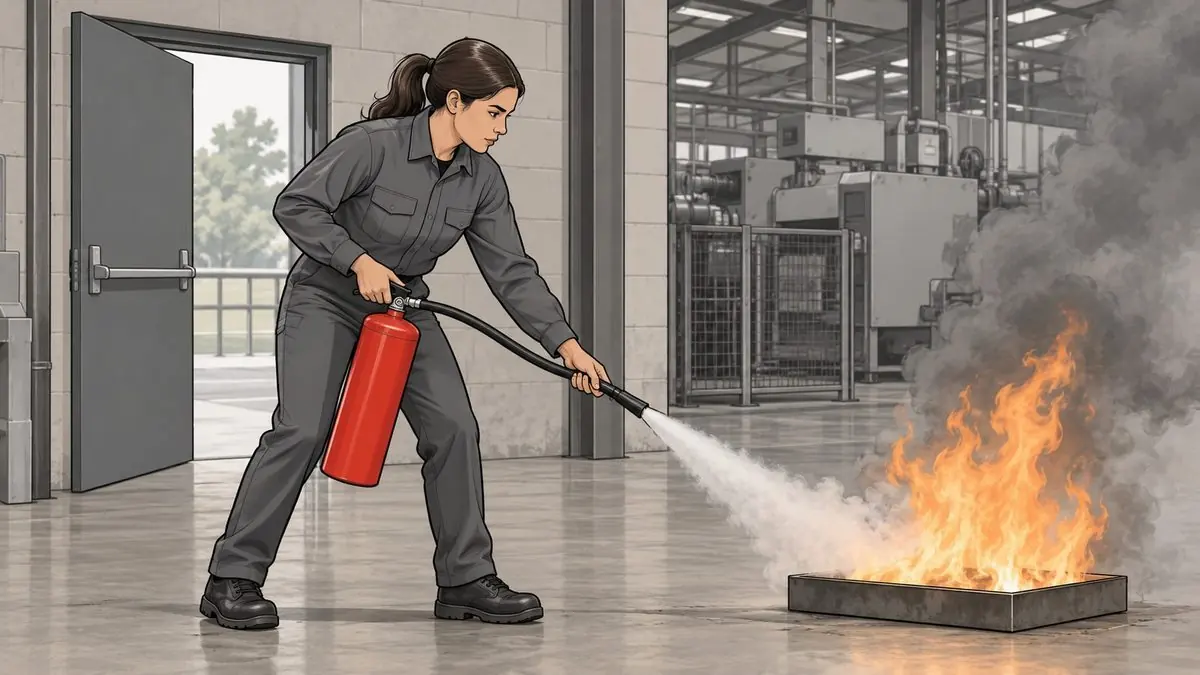
The short answer: how to use a fire extinguisher comes down to OSHA's PASS steps. Pull the pin, aim low at the base of the fire, squeeze the handle and sweep side to side, with your exit behind you. If the extinguisher runs empty or the fire keeps growing, you leave. OSHA 1910.157(g) requires yearly education for everyone where extinguishers are provided for employee use, and yearly training, which OSHA reads as hands-on, for those designated to fight fires.
Paragraph (g) of OSHA's portable fire extinguisher standard runs four short paragraphs, and the word "hands-on" appears in none of them. It comes from a definition two sections earlier and from an enforcement directive.
We build a VR fire extinguisher simulator at Fyware, and where it fits in an OSHA program depends on that word.
How to use a fire extinguisher: OSHA's PASS steps
OSHA spells out PASS in its Evacuation Plans and Procedures eTool:
- Pull the pin. This also breaks the tamper seal.
- Aim low, pointing the nozzle, horn or hose at the base of the fire.
- Squeeze the handle to release the agent.
- Sweep from side to side at the base until the fire appears to be out. Watch the area, and if it reignites, repeat the last three steps.
On a CO2 unit, the eTool warns not to touch the plastic discharge horn, which "gets very cold and may damage skin."
PASS is guidance: the standard itself, 29 CFR 1910.157, describes no technique. Picking the right unit comes first, and which extinguisher matches each class of fire is in our October guide.
What to do before you pull the pin
Ahead of PASS, the eTool asks you to sound the fire alarm, call the fire department if appropriate and pick a safe evacuation path before approaching the fire. On the path it is blunt: "Do not allow the fire, heat, or smoke to come between you and your evacuation path."
Its companion page, Fight or Flee?, asks for a risk assessment before any attempt. It looks at the size of the fire, your evacuation path and the air near it.
How close should you stand to the fire?
OSHA sets no distance. The eTool says to discharge the extinguisher "within its effective range."
Google's AI answer for this search says to stand 6 to 8 feet back (checked November 23, 2026). That figure matches an NFPA home safety message about grease fires. OSHA's own figure, 10 to 15 feet, is a reason to leave: if radiated heat makes it hard to get that close, Fight or Flee? lists the fire among those you should not fight.
Portable extinguishers "can be discharged in a matter of seconds," the same page says.
When should you drop the extinguisher and leave?
The Fight or Flee? table says to evacuate immediately when the fire:
- involves flammable solvents, has spread over more than 60 square feet, is partly hidden behind a wall or ceiling, or cannot be reached from a standing position;
- cannot be fought without respiratory protection because of smoke;
- forces you to crawl, or smoke is quickly filling the room;
- may put fire, heat or smoke across your evacuation path.
The 60 square feet rule comes from the eTool and does not appear in the CFR. What you can fight is a fire limited to the material where it started, with flames no higher than your head. Once it is out, back away in case it flames up again, and with "the slightest doubt" about your ability to fight it, evacuate.
Can a VR simulator count as hands-on training?
In OSHA's definitions, training means instruction "and hands-on practice in the operation of equipment" (1910.155(c)(41)). OSHA's enforcement directive CPL 02-01-037 says employees expected to use extinguishers "must be provided with 'hands on' training."
Hands-on does not have to mean live fire. Appendix A to Subpart L calls simulated fires "an acceptable part of a training program," and a 1991 interpretation letter says OSHA does not require starting fires. The same letter sets a floor: hands-on training should include "the actual discharging of fire extinguishers appropriate for the type of fires expected." I found no OSHA letter on virtual reality for this.
Our fire extinguisher simulator, one of four in Fyware Safe, runs on a Meta Quest 3 headset with no PC and no internet, in a clear room about 6.5 by 6.5 feet (2 by 2 meters). It lays 2 to 5 fires over your plant floor next to a cart of A, B, C, D and K extinguishers, with a 70-second clock per fire. When the clock runs out, the headset orders an evacuation and times the walk to the door.
What it practices is the simulated fire and the decision to leave. The actual discharge the 1991 letter describes stays in your program, and since the headset keeps no record of who trained, so does the paperwork. Fyware is not an OSHA Outreach trainer and does not certify anyone.
A version built for your plant starts at 45,000 USD, with basic awareness versions from 15,000. The PPE side is in our post on hands-on PPE training under OSHA 1910.132.
What OSHA fire extinguisher training requires
Two layers, both in 1910.157(g):
- Education for everyone, where extinguishers are provided for employee use: the general principles of extinguisher use and the hazards of incipient stage firefighting, at hire and at least annually ((g)(1) and (g)(2)). Education "does not require formal classroom instruction" (1910.155(c)(14)).
- Training for designated employees who will use firefighting equipment under an emergency action plan, at assignment and at least annually ((g)(3) and (g)(4)).
Who is designated is the employer's call. A 1986 interpretation letter says the decision to use extinguishers "may not be left up to the employees" and must be spelled out in the emergency action plan. Appendix A adds that people must learn "when it is time to get away from it."
A serious violation can cost up to $16,550 in 2026 (OSHA penalties).
OSHA's emergency action plan standard, 1910.38, does not contain the word "drill" and sets no fire drill frequency for general industry.
Frequently asked questions
What are the four steps to using a fire extinguisher?
Pull the pin, aim low at the base of the fire, squeeze the handle and sweep from side to side. OSHA teaches them as PASS in its eTool.
Does OSHA require annual fire extinguisher training?
Yes, in two layers: annual education for all employees when extinguishers are provided for their use, and annual training for employees designated to use them (1910.157(g)). OSHA defines that training as including hands-on practice (1910.155(c)(41)).
Can fire extinguisher training be done online?
In part. Education "does not require formal classroom instruction" (1910.155(c)(14)), and Appendix A to Subpart L accepts instruction sheets or flyers. Training for designated employees includes hands-on practice, which a 1991 OSHA letter says should include the actual discharge of an extinguisher.
How far away should you stand from a fire with an extinguisher?
OSHA sets no distance: use the extinguisher within its effective range. If radiated heat keeps you from getting within 10 to 15 feet, OSHA's eTool says not to fight that fire.
How often are fire drills required by OSHA?
OSHA's emergency action plan standard sets no fire drill frequency for general industry. It does require reviewing the plan with each employee at the start and whenever their duties or the plan change (1910.38(f)).
PASS and the decision to leave, ready to read at the start of the shift, with three crew questions and a sign-in sheet: fire extinguisher toolbox talk with sign-in sheet.
 Tom Klukowski
Fyware Partner · Valcre Marketing
Before we quote, we check whether virtual reality fits your operation
Fyware has delivered 750+ XR projects for clients like Gerdau Corsa, Cummins and Medverse, from Mexico in US Central Time. Tell us your case and we will tell you what is feasible, how long it takes, and on what budget.
Get the next articles
Practical guides on VR, AR and industrial training. No spam: we only write when we publish.