
Crane operator training simulator in virtual reality for a steel mill
It started with one crane. Today it is eleven simulators and a platform.
Gerdau Corsa trains its own crane operators. Over seven years of continuous work the program grew from a family of crane simulators into eleven modules covering six cranes, the roll shop, the electric arc furnace tapping control room, lockout/tagout, a safety induction video and the platform that hosts them. The plant reports 10 simulator hours a month and zero production stops to train.
- Industry
- Steel mill
- Use case
- Crane operator training
- Technology
- PC VR with Meta Quest 2 and 3
How it started
Practicing on the real crane costs production
The challenge
Practicing on a real crane means stopping production and exposing people. In practice the operator reached the equipment with a talk and a supervised ride. And a steel plant does not have one critical machine: it has cranes of several types, an electric arc furnace, and lockout procedures that get used once and have to go right.
What the plant brought
The standard. The procedures, the sequence of every maneuver, the assessment criteria and what counts as an error are theirs: the plant trains its own operators and knows how the work is done. Every exercise follows that procedure.
What we built
The eleven modules and the platform that hosts them. It started with overhead crane training, with the real physical controls wired into the simulation, and grew into furnace, lockout and induction on the same architecture, so a new piece of equipment does not start a project from scratch.
An eleven-module program
The program covers six of the plant's own cranes, across overhead, scrap-handling, logistics and molten-metal duty, each with its physical controls: the operator uses the same levers as in the cab. On top of that came the roll shop, where rolling mill roll changes are rigged from the floor rather than from the cabin.
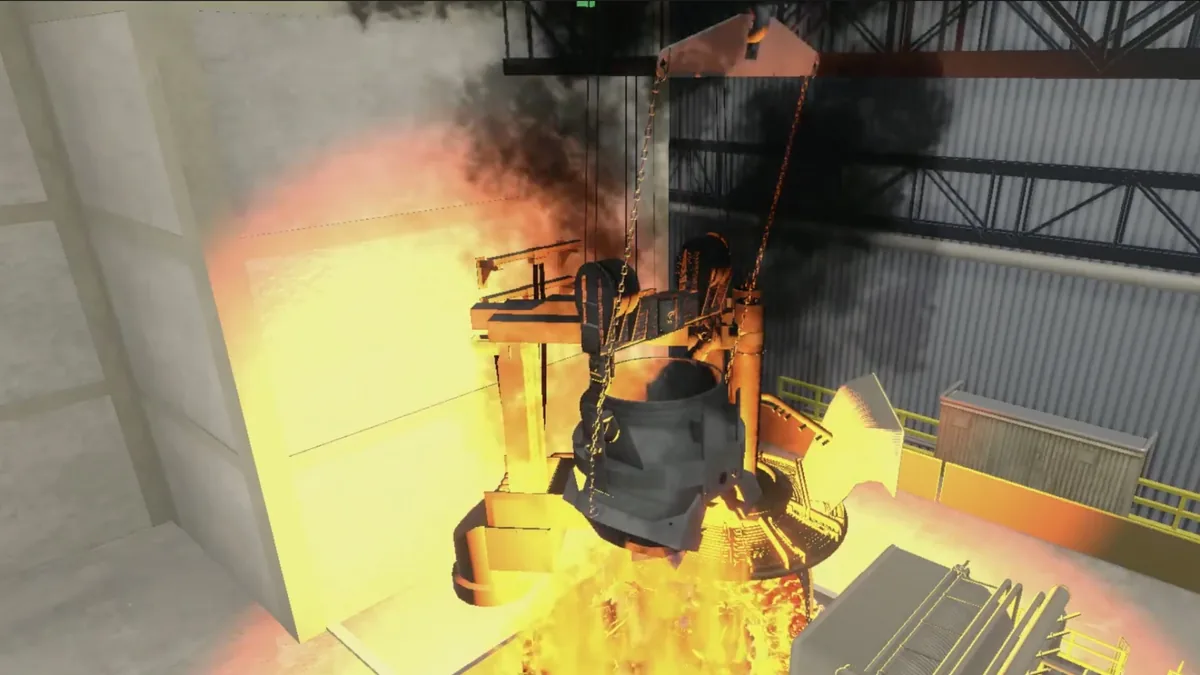
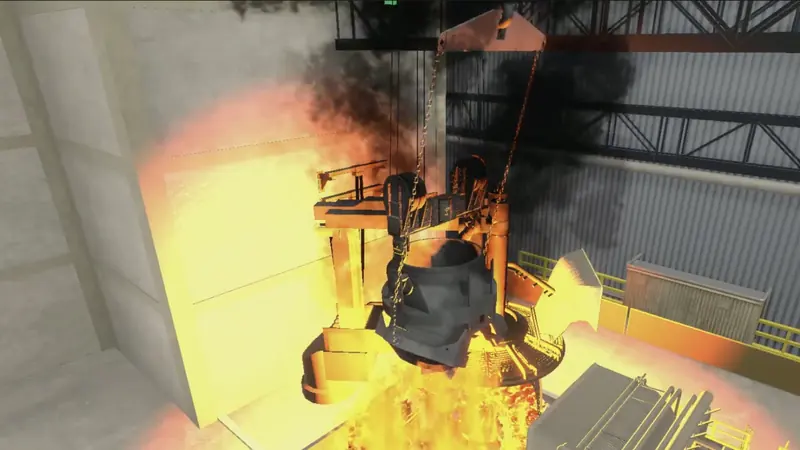
The other four come from the steelworks' operation. The electric arc furnace tapping control room is trained with the panel, the valves and the button sequence that taps the steel into the ladle. Lockout/tagout in the rolling mill has the operator place the padlock on the panel with the glove on, the procedure that runs once and allows no rehearsal. A safety induction video builds awareness of why safety matters before the person sets foot in the plant. And all of it lives inside a platform of its own: a single catalog the operator enters from, with a per-person report and a ranking.
That platform is the piece almost nobody asks for at the start and everybody ends up needing. Without it every simulator is an island, and the evidence of who did what ends up in a spreadsheet nobody maintains.
Why a steel mill is the hard case
A steelworks does not have "the crane". It has the one in the scrap yard, working with a lifting magnet or a hydraulic grab over loose material that shifts on its own; the one that charges the electric arc furnace; the one that carries the ladle of liquid steel over people and equipment; the continuous casting crane, where the pour has a window and gets no second attempt; and the one stacking billets on their way to the rolling mill. Same trade, five different risks.
That is why a generic "crane simulator" does not cover a steel mill. Each process changes what a mistake costs: a ladle of liquid steel that swings and hits is nothing like a stack of billets that drops. And so does the environment: heat, dust, short sightlines from the cabin, and radio coordination with people down on the floor.
On top of that, crane work sits inside a compliance envelope (NOM-006-STPS-2023 in Mexico, OSHA's overhead crane rules in the United States), and every one of them asks for trained operators and documented procedures. A simulator does not issue the certificate and does not replace the crane operator course, but it produces what audits are usually missing: documented practice per person, per module, before anyone climbs up. If what you need is the DC-3 certificate backed by objective evidence, that is the role it plays.
Inside the program
The eleven modules, from the inside
Six cranes, the roll shop, the electric arc furnace tapping control room, lockout/tagout, the safety induction video and the platform that hosts them. Some modules have a short video: click the image to play it.Some modules have a short video on click.


 VR anti-theft protocol simulator
 Medical procedure VR simulator
 Industrial TrainingThe full line