
Crane operator training simulator in virtual reality for a steel mill
It started with one crane. Today it is eleven simulators and a platform.
Gerdau Corsa trains its own crane operators. Over seven years of continuous work the program grew from a family of crane simulators into eleven modules covering six cranes, the electric arc furnace, lockout/tagout, a 360 induction and the platform that hosts them. The plant reports 10 simulator hours a month and zero production stops to train.
- Industry
- Steel mill
- Use case
- Crane operator training
- Technology
- PC VR with Meta Quest 2 and 3
How it started
Practicing on the real crane costs production
The challenge
Practicing on a real crane means stopping production and exposing people. In practice the operator reached the equipment with a talk and a supervised ride. And a steel plant does not have one critical machine: it has cranes of several types, an electric arc furnace, and lockout procedures that get used once and have to go right.
What the plant brought
The standard. The procedures, the sequence of every maneuver, the assessment criteria and what counts as an error are theirs: the plant trains its own operators and knows how the work is done. Every exercise follows that procedure.
What we built
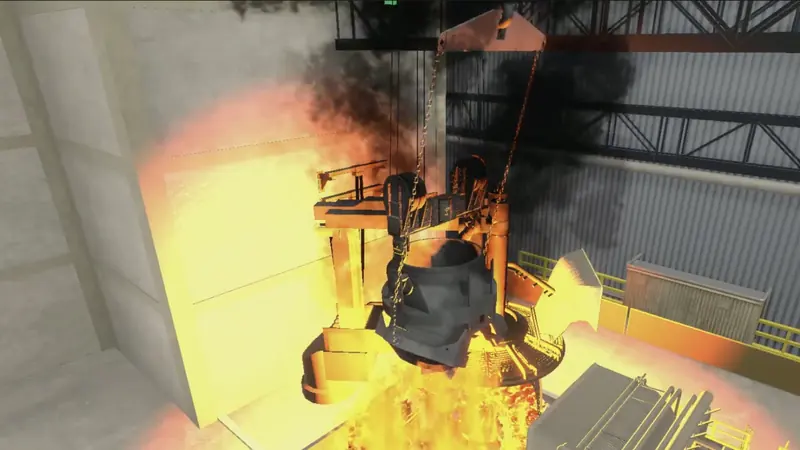
The eleven modules and the platform that hosts them. It started with overhead crane training, with the real physical controls wired into the simulation, and grew into furnace, lockout and induction on the same architecture, so a new piece of equipment does not start a project from scratch.
An eleven-module program
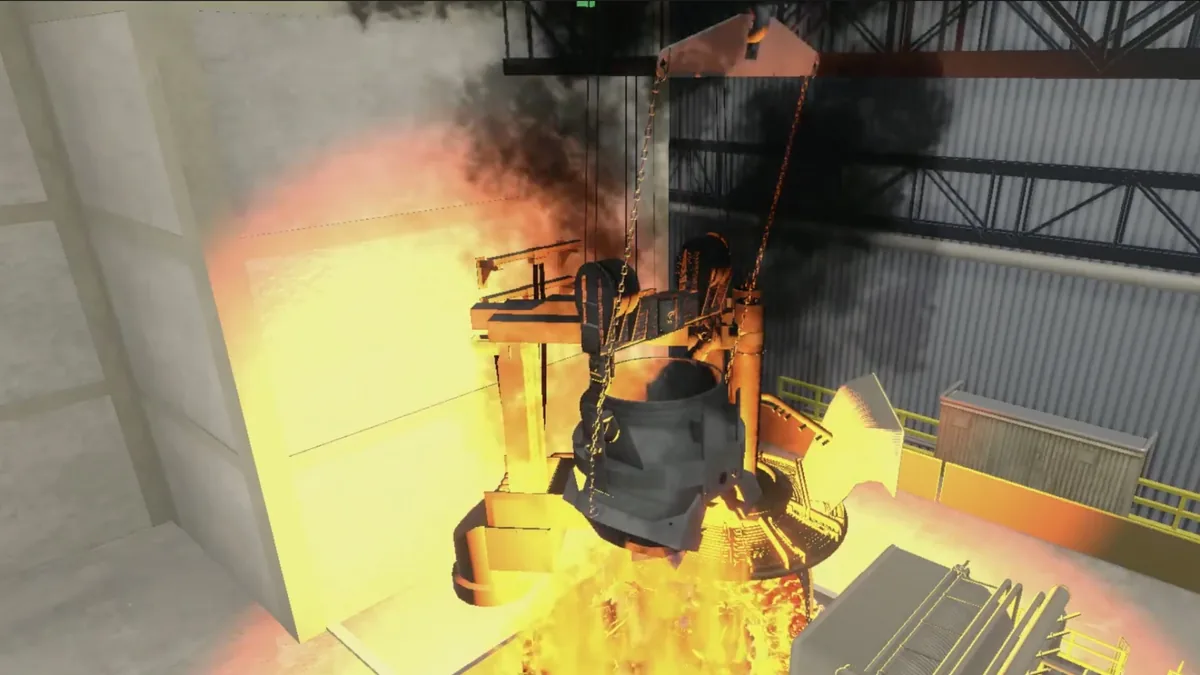
The program covers six of the plant's own cranes, across overhead, scrap-handling, logistics and molten-metal duty, each with its physical controls: the operator uses the same levers as in the cab. On top of that came a floor-level rigging module, practiced from where the load is slung rather than from the cabin.
The other four come from the steelworks' operation. The electric arc furnace is trained in its control room, with the panel, the valves and the button sequence. Lockout/tagout has the operator place the padlock on the panel with the glove on, the procedure that runs once and allows no rehearsal. A 360 induction video walks the plant before the person sets foot in it. And all of it lives inside a platform of its own: a single catalog the operator enters from, with a per-person report and a ranking.
That platform is the piece almost nobody asks for at the start and everybody ends up needing. Without it every simulator is an island, and the evidence of who did what ends up in a spreadsheet nobody maintains.
Why a steel mill is the hard case
A steelworks does not have "the crane". It has the one in the scrap yard, working with a lifting magnet or a hydraulic grab over loose material that shifts on its own; the one that charges the electric arc furnace; the one that carries the ladle of liquid steel over people and equipment; the teeming crane, where the pour has a window and gets no second attempt; and the one stacking billets on their way to the rolling mill. Same trade, five different risks.
That is why a generic "crane simulator" does not cover a steel mill. Each process changes what a mistake costs: a ladle of liquid steel that swings and hits is nothing like a stack of billets that drops. And so does the environment: heat, dust, short sightlines from the cabin, and radio coordination with people down on the floor.
On top of that, crane work sits inside a compliance envelope (NOM-006-STPS-2023 in Mexico, OSHA's overhead crane rules in the United States), and every one of them asks for trained operators and documented procedures. A simulator does not issue the certificate and does not replace the crane operator course, but it produces what audits are usually missing: documented practice per person, per module, before anyone climbs up. If what you need is the DC-3 certificate backed by objective evidence, that is the role it plays.
Inside the program
The eleven modules, from the inside
Six cranes, floor-level rigging, the electric arc furnace, lockout/tagout, the 360 induction and the platform that hosts them. Some modules have a short video: click the image to play it.Some modules have a short video on click.
- Single training catalog
- Per-person report
- Results ranking
How it gets justified
Return is calculated process by process
Every process has its own number
One blanket savings figure for a whole steel mill means nothing, because a mistake does not cost the same in every bay. The steel ladle and the billet stack need two separate evaluations. That is why this program grew module by module instead of arriving as a single purchase.
Shadowing costs you twice
While the new operator learns on the real crane, two people are working below their pace: the one teaching, who is standing behind instead of doing their own job, and the one learning, who moves the machine slowly. That cost rarely shows up in a training budget, and it is the one a simulator removes.
The first climb has a price
A loaded bridge crane is a big machine and the operator going up for the first time freezes. Practicing first changes the state the person arrives in: with the sequence already in their hands.
Where the numbers come from, and where they do not. The only measured figures on this project are the 10 simulator hours a month and the zero production stops, both reported by the plant. Beyond that, what plants already running crane simulators report back to us (published here as exactly that, their words and not our measurement) runs in the order of training dropping from around three months to about five weeks, roughly two fewer weeks of shadowing on the crane, and reductions close to 20% on their process indicator. These figures are external to this case, they have not been audited and we do not guarantee them: they are useful for sizing, and no commitment to a result can rest on them. Your plant's return gets calculated with your process in front of you.
Project details
- Client
- Gerdau Corsa
- Relationship
- Seven years of continuous projects
- Scope
- Eleven training modules and the platform that hosts them
- Platform
- PC VR with Meta Quest 2 and Meta Quest 3
- Technologies
- Unity (C#), Meta Quest controllers and physical industrial peripherals (Logitech joysticks)
- Reported use
- 10 simulator hours a month, with no production stops to train
What makes it work
Four decisions you can repeat
- You replicate the plant's own equipment, with its procedure.
- The controls are physical industrial peripherals, so the hand learns the movement.
- The program grows in modules on one architecture, so the second machine is not a new project.
- A single platform hosts everything and keeps the report, which is what turns practice into evidence.
The operating standard, the procedures and the assessment criteria belong to the plant, which trains its own operators. We built the simulators to that specification. We spell it out because in a project like this it is easy for a vendor to take the whole medal.
Frequently asked questions
My new operators take weeks to learn the process, how do I speed that up?
The bottleneck is almost never the person: it is access to the equipment. You only practice when the crane is free and someone can supervise, so the curve is set by how long the operator waits for a slot. A simulator removes that queue. On this project the plant reports 10 simulator hours a month, with not a single production stop, and the operator reaches the cabin having already flown the load. We do not publish a weeks-to-days figure because the plant did not measure it that way; what is measured are the practice hours accumulated before the first real climb.
How do I train crane operators without stopping production?
By replicating the crane instead of borrowing it. Six of the plant's own cranes were replicated here, across overhead, scrap-handling, logistics and molten-metal duty, with their physical controls, and every exercise follows the plant's own procedure rather than a generic one. Practice happens off the equipment, so production stops for training are zero and the crane keeps working while the operator practices.
Is practicing with a game controller any use if my crane runs on levers?
For learning the sequence yes, for learning the movement no. That is why these simulators do not stop at the headset controllers: the crane is operated with physical industrial peripherals wired into the simulation, so the hand makes the same movement it will repeat in the cabin. That is the difference between knowing what comes next and knowing how to do it.
I have several different crane types, do I need a simulator for each one?
One per equipment type yes, but not a project from scratch for each. This one started with a family of cranes and is now eleven modules, including the electric arc furnace, lockout/tagout and a 360 induction video, on an architecture that lets the model be replicated onto new equipment and other plants. The heavy work is the first one; the rest inherit the base.
If the training is spread across several simulators, how do I know who is ready?
With a platform that hosts them all and keeps the result, which is the piece almost nobody asks for at the start and everybody ends up needing. Here the eleven modules live in a single catalog the operator enters from, and out of it come the per-person report and a ranking. Without it every simulator is an island and the evidence of who did what ends up in a spreadsheet.
Does one simulator cover both the scrap yard and the steel ladle?
No, and that is the trap in buying “a crane simulator” for a steel mill. The lever is the same, but the scrap yard is worked with a lifting magnet or a grab over loose material that shifts on its own, charging the electric arc furnace has its own sequence, and the ladle of liquid steel travels over people and equipment inside a window that allows no second attempt. Because a mistake does not cost the same in every process, each one needs its own module and its own return evaluation.
Does this replace the crane operator course we run today?
No, it feeds it. The crane operator course, the assessment and the certificate stay with whoever issues them, and a simulator does not issue a license. What it solves is the part the course cannot: the practice. In a traditional course the hands-on portion depends on the equipment being free, so it gets cut short or done as a group watching one person. Here each person runs the full procedure as many times as they need, and what comes out of it is exactly the per-person evidence an audit usually cannot find.
How much will this save me at my plant?
Honestly: nobody can guarantee that before seeing your process, and anyone who hands you a percentage on the first call is guessing. What is measured on this case is 10 simulator hours a month and zero production stops to train, reported by the plant. What other plants report back to us, in their words and not our measurement, runs in the order of training dropping from around three months to about five weeks and reductions close to 20% on their process indicator. That is useful for sizing. The number you can defend in front of your committee comes from calculating it process by process, with the real cost of your failure mode and the cost of the shadowing you are already paying twice.
 Tom Klukowski
Fyware Partner · Valcre Marketing
Want a result like this in your operation?
Fyware has delivered 750+ XR projects for clients like Gerdau Corsa, Cummins and Medverse, from Mexico in US Central Time. Tell us your case and we will tell you what is feasible, how long it takes and what it costs.
“They have been innovative and relentless in solving very technical issues.”
 Paul A. LiberatoreOwner/CEO, Access Flight Training Services LLCPublic review on GoodFirms, 5 stars · August 2026
Same approach, your equipment and your procedure: we replicate the machine with its real controls and the operator banks hours before touching it.
See immersive industrial training VR anti-theft protocol simulator
 Medical procedure VR simulator
 Industrial TrainingThe full line