
VR Training for Mining: Practice the Risk Without the Consequences
 By Carlos Franco, Co-Founder & CEO at Fyware · LinkedIn
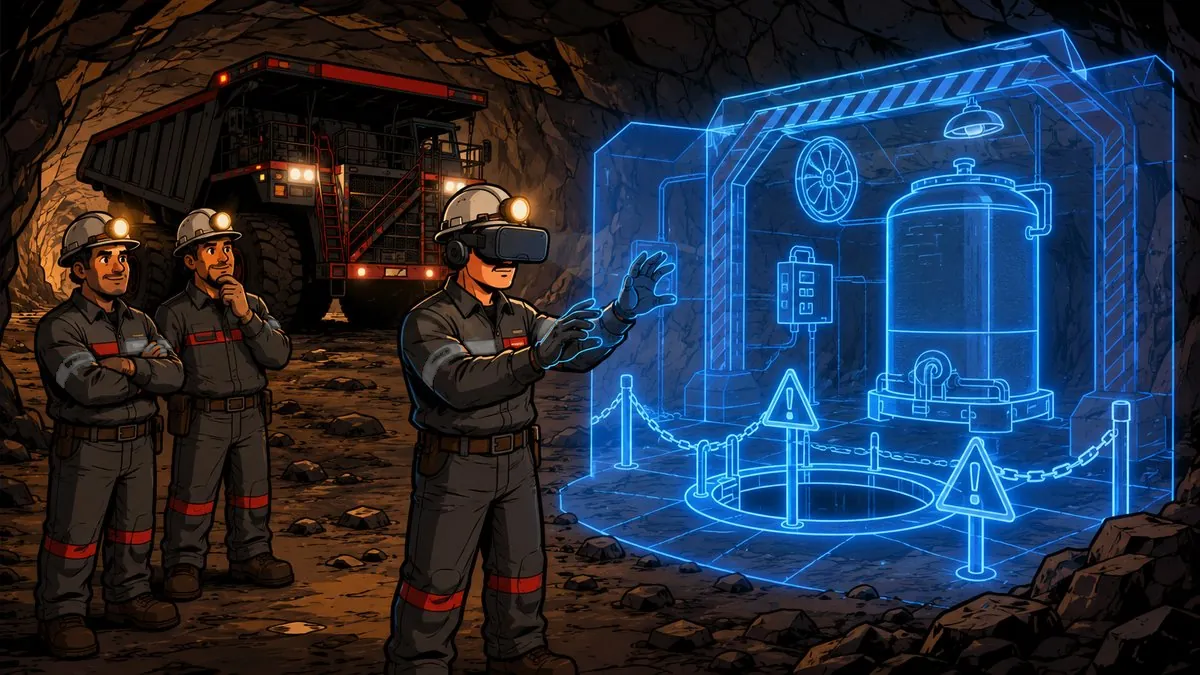
The short answer: VR training for mining is simulator practice for the procedures that cannot be rehearsed in a live mine, such as heavy equipment operation, rescue, confined spaces or energy lockout: the operator repeats the scenario in a headset until it is mastered, and every attempt is recorded as evidence. For maintenance on the floor, the complement is digital work instructions.
In mining, errors cost lives, halted operations and fines measured in millions. Yet the standard way to prevent them is still a classroom, a flip chart and the hope that the operator remembers the procedure 400 meters underground. VR training for mining exists to close exactly that gap: practice the critical risk as many times as it takes, without exposing anyone.
What VR training solves in a mining operation
Mining training has three problems a classroom cannot fix. Access: you cannot stop a site so twenty people can rehearse an emergency procedure. Repetition: the highest-risk scenarios, like a hazardous material spill or a heavy equipment failure, are precisely the ones you can never rehearse for real. And evidence: when the audit comes, an attendance sheet does not prove an operator can execute.
A VR simulator inverts all three. The operator runs the full scenario in a headset, fails without consequences, repeats until mastery, and the system logs every attempt with objective performance data. Our industrial clients report up to 60% lower training costs versus traditional methods, and the meta-analysis by Howard, Gutworth and Jacobs (2021) finds a moderate overall effect of virtual reality (d = 0.541) that fades or soars depending on how well the task fits the technology: d = 0.207 when the fit is poor, d = 0.820 when it is strong.
Digital work instructions on the mine floor
Not everything needs a headset. For equipment maintenance, start-ups and operating procedures, GIRI digital work instructions put the visual step-by-step on the phone or tablet the technician already carries: scan a QR on the equipment and execute with augmented reality guidance, no app required.
We already operate GIRI with two port terminals in Chile, where mineral logistics demand the same safety and traceability standards as the mine site. The platform reports 62.3% fewer execution errors and US$1.5M (€1.4M) recovered per year in a 250-person plant.
From steel mill cranes to mining equipment
Our most mature simulator trains heavy crane operators in steel mills, a sibling environment to mining in risk, tonnage and cost of error. That same engineering applies to the scenarios mining companies ask us for: confined spaces, hazardous materials handling and heavy equipment operation. Every development is custom-built to your real procedure, and the result is 100% your property, with no per-headset licenses.
- Custom VR simulators for critical procedures and emergencies
- Digital work instructions for maintenance and operations
- Real-time session supervision with Fyware Hub, 100% offline for sites without connectivity
What the investment returns in mining
The business case is built with your numbers: turnover, training hours, incidents and error-driven downtime. That is why we publish a mining-specific ROI calculator: enter your data and get the case in minutes.
If your operation is in Mexico or Chile, we already know the terrain. As we wrote in our guide to virtual reality for industrial safety, simulation pays for itself wherever errors are expensive. In mining, errors are always expensive.
With your mining operation's data: mining ROI calculator.
Frequently asked questions
How is virtual reality used for training in mining?
On the procedures where real practice is expensive or dangerous: heavy equipment operation, rescue, confined spaces, lockout-tagout and event response. The operator repeats the scenario until it goes right, including the failure, which is the part you cannot stage on purpose in an active mine. Every attempt is logged with individual performance, so besides training you end up with evidence for the contractor and for the client's audit.
Does it work for contractors who rotate constantly?
That is where it shows most. Contractor turnover means the induction repeats every few weeks with a different instructor each time, so the standard degrades. A simulator delivers the same scenario and the same evaluation criteria every time, and with Fyware Hub a single instructor supervises up to 12 headsets at once from one tablet, with no internet.
What does a mining training simulator cost?
A custom simulator starts around USD 15,000 outside Mexico, and USD 10,000 from Mexico, rising with how many procedures it covers, the level of realism and whether hardware is needed. We publish a mining-specific ROI calculator where you enter your operation's data and get the estimated return, with every assumption visible.
 Tom Klukowski
Fyware Partner · Valcre Marketing
Before we quote, we check whether virtual reality fits your operation
Fyware has delivered 750+ XR projects for clients like Gerdau Corsa, Cummins and Medverse, from Mexico in US Central Time. Tell us your case and we will tell you what is feasible, how long it takes, and on what budget.
Get the next articles
Practical guides on VR, AR and industrial training. No spam: we only write when we publish.