
OSHA Electrical Safety Standards: Training and Lockout
 By Carlos Franco, Co-Founder & CEO at Fyware · LinkedIn
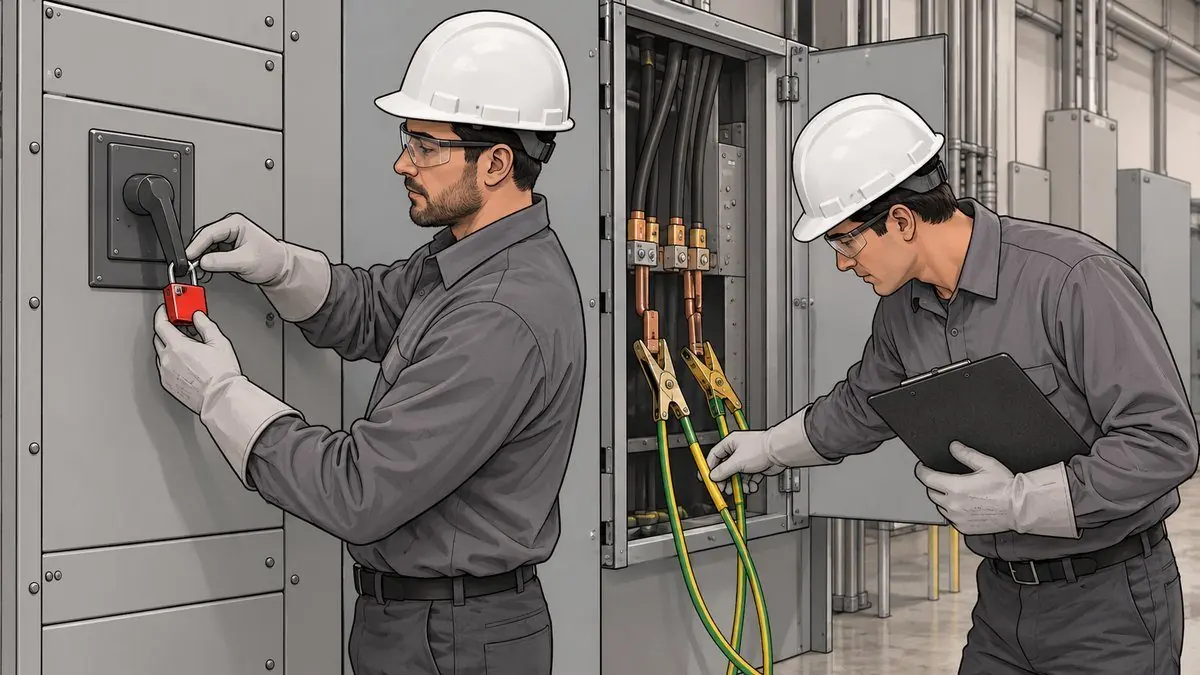
The short answer: OSHA electrical safety standards for general industry live in 29 CFR 1910 Subpart S, and the work-practice rules are 1910.331 through 1910.335. Live parts are deenergized before anyone works on or near them, lockout and tagging follow written procedures, and every employee exposed to a shock risk gets classroom or on-the-job training. The rule sets neither hours nor a renewal interval for that training, and whether someone is qualified is decided equipment by equipment.
OSHA's definition of a qualified person comes with a note that most training certificates leave out. It is "likely," the note says, for one employee to be "qualified" on certain equipment in the plant and "unqualified" on the rest (1910.399).
Our Mexican standard for the same work, the NOM-029, asks for a signed work plan for every maintenance job. The US text is lighter on paperwork and more precise about who may touch what. I read both because at Fyware we put maintenance procedures in front of the person doing the work, and the procedure has to match the rule.
Which OSHA electrical safety standards apply?
For maintenance inside a plant, the core is 1910.333, surrounded by 1910.331 to 1910.335. These sections "cover electrical safety-related work practices" for qualified and unqualified persons working on or near premises wiring and the equipment connected to it (1910.331).
Two neighbors split off. Generation, transmission and distribution installations worked by qualified persons fall under 1910.269 (1910.331(c)). Machines with mechanical, hydraulic or pneumatic energy fall under the lockout standard, 1910.147.
Qualified or unqualified, one machine at a time
A qualified person is "one who has received training in and has demonstrated skills and knowledge" in the construction and operation of electric equipment and the hazards involved (1910.399). Before working on or near exposed energized parts, that person must be trained in three things (1910.332(b)(3)):
- Live parts: telling exposed live parts apart from the rest of the equipment.
- Voltage: determining the nominal voltage of those parts.
- Clearance: the approach distances in 1910.333(c) and the voltages they correspond to.
A second note matters for apprentices. Someone in on-the-job training who works under the direct supervision of a qualified person counts as qualified for the duties at that level of training.
What does 1910.332 training require?
It applies to employees who face a risk of electric shock that the installation rules in 1910.303 to 1910.308 do not reduce to a safe level (1910.332(a)). Unqualified employees in that group are trained too, in the practices that keep them clear of the hazard (1910.332(b)(2)).
The training "shall be of the classroom or on-the-job type," and its depth depends on the risk (1910.332(c)). 1910.332 sets no minimum hours or refresher interval, and it asks for no card.
That gap is where NFPA 70E comes in. It is the consensus standard for electrical safety in the workplace, published by the National Fire Protection Association. Most NFPA 70E training sold online is aimed at the individual worker. What an employer has to show an inspector is narrower: trained people, matched to the equipment they actually work on.
Lockout and tagging under 1910.333
Live parts are deenergized before an employee works on or near them, unless the employer can show that doing so adds hazards or is infeasible; parts under 50 volts to ground can stay live if that does not raise the risk of burns or arcs (1910.333(a)(1)). When the work is deenergized, paragraph (b)(2) asks for:
- Written procedures, kept on file and available for inspection.
- Isolation: a push button or interlock is never the only means of disconnecting, and stored energy is released or blocked.
- Lock and tag on each disconnecting means. A tag alone is allowed only when a lock cannot be applied, and then it needs one more measure that gives equal protection.
- Verification: "A qualified person shall use test equipment" to test the circuit, including for induced voltage and backfeed.
- Reenergizing in a set order: tools and jumpers removed, employees warned and clear.
A procedure written for 1910.147 can satisfy all of this, provided it covers the electrical hazards and includes the tag rule and the test by a qualified person. Why one plant's physical practice board sat unused is in our post on lockout tagout training at three in the morning.
What does an electrical citation cost in 2026?
The same as in 2025. OSHA canceled this year's inflation adjustment (memo of May 21, 2026), so the maximum penalties stay at $16,550 per serious violation and $165,514 per willful or repeated one. A missing written procedure and an untrained employee at the same panel can be two separate items.
Where digital work instructions fit
Paragraph (b)(2)(i) wants the procedure written and available. Available to an inspector and available to the technician at the panel are different distances, and a binder in the maintenance office only covers the first.
GIRI, the digital work instruction platform we distribute in the Americas, puts it on the equipment: scan a QR code and follow the steps, with a photo for each step. Its manufacturer, AR-Experts, reports 62.3% fewer errors. The authorization and the test by a qualified person stay with your people. The sequence just stops living two buildings away.
For practice before anyone opens a panel, the simulator is built to order on your own switchgear: it takes about three months and starts at 45,000 USD, with basic awareness versions from 15,000. The ready-made simulators in Fyware Safe cover fire, PPE, forklifts and pedestrian crossings. If the job is done from a lift or a ladder, the OSHA fall protection training guide covers 1910.30.
Frequently asked questions
How often does OSHA require electrical safety training?
1910.332 sets no interval. It requires training matched to the risk, of the classroom or on-the-job type, before the employee is exposed.
What is a qualified person under OSHA electrical standards?
Someone trained in and able to demonstrate the skills and knowledge for specific electric equipment and its hazards (1910.399). A person can be qualified on one machine and unqualified on another.
Can a tag be used without a lock?
Only when a lock cannot be applied, or when tagging gives equivalent safety, and then with at least one additional safety measure (1910.333(b)(2)(iii)).
Who may test for absence of voltage?
A qualified person, with test equipment, checking for induced voltage and backfeed as well (1910.333(b)(2)(iv)(B)).
Who can provide OSHA electrical safety training?
1910.332 names no provider; it asks for classroom or on-the-job training matched to the risk, and the employer decides who delivers it. Fyware does not certify workers: we distribute GIRI and build custom simulators.
Estimate what digital work instructions are worth on your own maintenance procedures: digital work instructions ROI calculator (GIRI).
 Tom Klukowski
Fyware Partner · Valcre Marketing
Before we quote, we check whether virtual reality fits your operation
Fyware has delivered 750+ XR projects for clients like Gerdau Corsa, Cummins and Medverse, from Mexico in US Central Time. Tell us your case and we will tell you what is feasible, how long it takes, and on what budget.
Get the next articles
Practical guides on VR, AR and industrial training. No spam: we only write when we publish.