
Haptic gloves for microgravity maintenance training
At ESA’s Orbital Robotics Laboratory, test subjects repair a space station unit in VR while tools and components behave as they would in microgravity. They wear a Meta Quest 3 and SenseGlove Nova 2 haptic gloves. ESA commissioned the proof of concept from SenseGlove. Fyware, as system integrator, built the virtual environment in Unreal Engine.
- Industry
- Space research
- Use case
- Maintenance training in microgravity
- Technology
- Meta Quest 3 and SenseGlove Nova 2 haptic gloves
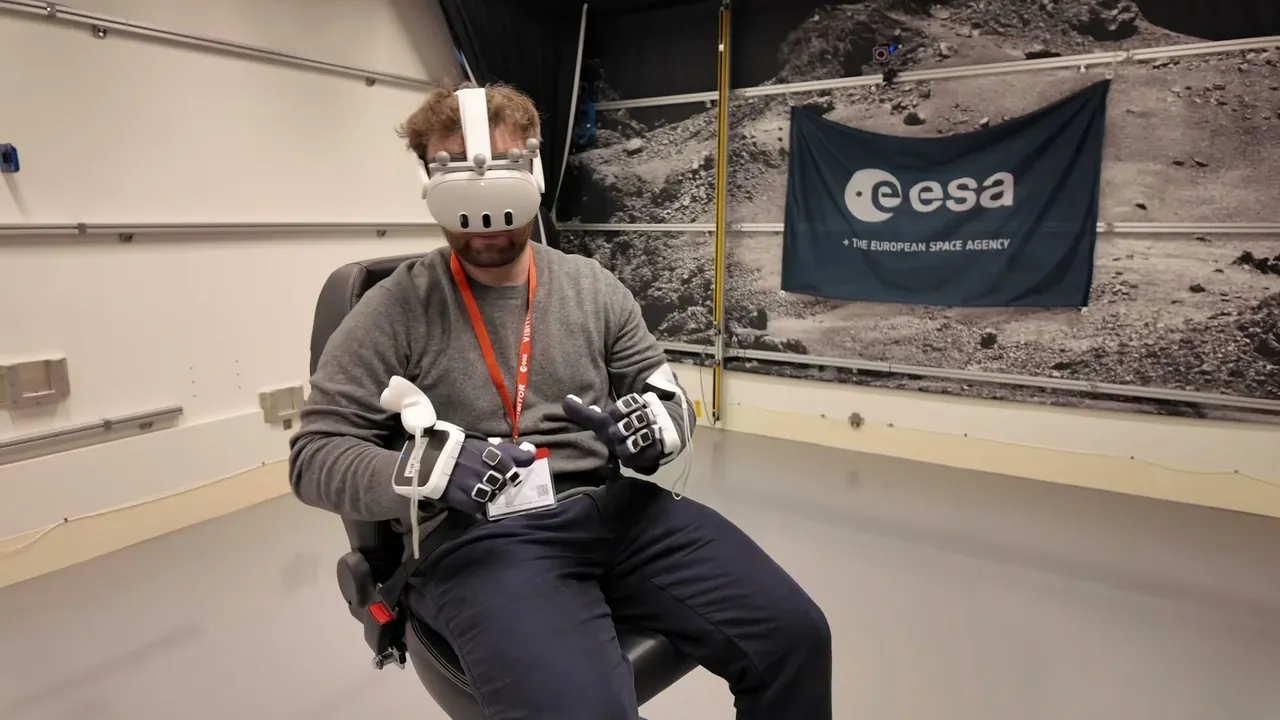
This proof of concept brings haptic gloves into VR training for maintenance work in microgravity. It runs at the Orbital Robotics Laboratory (ORL) of the European Space Agency (ESA), at ESTEC in the Netherlands. Each test subject sits on a chair designed by ESA that hovers over a flat floor on a thin air cushion. Wearing a Meta Quest 3 headset and SenseGlove Nova 2 haptic gloves, they carry out a five-task repair inside a virtual space station. ESA commissioned the proof of concept from SenseGlove. SenseGlove commissioned Fyware, a VR development studio in Mexico, to develop the station module, the microgravity physics, the glove interactions and the guided procedure in Unreal Engine 5.5. Fyware delivered the project to SenseGlove in February 2026.
Sources: the simulation’s voice script (five tasks), the technical documentation delivered with the source code, the project completion letter (16 February 2026) and SenseGlove’s video of the experiment (12 November 2026).
Who did what
European Space Agency
Commissioned the proof of concept from SenseGlove for its Orbital Robotics Laboratory (ORL), at the ESTEC site in Noordwijk, the Netherlands, where it runs on the lab’s microgravity platform.
SenseGlove
Manufacturer of the Nova 2 gloves and their SDK. Tested every build on the hardware and provided guidance to Fyware. senseglove.com
Fyware
The system integrator in charge of building the virtual environment and integrating the Nova 2 SDK: a reproduction of the ISS Columbus module, with microgravity physics, the glove interactions and the training procedure, in Unreal Engine.
Why maintenance in microgravity is hard to rehearse on Earth
In orbit, a tool that is let go drifts away, and so does every loose screw. Under those conditions, a simple repair can quickly become challenging.
At ESA’s Orbital Robotics Laboratory, a free-floating facility called ORBIT reproduces weightlessness on the ground, in two dimensions. For this experiment, a chair designed by ESA hovers a few micrometers off a very smooth, flat floor on a thin air cushion, and the person seated on it floats on a plane.
A VR headset places that person inside the station. For the hands, traditional VR controllers typically use buttons or triggers to grasp virtual objects, while haptic gloves let users grasp through natural hand movements and receive tactile cues.
The proof of concept adds haptic gloves to this setup. SenseGlove describes the goal as making virtual environments more intuitive by adding a sense of touch, and so helping teams prepare for the environment of a space mission.
Meta Quest 3 and SenseGlove Nova 2 on ESA’s floating chair
The experiment puts a Meta Quest 3 headset and SenseGlove Nova 2 haptic gloves on the person seated in ESA’s chair. The headset shows the inside of a space station, and the gloves let that person take hold of the tools and parts drifting in it.
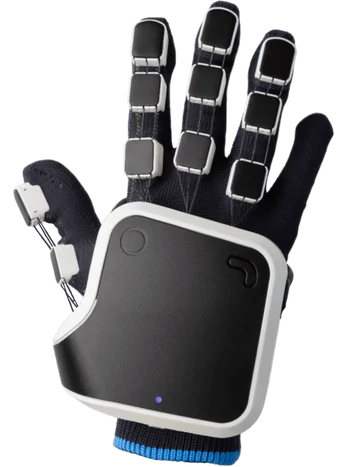
The gloves: SenseGlove Nova 2
The Nova 2 is a wireless force-feedback haptic glove. Four finger brakes create resistance in the fingers of up to 20 N, from thumb to ring finger. Vibrotactile actuators and an active contact-feedback strap complete the feedback: the strap presses into the palm when a virtual object or surface applies pressure to it. The glove tracks six degrees of freedom, with a tracker or controller mounted on it for positional tracking, so the user interacts with the virtual environment with an actual sense of touch.
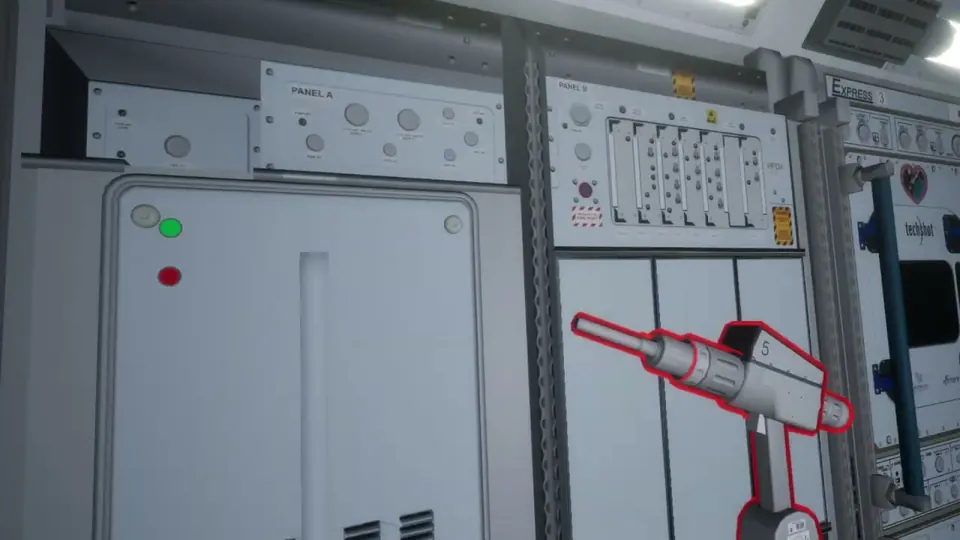
The task: replacing a fuse in microgravity
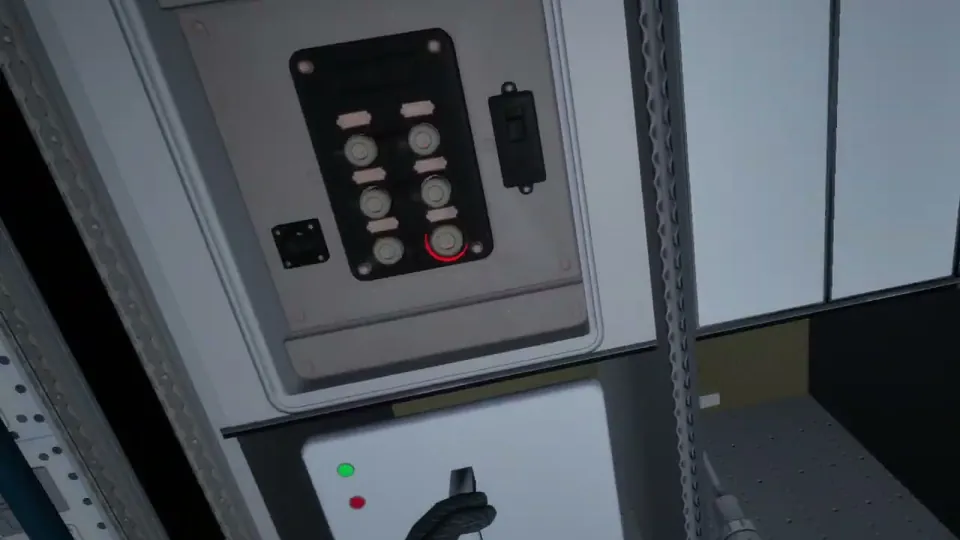
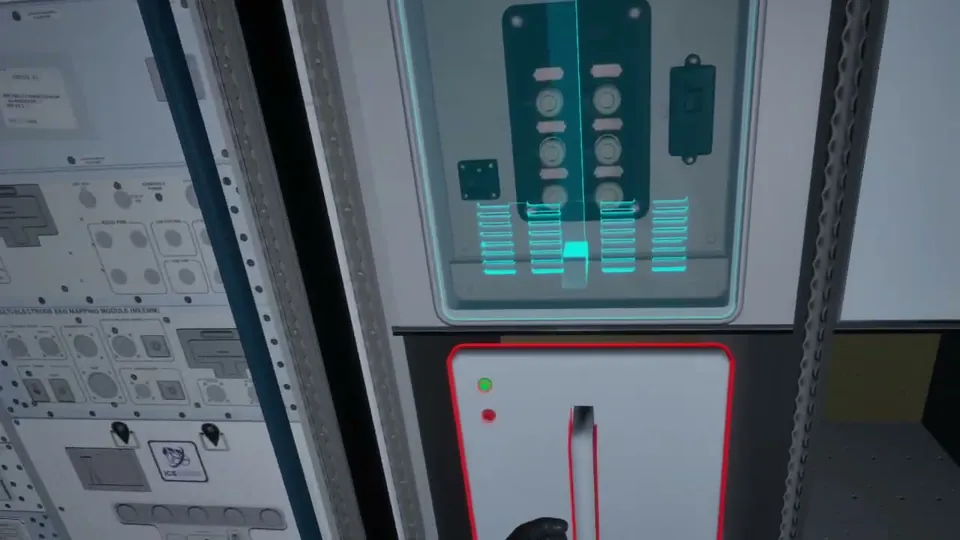
For the virtual environment, Fyware reproduced the Columbus module of the International Space Station. A voice assistant guides the user through a training procedure of five tasks.
- Find the work area and catch the drill, which is already floating.
- Unscrew the cover of the electronic unit, with the index finger on the drill’s trigger.
- Replace the fuse.
- Reassemble the unit.
- Stow the tools and the damaged fuse so nothing is left drifting around the module.
A red outline marks the next object to pick up, and a translucent hologram shows where each part belongs.
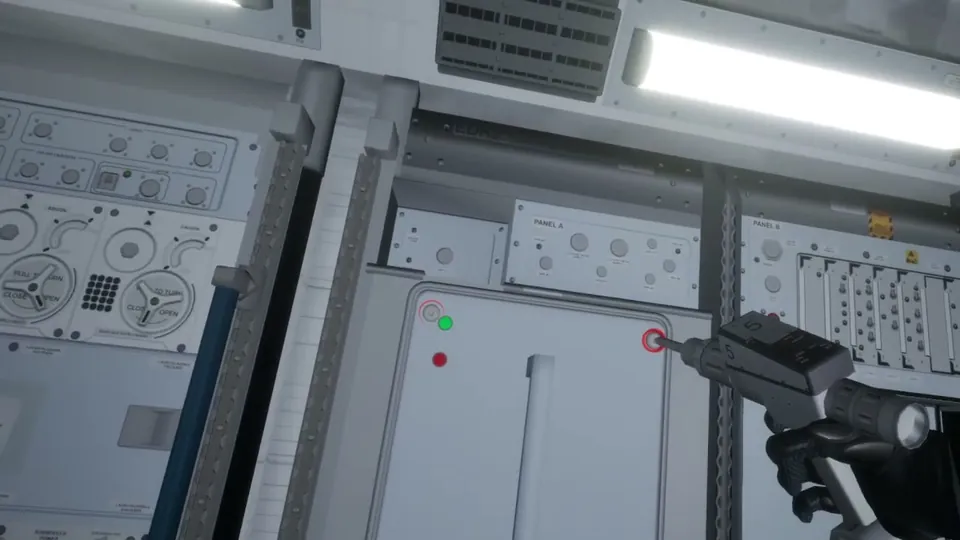
What the gloves change
Natural grasping with force feedback
With the Nova 2, the user reaches for the drill and closes their fingers around it. Vibrotactile feedback in the palm signals contact with the virtual drill. Once the tool is grasped, force feedback lets the user feel the object within the fingers: its size and shape, as well as its stiffness.
Intuitive tool operation
Pressing with the index finger activates the drill trigger, just like on a real drill.
Releasing and placing objects in microgravity
Users can release and reposition virtual objects through natural hand movements, enabling intuitive interactions with tools and components in a simulated microgravity environment.
How it was built
Commissioned by SenseGlove, Fyware led the development and project management of the VR simulation, while SenseGlove provided guidance on UX and haptic integration, tested the application on its hardware, and reviewed and validated each development milestone.
Engine. The project was specified in Unreal Engine, using a version compatible with the SenseGlove plugin.
Microgravity physics. Fyware simulated microgravity with Unreal Engine’s Chaos physics. Each object switches between floating freely and being held or docked, and only the objects that belong to the current step can be picked up.
A data-driven procedure. A central simulation manager runs an ordered list of steps. Each step is its own data asset, so steps can be added or reworded without changing the tools.
Testing and delivery. SenseGlove’s engineers in Rotterdam ran every build with the gloves and sent back video of each session. On 16 February 2026 SenseGlove received the builds, with the full source code and the technical documentation.
In use at ESA’s Orbital Robotics Laboratory
SenseGlove’s video, published on 12 November 2026, shows the proof of concept in use at the laboratory. Seated on the chair, with the headset and the gloves on, test subjects work through the fuse replacement.
SenseGlove presents the collaboration as an early step toward natural space training without the constraints of reaching space itself.
SenseGlove published its own case study of the project, Training Astronauts for Microgravity with XR and Haptics, on 26 November 2026.
 Watch on YouTube · 1:22
Simulation screens and the five-second clip: Fyware’s final build. Ten-second clip and the stills of the lab and of ESTEC: SenseGlove’s video (YouTube, 12 November 2026). Nova 2 product image: SenseGlove.
Frequently asked questions
Who developed the VR simulation for this project?
On the ESA project, Fyware led development and project management, while SenseGlove advised on UX and haptics, and reviewed and validated each step until the project was completed.
Who commissioned the project?
ESA commissioned the proof of concept from SenseGlove for its Orbital Robotics Laboratory. SenseGlove commissioned Fyware, as system integrator, to build the virtual environment.
Can haptic gloves be used to improve astronaut training in virtual reality?
That is the question this proof of concept explores at ESA’s Orbital Robotics Laboratory. SenseGlove presents the collaboration as an early step toward space training that is more intuitive.
What does a haptic glove add over VR controllers?
Traditional VR controllers typically use buttons or triggers to grasp virtual objects. Haptic gloves let users grasp through natural hand movements and receive tactile cues.
How do you simulate zero gravity in VR?
In this project, in two layers. ESA’s chair lets the person float on a plane. Inside the headset, Unreal Engine’s Chaos physics makes tools and components behave as they would in microgravity: once released, an object keeps moving until it is caught or placed.
Which engine and hardware does it use?
Unreal Engine 5.5.4 and SenseGlove SDK 2.305, running as PC VR on a Meta Quest 3 with SenseGlove Nova 2 gloves.
 Tom Klukowski
Fyware Partner · Valcre Marketing
Do you have a procedure to train with haptic gloves?
Tell us what the procedure is and which headset and gloves you are considering. The first step is a twenty-minute conversation with our team.
Fyware builds the virtual environment and the guided procedure for the headset your team uses.
See immersive training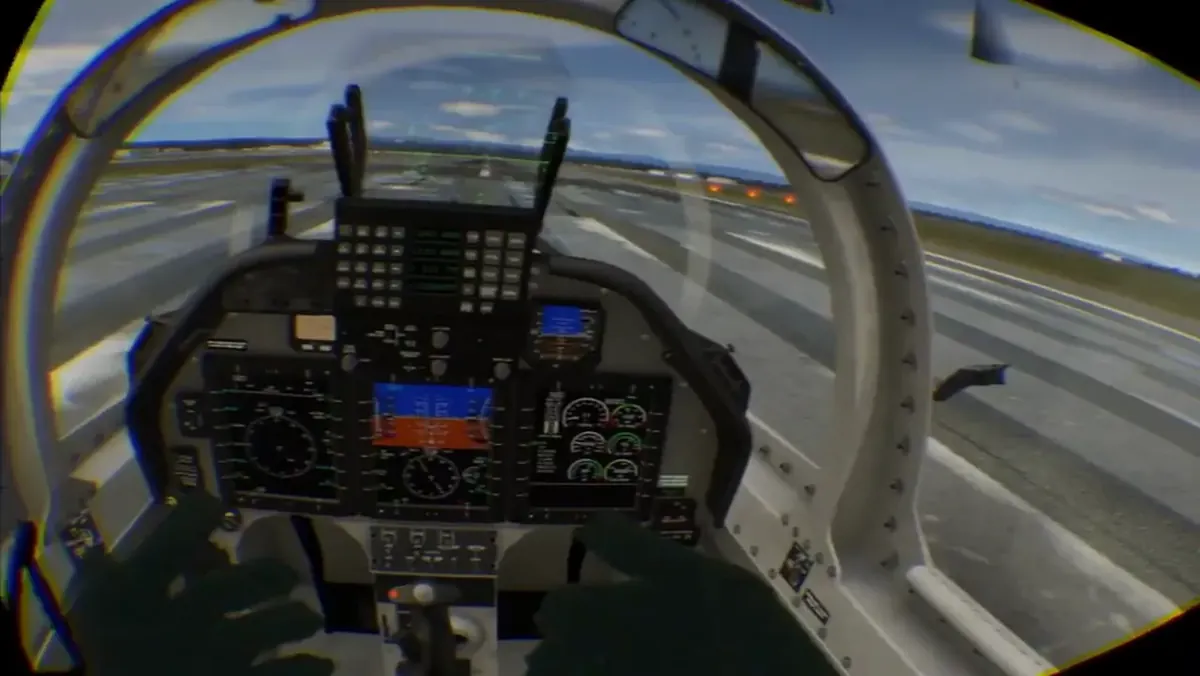 VR integration for a portable flight simulator
180° field of view with hand tracking and haptic gloves, and no controllers in the pilot's hands
VR · Flight training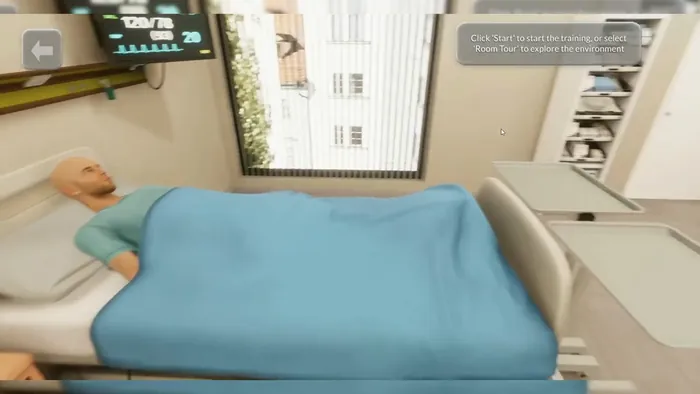 Sterile procedure setup, Medverse
0 supplies of sterile stock per repetition, and no headset: it runs on the hospital's PC
VR · Medical procedures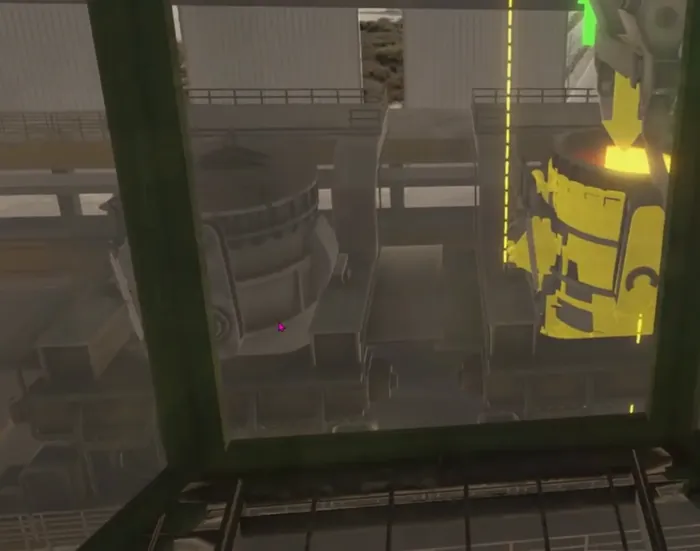 Crane operation training simulation, Gerdau Corsa
11 modules of VR training, with 10 simulator hours a month and 0 production stops
VR · Industrial training